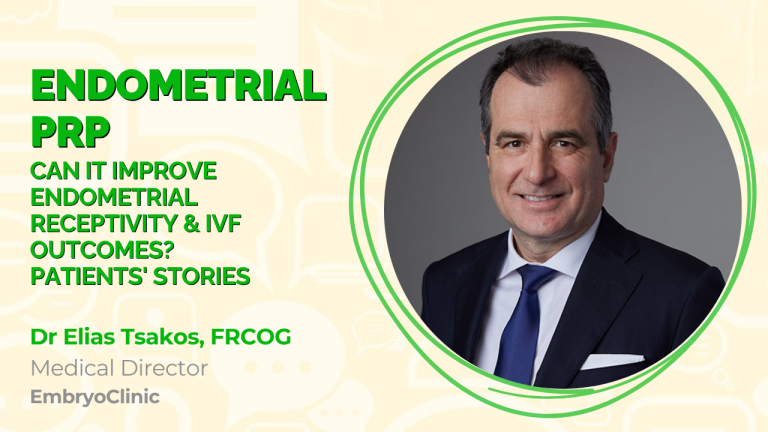


During this live session, Dr Elias Tsakos, MD, FRCOG, Medical Director of Embryoclinic, Greece, explored whether Platelet-Rich Plasma (PRP) can enhance endometrial receptivity and improve IVF outcomes. Dr Tsakos explained the science behind PRP, patient suitability, timing, and success rates. He also addressed whether PRP can be beneficial in challenging cases such as thin endometrium, recurrent implantation failure, intrauterine adhesions, and endometriosis-related endometrial issues, offering a deeper look at when and for whom this therapy may offer hope.
In recent years, Platelet Rich Plasma (PRP) has become an increasingly discussed topic in fertility treatment. In this event, Dr Elias Tsakos shared both scientific evidence and extensive clinical experience to explain how PRP may improve endometrial receptivity and support implantation in selected IVF patients.
Dr Tsakos explained that for many years, IVF has focused predominantly on embryos, laboratory conditions, egg quality, and genetic testing. While these advances have improved embryo selection, implantation remains a critical and sometimes overlooked factor.
The uterus and endometrium act as the “human incubator”, sustaining pregnancy for nine months. Even excellent-quality embryos may fail to implant if the endometrial environment is suboptimal. According to Dr Tsakos, this shift in focus back to implantation is long overdue.
He noted that modern IVF training has increasingly separated reproductive endocrinology from surgical expertise. As a result, detailed assessment of the uterine cavity and endometrium has sometimes been neglected in favour of laboratory-based solutions.
Platelet Rich Plasma is an autologous product, meaning it is derived from the patient’s own blood. After centrifugation, platelets are concentrated into a small volume of plasma that is rich in growth factors, peptides, and anti-inflammatory proteins.
Dr Tsakos described platelets as “humble cells” that are often underestimated. When concentrated and delivered correctly, they release biologically active substances that support tissue repair, angiogenesis, immune modulation, and cellular regeneration.
PRP has been safely used for many years in orthopaedics, sports medicine, aesthetics, and gynaecology. Its application in reproductive medicine has expanded more recently, especially for difficult IVF cases.
In standard practice, PRP is infused into the uterine cavity using a thin catheter, similar to an embryo transfer or IUI procedure. The process usually takes 8–10 minutes and does not require anaesthesia.
In selected cases, PRP can also be injected locally into specific areas of the endometrium via hysteroscopy. This more targeted approach is reserved for patients with focal damage, adhesions, or scarring.
Dr Tsakos emphasised that PRP is generally a simple, painless, and safe procedure, with minimal risk of adverse effects.
One of the strongest messages in Dr Tsakos’s presentation concerned standardisation and quality control.
He explained that many published studies do not describe:
how much blood is drawn
how PRP is prepared
the final platelet concentration delivered
At Embryoclinic, each PRP sample is measured before use. Their target concentration is between 800,000 and 1.5 million platelets per millilitre. Lower concentrations may be biologically ineffective.
Dr Tsakos advised patients to ask their clinic for documentation of platelet concentration and sterility testing, as blood products can support bacterial growth if not handled aseptically.
PRP does not work through a single mechanism. According to Dr Tsakos, its effects include:
stimulation of epithelial and stromal cell proliferation
improved vascularisation and blood flow
immune modulation through cytokines and interleukins
tissue healing and remodelling
He cautioned that PRP does not create dramatic increases in endometrial thickness. In many cases, thickness may increase by only 1–2 mm. However, thickness is only one parameter of receptivity. Doppler flow, vascular pattern, tissue quality, and immune balance may improve even when thickness changes are modest.
Dr Tsakos highlighted several clinical scenarios where PRP may be particularly relevant:
recurrent implantation failure despite good-quality embryos
recurrent miscarriage
thin endometrium
Asherman’s syndrome
previous uterine surgery or infection
He shared that Embryoclinic has achieved encouraging results in severe Asherman’s syndrome using repeated cycles of PRP combined with hysteroscopic adhesiolysis, allowing regeneration of endometrial tissue that previously appeared irreversibly damaged.
PRP should not be viewed as a standalone solution. Dr Tsakos stressed the importance of full endometrial evaluation, including:
3D and 4D ultrasound
diagnostic hysteroscopy
endometrial biopsy
testing for chronic endometritis (CD138 plasma cells)
microbiome and PCR testing
natural killer (NK) cell assessment
In his experience, up to 30% of patients with “normal” findings on standard 2D ultrasound show abnormalities on advanced imaging.
Dr Tsakos acknowledged that earlier studies on PRP were small and poorly standardised. This contributed to scepticism among clinicians.
However, a 2023 meta-analysis including higher-quality studies reported:
significantly improved implantation rates
higher clinical pregnancy rates
reduced miscarriage rates
encouraging live birth outcomes
These benefits were particularly evident in patients with recurrent implantation failure and thin endometrium.
Although PRP is sometimes promoted for ovarian rejuvenation, Dr Tsakos was cautious. He explained that PRP cannot create new follicles. Its potential ovarian effects may be limited to improving blood flow and follicular response in selected younger patients.
In his view, PRP is currently far more promising for endometrial receptivity than for ovarian reserve, especially in women over 45.
Dr Tsakos concluded with several important points:
PRP is autologous and generally safe
It may improve endometrial function rather than thickness alone
It appears most useful in selected, difficult IVF cases
Proper preparation, measurement, and sterility are essential
Endometrial assessment should be comprehensive and personalised
PRP is not a miracle treatment, but when used carefully and selectively, it may offer meaningful benefits for patients struggling with implantation.
First of all, I would suggest having your embryos PGT-A tested. In my opinion, this is imperative in your situation to ensure that you have DNA-competent embryos. There’s no point after so many failures, after all this effort, to go ahead with embryo transfers with embryos that are not PGT-A tested. PGT-A testing does not mean that you will get pregnant. It does not mean that you will have an implantation. What it means, however, is that if we optimize your endometrium, you may have the chance of success of a 34-year-old, which is remarkable.
If you have IVF, let’s isolate two factors—what I mentioned in my introduction, my pretty long introduction: embryo and endometrium. Those two factors probably account for 90% of the equation’s success. Optimize your embryos by having PGT-A testing. Put them on the side, so you have 1 or 2 good-quality embryos. Then focus on the endometrium. I would do a hysteroscopy by an experienced hysteroscopist. What I see as normal may not be normal to my colleague who started last year with me.
I get on my team very experienced doctors, most of them with amazing studies, but it takes about 2 years for us to line up visuals, if you see what I mean. So, hysteroscopy — what we see is not objective. Some people see a big mountain, some others see a small mountain. You know, equally with a hysteroscopy image.
Remember that hysteroscopy is 2D — two-dimensional. And this is a call out for the technology industry. You know, we have 3D laparoscopy, 3D robotics — you know, give us 3d, give us equipment to do 3d hysteroscopy. You know, why are we left in 2D? I will tell you why. Because there’s not a lot of research on hysteroscopy. And this is our fault. You know, we haven’t shouted loud enough about how important it is.
So, it’s 2D. You know what I see — my eyes are trained after 30 years. I see 2D, I convert it to 3d. That’s why I don’t use 3d laparoscopy. I use 2D because my brain has remodelled, and I see 3d even on 2D.
When I do a robot, I’m more relaxed, because it’s 3d. I’m more, you know, I don’t consume so much energy — but that’s not always the case. Hysteroscopy by itself is not accurate unless you do those five tests:
Take a sample for histology
Take a sample for CD138 plasma cells
We do this combined. We don’t even mention to our patients — no extra charge, nothing — because I think it’s amazingly important. If I were to do just one, I’d rather do just the CD138, not the standard biopsy, but we do both. So it’s, you know, it’s not negotiable in our department.
Just like IVF at Embryoclinic, you don’t pay for ICSI. It’s part of IVF. You know, if we think it’s ICSI, we’re not going to call you up and say, “Oh hi, can we have another thousand for doing ICSI?” Whatever we do in the lab, it is our responsibility to give you the best possible outcome.
And equally with hysteroscopy biopsy. Biopsy, CD138, NK cells, microbiome — latest generation of NGS microbiome — and I would do in your case PCR testing for microbes.
Even if it’s very unlikely that everything will come abnormal, you know if I were to predict, because you’ve done a lot of good tests, a lot of good work. I would predict that your microbiome is off, off the range. And that—simply treat it with lactobacilli, very simple. If you were not to do that, I think it’s very cost-effective, to be honest. More and more, I do it blindly, routinely, on my patients without testing for the easy cases. I invariably give them lactobacilli anyway. You know, it doesn’t harm. It’s good for your gut, it’s good for your uterus, it’s good for your brain. I take it myself. So yeah—sort out the embryo problem and then sort out the endometrial problem. You will get pregnant, I’m sure.
I think it’s very difficult to answer that. All I have to say is that you have a lot of reasons—you have a lot of enemies, if you like—to fight in order to achieve a pregnancy. In my opinion, I think you should fight them separately. Now, let’s start with: it doesn’t really matter if it is linked or not. What matters is that Hashimoto thyroid disease—Hashimoto—is, by itself, an enemy. One big enemy. Thin endometrium is by itself. Look into them on their own merit.
So:
Hashimoto — one enemy
Thin endometrium
Endometriosis
Look into them one at a time, and then all of them together. Now, I will give you some pieces of information on Hashimoto. Hashimoto is very common. 10–15% of women have Hashimoto’s. Look into this very carefully. Google it. Chip it. Become an expert in Hashimoto.
Most people don’t supplement with thyroid if TSH is normal with Hashimoto’s. I disagree. I think you definitely need supplementation. Even if your TSH is normal, even if your T3, T4 are normal—so I don’t know whether you’re having supplementation—you should definitely have supplementation if you’re undergoing IVF.
Look into micronutrients. We are failing our patients by just checking TSH. You know, that’s not enough. We need to do the full panel—5 hormones. And also we need to check for vitamins and micronutrients. And invariably, those are deficient. Look into supplementing. Hashimoto needs vitamin supplementation—either through food or through supplements.
Also, look into other autoimmune conditions that you may not be familiar with. You know, one autoimmune disease may be associated with another autoimmune disease which may not be diagnosed.
Now stage 4 endo: I hope it’s been operated on—and I hope it’s been operated on properly. But you know if it has—fine, very happy. If not, it needs to be tackled. There’s the dispute between IVF doctors, reproductive endocrinology and infertility specialists, and endoscopic surgeons—who is right, who is wrong? Nobody is right, and nobody is wrong. They need to get together.
Endometriosis—I’ve been to the most amazing centres in the world. How can you understand if an endometriosis centre is top-notch?
If they have a fertility specialist in the multidisciplinary team or not. We have to be included. It’s not just the surgeon, it’s not just the reproductive endocrinologist. If you had stage 4 endometriosis, there’s a good chance that you may have adenomyosis without knowing. So look into this.
Have a high-resolution 3D/4D scan. Make sure you exclude adenomyosis. If you have adenomyosis, discuss the options to tackle it: pharmaceutical, lifestyle, supplements, and so forth.
Treat your microbiome. Treat your high NK cells.
PRP: Sometimes we need to do more than one PRP. That’s another little secret—depending on what we’re treating. In my opinion, if you’ve standardised everything else and if you have a reasonable endometrium on the 3D/4D scan, then perhaps one is enough. But to be on the safe side, what I do is:
On the first embryo transfer cycle—whether it’s natural or medicated—I usually (in your case, I have my precious normal-tested embryos on the side) do PRP once, possibly day 8 or day 9 of estrogen treatment, and then evaluate again on day 14–15 prior to embryo transfer. If I’m happy with the endometrium, I leave it be. If I’m not happy, I do a second PRP.
That’s a very good clinical question. “Depends” is my answer.
Firstly, I would say that in my practice, I never do dilatation. This is one of the no-nos. I haven’t done a dilatation and curettage without a hysteroscopy in my life, and I’ve been around for about 35 years. I do hysteroscopy.
I presume you’re referring to dilatation after miscarriage, and I will share a little bit of my secrets. I think we have a very loyal and amazing team watching us. We don’t do blind D&C for miscarriages anymore. We’ve stopped doing that. What do we do? We do hysteroscopic removal of retained products of conception. Why do we do it? Because we kill 4 birds with 1 stone.
Firstly, D&C was the last, and I hope it will always be the last, blind technique of medicine. Of the entire medicine, not just gynaecology. Why did we move on to hysteroscopies to remove polyps and fibroids, and hyperplasia from the endometrium? We moved into hysteroscopy possibly 25–30 years ago, and we’re still doing blind D&CS for retained products of conception, for the most valuable population we can ever have: the fertile population wishing to become mothers.
Hysteroscopic removal of retained products of conception. Why? Firstly, we see. We see the sac, we see the products, we see the retained areas, and we remove it. Invariably, it’s in one of those quads of the cavity, unless it’s a very advanced pregnancy beyond 10 or 11 weeks. But in that case, we would consider providing medical treatment for expulsion of the embryo anyway.
So why scrape the whole uterus? Why risk the whole uterus for adhesions, infection, damage, bleeding—if you can only focus on one area, which has the products? Firstly, we localize.
Secondly, we remove it completely. You know, we’ve all had it. I’ve had it. Everybody has had it who’s done a few hundred, few thousand retained products of conception. When you do the blind D&C, you have two risks. One is you leave some behind, and the other is that you take away healthy endometrium. So we avoid that.
Number three, we have a 100% diagnosis. You know how many times have we had a patient with a miscarriage, and we said, “Okay, you had a miscarriage, natural miscarriage, after IVF, whatever—oh, let’s do a hysteroscopy to make sure you don’t have myomas, polyps, or any heart-shaped uterus, diaphragms?”
How many times? Almost 50%–70 % of the time. The woman has had a dangerous procedure—a blind procedure—which is the D&C, and then they’ve had a second procedure with a hysteroscopy. And that repeated dilatation may cause a problem.
At the same time, we present all the evidence: that we have a normal uterus, or we have a uterus with adhesions, or a uterus that is heart-shaped or even with a diaphragm. We diagnose that.
And number four, we can use the instruments with less dilation of the cervix. So the cervix does not get fully dilated. So we can have a smaller dilatation.
Coming back to your question—would I do PRP or not? “Depends” is the answer.
If the uterus is normal—because I visualise, it’s not just the blind D&C, I see—if I see adhesions, if I see some areas that may require a little bit of extra help, I can consider that. I can do it in one time during the procedure. But invariably, I like to do it at the second stage—having discussed and counselled the patient correctly based on the findings of the hysteroscopy—and do it a little bit later.
Yes, I would, is the answer. It wouldn’t be prophylactic. I mean, prophylactically would be if I did it on the first embryo transfer. No, I wouldn’t do it on the first embryo transfer unless there’s a clinical indication. Recurrent implantation failures—or even 2 implantation failures and more—would be an indication to consider PRP.
As I said to our previous attendee, I would always look into the embryo as well. You know, you can’t fix one and have the other one untested or unfixed.
Now, whether I do a PGT-A or not, again depends on the age and the number of miscarriages. For example, if I have a 32-, 33-, 35-year-old with 1 or 2 failures, perhaps PGT-A is not 100% indicated. You know, this is a grey area, but I would like to do it. In my opinion, the biggest risk of failure of IVF, bigger than ovarian hyperstimulation, bigger than ectopic, bigger than miscarriage, bigger than complication of miscarriage, complication of pregnancy, is giving up.
That’s the biggest risk: having a wonderful woman or a wonderful couple who are just going to give up. They will give up if we don’t give them the pregnancy fairly quickly. I get very stressed. Time to pregnancy for me is a very important factor.
We cannot have our patients hanging on forever. When I was younger, I was visiting clinics all over the world. I still do, but I don’t visit many times. And you know, so many times I saw patients—2 years later, still there; same patients—three years later, still there. These are the resilient ones.
All I have to say here is that if you really keep going, you will achieve your purpose in the end. Unfortunately, not all people are made of steel. People may give up, they may become disheartened. I would like to offer as much as I have, with a reason, every single time after a failure. So yes, I would consider it.


Necessary cookies are absolutely essential for the website to function properly. This category only includes cookies that ensures basic functionalities and security features of the website. These cookies do not store any personal information.
Analytical cookies are used to understand how visitors interact with the website. These cookies help provide information on metrics the number of visitors, bounce rate, traffic source, etc.
| Cookie | Duration | Description |
|---|---|---|
| _ga | 2 years | This cookie is installed by Google Analytics. The cookie is used to calculate visitor, session, campaign data and keep track of site usage for the site's analytics report. The cookies store information anonymously and assign a randomly generated number to identify unique visitors. |
| _gat_UA-38575237-21 | 1 minute | No description |
| _gid | 1 day | This cookie is installed by Google Analytics. The cookie is used to store information of how visitors use a website and helps in creating an analytics report of how the website is doing. The data collected including the number visitors, the source where they have come from, and the pages visted in an anonymous form. |
Any cookies that may not be particularly necessary for the website to function and is used specifically to collect user personal data via analytics, ads, other embedded contents are termed as non-necessary cookies. It is mandatory to procure user consent prior to running these cookies on your website.
Other uncategorized cookies are those that are being analyzed and have not been classified into a category as yet.
| Cookie | Duration | Description |
|---|---|---|
| _gat_FSQM52 | 1 minute | No description |
| cf_ob_info | No description | |
| cf_use_ob | No description |


