
For patients facing a persistently thin uterine lining or repeated failed embryo transfers, platelet-rich plasma (PRP) may be worth discussing—but identifying the underlying problem comes first.
After cancelled transfers or unsuccessful treatment, an increase in lining thickness can feel like the next milestone to reach. Yet endometrial receptivity—the lining’s ability to support implantation—cannot be reduced to a single ultrasound measurement. Its shape, appearance, blood flow and contractility may also matter.
The endometrium is the internal lining of the uterus, where implantation takes place. A lining measuring less than 7 millimetres is one concern, particularly when accompanied by repeated implantation failure. But thickness alone cannot explain why an embryo has not implanted or why a pregnancy has ended in miscarriage.
That distinction matters when considering an additional treatment. PRP contains factors involved in tissue repair, restoration and blood flow, making it a plausible option for a damaged endometrium. Plausibility, however, is not the same as proof that treatment will improve the chance of taking home a baby.
Before considering whether PRP could thicken the lining, the priority is to investigate what may be preventing implantation. The answer may point toward treatment of the uterine cavity, a different preparation protocol, closer assessment of embryos—or, in selected cases, a discussion about PRP.
Making PRP involves taking blood from a patient’s vein and processing it to concentrate the platelets. It is an autologous product, meaning it comes from the person receiving it. Its use in fertility care follows earlier applications in orthopaedics, aesthetic procedures and some gynaecological procedures.
For the endometrium, the hoped-for effect is repair: encouraging tissue restoration, cellular growth and improved blood flow. Research has produced some encouraging findings, but the evidence remains inconclusive. Endometrial PRP is not a routine procedure.
A better ultrasound measurement does not necessarily translate into a better pregnancy outcome. One study found an overall increase in thickness of 1.1 millimetres, alongside a tendency toward improved live birth rates that was not statistically significant. An analysis of 7 randomised controlled trials found about 1 millimetre of improvement, but the clinical pregnancy benefit was described as marginal and fragile.
Those findings leave a substantial gap between what patients hope PRP will achieve and what research can currently establish. A lining that becomes thicker has changed, but that does not by itself demonstrate a dependable improvement in live birth. Treatment discussions need to keep those outcomes separate.
There is also no single, consistently applied PRP preparation method. Protocols vary, and the final product is not always measured precisely. Without standardised preparation and reliable quality control, results from one clinic or study may be difficult to compare with another.
Repeated implantation failure or miscarriage can be associated with an abnormal endometrium, but several different problems may lie beneath that description. Previous uterine procedures, infections, miscarriages and congenital defects can contribute to damage or adhesions, which are areas of scar tissue. The likelihood of endometrial damage also increases with maternal age.
A detailed assessment looks beyond the thickness reported on a routine scan. High-resolution ultrasound, including 3D and 4D assessment, can provide a closer view of the lining and the surrounding uterus. Blood flow assessment adds another dimension to understanding whether the implantation environment appears normal.
Hysteroscopy, which allows examination inside the uterine cavity, can reveal problems that require a different response from PRP. These include adhesions, polyps, fibrous tissue, defects and retained pregnancy tissue. Where appropriate, operative treatment may be possible during the same anaesthetic session.
Investigation may also include tissue assessment and CD138 testing for endometritis, inflammation of the uterine lining. Microbiome testing can form part of the assessment, with abnormal findings addressed before moving forward. The purpose is to identify a potentially treatable problem rather than proceed directly to an intervention whose benefit is still uncertain.
This is particularly relevant when the history includes several uterine operations, known adhesions, abnormal scans or repeated pregnancy losses. Those findings may help establish whether there is a clear endometrial reason to consider PRP. They do not, on their own, establish that PRP is the best next treatment.
For someone with fibroids, the first question may be whether the uterus is ready for pregnancy at all. Size matters, but so do location and the number of fibroids present. A discussion about improving the lining should not bypass an assessment of the surrounding uterine muscle and cavity.
Small fibroids measuring 2 to 3 centimetres and located far from the uterine cavity are most likely irrelevant to implantation. Fibroids of the same size within the myometrium, the muscular wall of the uterus, are more of a grey area because they may reduce implantation. Multiple fibroids can make the overall picture more concerning than any one measurement suggests.
Large fibroids, including those measuring 8 centimetres or 5 centimetres, warrant serious consideration before pregnancy is attempted. They can affect implantation, increase the chance of miscarriage and create complications if pregnancy continues. Removal may therefore need to be considered before either natural conception or IVF.
PRP does not resolve that decision. Its effect on the growth of large fibroids is not established in the evidence discussed here. For a patient with a substantial fibroid burden, assess whether surgery is appropriate before assuming a lining treatment will improve the situation.
An embryo described as “great” or “excellent” quality can offer reassurance, but appearance does not establish whether its DNA is normal. Chloe technology, for example, does not determine that. When miscarriages recur, the embryo and the uterine environment both deserve attention.
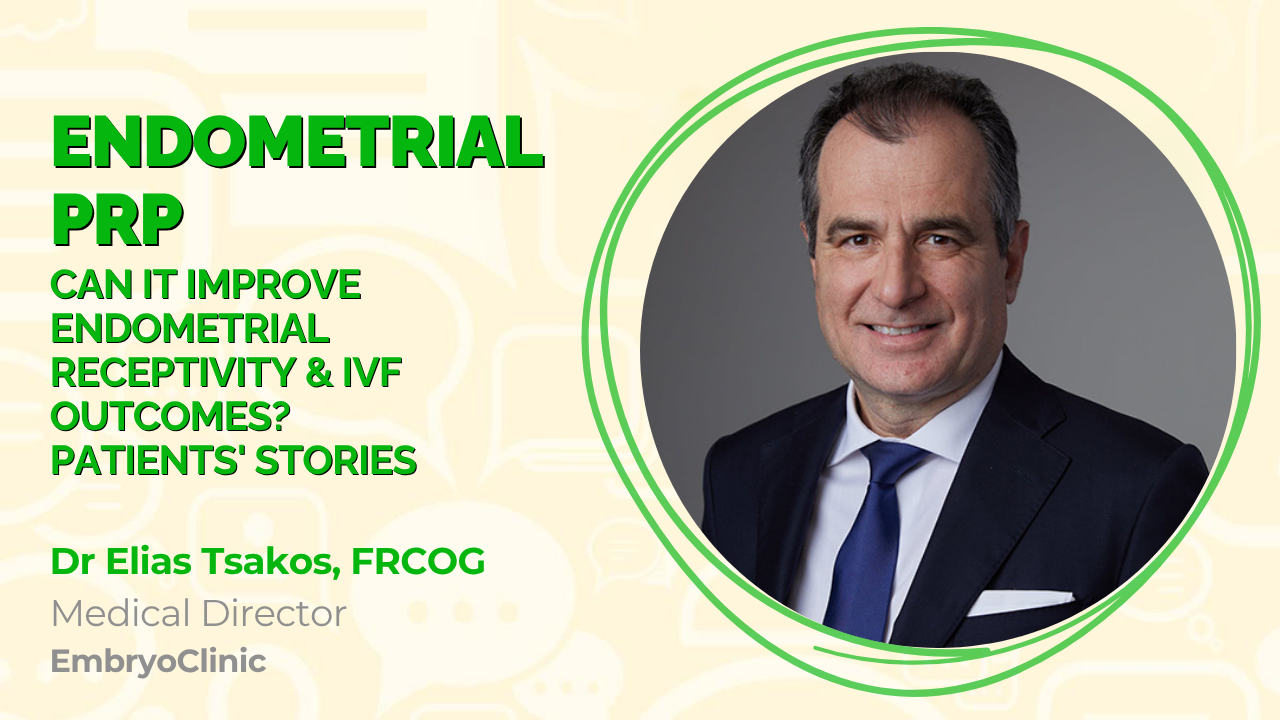
In the specific setting of repeated miscarriages despite embryos assessed as high quality, Dr Elias Tsakos, FRCOG, Medical Director, recommended further egg collections and PGT-A testing before another transfer, to identify at least one embryo with a normal test result. That proposed sequence involved fertilising the collected eggs, growing embryos to the blastocyst stage and testing them. It was a recommendation for that clinical situation, not a reason to assume every patient needs another retrieval or genetic testing.
Considering additional retrievals alongside PRP involves two separate decisions. One concerns which embryos are available for transfer. The other concerns whether the uterus has a problem that needs treatment before transfer.
Keeping those decisions separate can help make the proposed treatment plan easier to understand. A clinic should be able to explain why it is recommending more embryo creation, further uterine investigation or an endometrial intervention. A favourable embryo assessment should not automatically end the investigation, just as a thin lining should not automatically lead to PRP.
Sometimes the next step is to reconsider how the lining is being prepared. That includes reviewing whether the transfer uses a natural cycle, whether estrogen is added and how it is delivered. Oral, patch and vaginal approaches, or combinations of them, may be considered within an individualised protocol.
Viagra may also be used in selected cases to try to improve endometrial vascularity and thickness. The rationale is that it may help estradiol and other estrogens reach their target cells. It is an additional option when the lining remains difficult to build despite estrogen treatment, rather than an automatic part of preparation for every transfer.
A history of endometriosis or adenomyosis adds another layer to the decision. Endometriosis is inflammatory and may affect surrounding organs, including the endometrium. After surgery, allowing time for recovery and reassessing with high-resolution ultrasound can help guide the next transfer plan.
For selected patients, frozen transfer cycles with downregulation may be considered to improve the implantation environment and reduce inflammation, particularly when adenomyosis is also present. The duration needs to reflect the individual case. Repeated failure in this setting does not, by itself, make PRP the next logical step.
PRP can be delivered into the uterine cavity by intrauterine infusion, or beneath the surface of the lining by subendometrial injection. Injection places it closer to the basal area of the endometrium. That difference may matter, although the evidence is not strong enough to settle which approach reliably improves outcomes.
One review involving 7 studies and just over a 1000 patients suggested that injection performed better than either no treatment or infusion in patients with thin lining and repeated failed transfers. However, it included no randomised controlled trials. The findings support further investigation rather than certainty about the best technique.
PRP is generally described as minimally invasive and very safe, particularly because it uses the patient’s own blood. Safety discussions still need to include the limited long-term follow-up beyond birth.
There are unanswered practical questions as well. The duration of any benefit has not been fully studied, so the ideal interval between treatment and embryo transfer remains uncertain. Evidence for ovarian PRP is weaker still, and there is no solid evidence that combining ovarian and endometrial treatment produces an added benefit.
Before agreeing to PRP, patients can ask:
These questions belong in counselling and informed consent before a treatment decision, rather than being addressed only afterwards. PRP is best approached as an individualised decision with uncertain benefit. It should not displace the investigation or treatment of a clearer problem.
A difficult IVF history can make another intervention feel like the most hopeful next step. Yet a more focused assessment may be more useful than adding a procedure: examining the uterine cavity, addressing inflammation or fibroids, reviewing embryo information and tailoring transfer preparation. PRP may have a place for selected patients, but current evidence does not make it a routine solution for thin lining, miscarriage or implantation failure.
The wider experience of treatment matters too. Meaningful relationships, sleep, diet, exercise and stress management belong alongside medical care, rather than replacing it. A realistic plan can attend to both the clinical problem and the person living through it—while remaining clear about what is established, what is uncertain and why the next step is being recommended.
After surgery for stage four endometriosis and removal of the left tube, allow recovery time before reassessment—even after five cancelled cycles. Endometriosis is inflammatory and can affect the endometrium.
Have a high-resolution ultrasound, ideally in the early follicular phase and again around ovulation; otherwise, an ovulation-time scan is acceptable. Include 3D images, uterine blood-flow assessment, and assessment of the myometrium and surrounding areas. High-resolution transvaginal scanning can diagnose endometriosis with more than 85–90% accuracy.
If findings are normal, proceed with transfer; otherwise, discuss further management. The standard approach is frozen cycles with prolonged downregulation, particularly with adenomyosis, to improve the implantation environment and reduce inflammation.
Evidence for ovarian PRP is even weaker than for endometrial PRP. It may improve ovarian stromal vascularity or help restore ovaries damaged by surgery or endometriosis, but evidence for follicular development and folliculogenesis is very thin.
The clinical opinion is that it does not affect euploidy. Solid evidence remains a long way off, requiring even more careful counselling before use.
The duration has not been fully studied. Preparation before stimulation generally takes six to nine weeks if sperm is good, and longer otherwise. Egg collection and embryo creation may take months. Dual stimulation is strongly favoured to secure as many good-quality and euploid PGD-tested embryos as possible, especially over age 38 or after multiple failures.
Only then should attention turn to the endometrium. PRP comes after hysteroscopy, biopsies, CT scans, exclusion of endometriosis, downregulation for adenomyosis, and failure of treatments including hysteroscopic treatment, oral, transdermal or vaginal estrogens, and Viagra.
Avoid a long interval before transfer because PRP’s duration is unknown. The implantation window is thought to be a few months rather than days.
Within the 10 pillars of well-being, quality social connections and meaningful relationships come first, followed by diet, exercise, sleep, stress management, and metabolic health. Walking or mindfulness can help manage stress; medication for stress relief is not favoured unless advised by a psychiatrist.
From age 40, perhaps one in three people has an unrecognised metabolic disease or disorder detectable through simple tests. A waistline exceeding half your height most likely indicates metabolic syndrome. Alcohol, smoking, polluted environments, contaminated drinking water, and packaged foods can be harmful or disruptive.
Downregulation is strongly recommended. Depending on the case, treatment may extend beyond the standard one or two months to three or four months. For mild disease, six to eight weeks is more than enough.
PRP would probably not be recommended unless everything else had failed. First, undertake hysteroscopy, biopsy, exclusion of endometritis, microbiome testing to confirm normal endometrial flora, and tailored endometrial preparation. Particularly in complex cases, the best person in the IVF team should handle embryo preparation, and the best possible IVF specialist should perform the transfer.
Whether there is a compounded effect is unknown. If both worked, hysteroscopically guided PRP injections into four endometrial areas might help appropriately selected women, but this remains speculation without solid evidence.
Ovarian PRP is considered unlikely ever to demonstrate significant benefit. Avoid combining PRP with artificial growth factors or stem cells before evidence clarifies PRP’s basic value and protocols.
PRP’s effect on fibroids, including whether it increases their size, is unknown. With fibroids this large, removal should be seriously considered before IVF.
Fibroids can be deceiving. Small fibroids measuring 2–3 cm far from the cavity are probably irrelevant. Fibroids of the same size within the uterine wall occupy a grey zone and may reduce implantation by perhaps 20%, depending on their number. Larger or more problematic fibroids form another category.
Additional egg collections are recommended before transfer. Excellent embryo quality does not establish normal DNA. Collect as many eggs as possible, fertilise them, grow embryos to blastocyst, and perform PGT-A testing.
Aim for at least one PGTA-normal embryo; 2 or 3 would be better. Then address implantation and optimise the endometrium alongside body, soul, mind, friendships, psychology, food, and exercise.
Viagra is used when the endometrium cannot be built during the first transfer cycle despite oil patches and high-dose vaginal estrogens. The theory is that it facilitates estradiol delivery to target cells.


Necessary cookies are absolutely essential for the website to function properly. This category only includes cookies that ensures basic functionalities and security features of the website. These cookies do not store any personal information.
Analytical cookies are used to understand how visitors interact with the website. These cookies help provide information on metrics the number of visitors, bounce rate, traffic source, etc.
| Cookie | Duration | Description |
|---|---|---|
| _ga | 2 years | This cookie is installed by Google Analytics. The cookie is used to calculate visitor, session, campaign data and keep track of site usage for the site's analytics report. The cookies store information anonymously and assign a randomly generated number to identify unique visitors. |
| _gat_UA-38575237-21 | 1 minute | No description |
| _gid | 1 day | This cookie is installed by Google Analytics. The cookie is used to store information of how visitors use a website and helps in creating an analytics report of how the website is doing. The data collected including the number visitors, the source where they have come from, and the pages visted in an anonymous form. |
Any cookies that may not be particularly necessary for the website to function and is used specifically to collect user personal data via analytics, ads, other embedded contents are termed as non-necessary cookies. It is mandatory to procure user consent prior to running these cookies on your website.
Other uncategorized cookies are those that are being analyzed and have not been classified into a category as yet.
| Cookie | Duration | Description |
|---|---|---|
| _gat_FSQM52 | 1 minute | No description |
| cf_ob_info | No description | |
| cf_use_ob | No description |