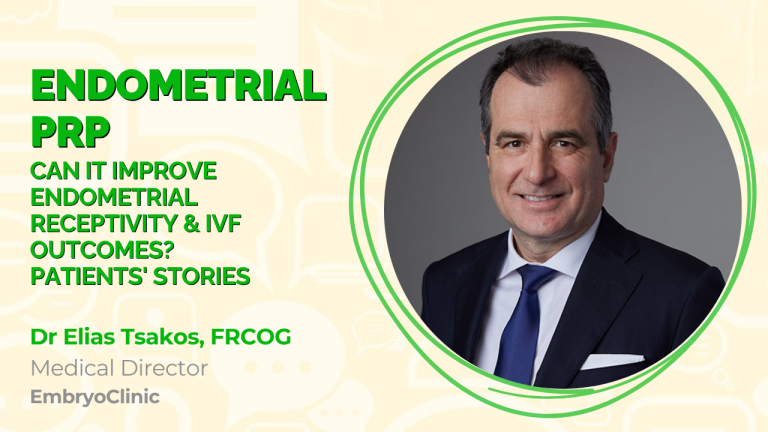


PRP for poor ovarian reserve can sound like a breakthrough—but it won’t make eggs younger or reverse ovarian aging. Dr Elias Tsakos, FRCOG, Medical Director of Embryoclinic, Greece explains why this treatment sits in the gray zone between hope and proof, and who might realistically consider it.
Poor ovarian reserve refers to a reduced number of eggs compared with what would be expected for a woman’s age. Women are born with a fixed pool of eggs, and that pool cannot be replaced. When that supply is lower than expected, ovarian reserve is considered diminished.
That does not automatically mean infertility. A woman can have poor ovarian reserve and still conceive, because fertility depends on more than egg number alone. Age matters greatly, and so does egg quality. A younger woman with fewer eggs may still have meaningful fertility potential, while an older woman may face a different challenge even if some eggs remain.
Rather than a single diagnosis, poor ovarian reserve describes a range of situations. Test results can suggest that egg numbers are low, but the actual number of eggs collected in IVF can still vary. Stimulation protocol, timing of egg collection, and technical factors all influence the final outcome.
A more severe situation is ovarian insufficiency, where ovarian function is effectively lost before age 40. That may show up as very low AMH, irregular cycles, or no periods at all. At the far end of the spectrum is menopause, when the follicular pool is exhausted.
The most useful single blood test for egg quantity is AMH. It helps estimate how many eggs may be available, but it does not measure egg quality. That distinction matters because the chance of a healthy baby is tied closely to egg quality, and egg quality is consistently related to age.
The other common measure is AFC, or antral follicle count, seen on ultrasound. This can be helpful, but it is operator dependent. Standardized measurement looks at follicles measuring four to seven millimeters, and scan quality matters. A good 3D scan may detect follicles that a lower-quality 2D scan misses.
For patients, the practical takeaway is simple: reserve markers can help predict response to IVF stimulation, but they cannot tell you whether the eggs are genetically normal. They are quantity tests, not quality tests.
A low result is not necessarily the final word. Poor ovarian reserve does not always predict exactly how many eggs will be retrieved, and it says very little about whether one of those eggs could still lead to a pregnancy.
PRP can sound like the obvious next move after a disappointing test result. In reality, it makes more sense only after the standard parts of treatment have been done well.
That starts with the stimulation protocol. Very high medication doses are common in poor responders, but more is not always better. While many clinicians use 450 units daily as a standard dose, Dr. Elias Tsakos says his own maximum is 300 units, sometimes with add-on medications such as clomiphene or letrozole. The goal is not simply to push harder, but to stimulate more intelligently.
For some patients, dual stimulation can help maximize one treatment window. This can be especially useful for women traveling for care and hoping to make the most of a single visit. In other cases, an accumulation strategy may be more realistic, with repeated egg collections over time and embryo accumulation rather than expecting one cycle to solve everything.
That matters particularly for women in their forties using their own eggs. If only one or two eggs are collected in a cycle, the strategy may shift rather than stop. A cycle yielding one egg may call for mild stimulation or even a natural cycle approach. If two good-quality eggs are obtained, it may make sense to continue. The first goal is to create a blastocyst. Then another. Then, if testing is part of the plan, at least one healthy embryo.
This is also where honest counseling becomes essential. The emotional pressure to “do something” can be intense, especially when time feels short. But PRP should not be used to postpone donor eggs when donor treatment is clearly indicated, and it should not be sold as a rescue therapy for every patient with low reserve.
PRP, or platelet-rich plasma, is made from a patient’s own blood. The process begins with drawing 20 to 60 mL of blood, which is then processed by centrifuging to concentrate platelets. The protocol uses two types of centrifuging.
This treatment is not new in medicine. PRP has been used for about 30 years in fields such as orthopedics, dermatology, wound care, and oral and maxillofacial surgery. What is newer is the attempt to use it in the ovaries.
PRP is not a single standardized product. Protocols vary, and many clinicians do not have quality-control feedback on what they are actually injecting.
The PRP is then injected into the ovaries, usually through transvaginal ovarian PRP. If access is difficult, laparoscopic PRP may be considered instead. That approach is more invasive and requires general anesthesia, but it also allows the pelvis to be assessed for problems such as endometriosis, infection, and adhesions. In selected difficult cases, it can also be combined with diagnostic procedures to look for uterine or pelvic factors that may affect fertility.
What makes PRP attractive is the biology of platelets. They contain growth factors, including platelet-derived growth factor, vascular growth factor, transforming growth factor, and insulin-like growth factor. These are thought to influence healing and tissue response.
In the ovary, the proposed effects include improved blood vessel formation, reduced fibrosis, mild local inflammation, and reduced oxidative stress. The hope is that this could improve the follicular environment and support follicles that are still present.
But there is an important limit here. PRP does not create new eggs or new follicles. If an ovary has nothing left to recruit, there is little for PRP to act on. That is why a detectable AFC matters so much when considering treatment.
This is also why the language around PRP matters. Calling it ovarian “rejuvenation” suggests a proven biological reset that has not been demonstrated. A more accurate way to think about it is as an experimental attempt to improve the function of remaining follicles, not to reverse age.
The evidence so far is intriguing, but weak. Studies have reported improvements in reserve markers such as AMH, higher antral follicle counts, lower FSH, more oocytes retrieved in later cycles, and occasional spontaneous pregnancies. But the studies are limited by small sample sizes, lack of control groups, low quality, and publication bias toward positive results.
Even pooled research has not settled the question. Meta-analyses suggest only small and inconsistent improvements. One reported change was plus 1.6 follicles. Another was plus 0.12 AMH increase. Those numbers may sound encouraging, but they are not the same as proving a higher chance of a baby.
For patients, that is the central problem. The endpoint that matters most is live birth, not a better blood test or a slightly improved scan. Right now, there is no clear evidence that PRP predictably improves live birth rates.
Still, the treatment is not being dismissed outright. Some women may also see improved reserve markers or a return of more normal ovarian activity. The problem is that these responses are not reliable enough to promise.
The best candidates appear to be younger women with some residual ovarian activity. Detectable AMH, a visible antral follicle count, and ongoing menstrual cycles all suggest that there may still be follicles capable of responding.
Long-standing ovarian failure is a poor indication. If ovarian function has been absent for a long time, the fertility value of PRP is likely minimal, if any. A woman with no visible follicles has little to gain from a treatment designed to support follicles that remain.
Age also shapes the discussion. Most PRP patients are in their early forties, around 42 to 43 years old, though biological age also matters. In healthy women aged 43 to 47 years old who still have regular periods and reasonable markers, trying to preserve the chance of using their own eggs may still feel worthwhile. But the expected benefit narrows sharply with age. At 44 to 45 years old, the value is considered very small.
That is not only because egg numbers fall. PRP may increase the number of eggs available, but it does not improve oocyte quality or DNA integrity. It may give a woman more eggs, but not younger eggs. So even when embryos look promising, age-related DNA abnormality remains a major issue.
If PRP is being considered before egg collection, in most cases one procedure is used.
Patients considering PRP should ask a few practical questions before moving forward:
Those questions matter because PRP sits in a gray zone between possibility and proof. It may have a place, but only when the goals are clear and the limits are understood.
Patients sometimes ask whether ovarian PRP should be done before embryo transfer. For the ovaries, the answer is no. There is no value in ovarian PRP before transfer if the goal is implantation.
The future of ovarian regenerative treatment is likely to move beyond today’s PRP protocols.
Whether any of these approaches will prove clinically meaningful remains unknown. Better studies will also need to focus on outcomes that matter to patients, especially live birth.
For women facing poor ovarian reserve, PRP occupies an uncomfortable but understandable space. It is not established enough to be called a solution, yet it is promising enough that some patients will reasonably want to explore it after standard treatment has been optimized. The most balanced view is that PRP cannot reverse age, repair DNA, or guarantee a baby.
The quality of counseling matters as much as the procedure itself. Patients need a plan that is scientific, realistic, and flexible enough to change course when needed. Hope has a place, but it works best when paired with honesty about what medicine can and cannot yet do.
In women aged 43 to 47 years old who are healthy, have reasonable markers, detectable AMH, and regular periods, it is reasonable to fight for the eggs. The first step is not PRP. Spend about 6 months optimizing general health, including vitamin D, metabolic status, insulin resistance, thyroid status, and lifestyle factors such as exercise and avoiding alcohol. Alcohol is bad for fertility, and there is no safe minimum. Weight is also important.
Stimulation protocols should be optimized, because many routine stimulation approaches are not ideal in poor responders. If this full optimization still results in no eggs, PRP can be discussed carefully. At 44 to 45 years old, however, the value is believed to be very small.
Most PRP patients are in their early forties, around 42 to 43 years old, but biological age also matters. A useful example is a 45-year-old Swedish woman of Middle Eastern origin who collected 10 eggs and had a biological age of about 35 to 38. Because she did not want PGT-A for religious reasons, it was not performed. Even in that case, only about three blastocysts would be expected, and likely one euploid blastocyst.
The key limitation is that PRP does not improve DNA. At 45 years old, even embryos that appear healthy have a high chance of being DNA abnormal. Still, any woman with regular periods, general health, and production of an egg has some chance, however small, of a healthy egg, healthy embryo, and healthy baby.
It depends. Success at 45 is possible but uncommon. A healthy 45-year-old woman with regular periods may still be worth trying with her own eggs.
A practical approach is to dedicate four to six cycles, using reasonable stimulation rather than huge stimulation. Usually, 300 units daily is enough. If two good-quality eggs are obtained, continue with that approach. If only one egg is obtained, use mild stimulation or even natural cycles.
The priority is embryo accumulation. The first goal is blastocyst formation, the second goal is a second blastocyst, and the third goal is at least one DNA-tested healthy embryo. Only after embryo creation should the focus move to the uterus, including hysteroscopy, laparoscopy if needed, microbiome assessment, and exclusion of endometritis and endometriosis. The first focus is the eggs, not the uterus.
There is no value of PRP on the ovaries prior to embryo transfer.
There may be value of PRP in the endometrium before transfer if there are indications, and the value on the endometrium is considered slightly higher than on the ovaries. Published meta-analyses show some real benefit, and the mechanism makes sense, especially for women with thin endometrium, implantation failures, uterine surgery, or Asherman syndrome.
Four to six weeks is enough.
Usually one procedure is done, but laparoscopic PRP can also be considered. It is believed to be more accurate, allows treatment of the whole ovary, and permits diagnostic hysteroscopy and laparoscopy at the same time to exclude uterine or pelvic conditions such as endometriosis, infection, and hydrosalpinx. This approach is more invasive and requires general anesthesia, but in challenging cases it has a place.
Exosome treatment and stem cell treatment are under discussion with world experts. Within a couple of years, or sooner, there may be evidence for a more fortified PRP approach.
There is also work with teams in Sweden and Spain on taking a strip of ovarian cortex, activating it in the lab, and implanting it back into the same ovary or the other ovary to stimulate follicular growth. Ovarian tissue transplantation between twin sisters has been tried with modest results, and continued work may identify ways to improve ovarian quality.
Keep going and do not give up, because there is always hope.
At the same time, do not believe promises of a cure when there is no cure. PRP should be approached scientifically and honestly. IVF is not one procedure but a package of procedures, so it needs time, space, and dedication.
It is also important to trust what you know about your own body. Many patients know more than clinicians about their own cycle timing and gut feelings, and those instincts should be listened to and respected.


+ 1 more answers
Necessary cookies are absolutely essential for the website to function properly. This category only includes cookies that ensures basic functionalities and security features of the website. These cookies do not store any personal information.
Analytical cookies are used to understand how visitors interact with the website. These cookies help provide information on metrics the number of visitors, bounce rate, traffic source, etc.
| Cookie | Duration | Description |
|---|---|---|
| _ga | 2 years | This cookie is installed by Google Analytics. The cookie is used to calculate visitor, session, campaign data and keep track of site usage for the site's analytics report. The cookies store information anonymously and assign a randomly generated number to identify unique visitors. |
| _gat_UA-38575237-21 | 1 minute | No description |
| _gid | 1 day | This cookie is installed by Google Analytics. The cookie is used to store information of how visitors use a website and helps in creating an analytics report of how the website is doing. The data collected including the number visitors, the source where they have come from, and the pages visted in an anonymous form. |
Any cookies that may not be particularly necessary for the website to function and is used specifically to collect user personal data via analytics, ads, other embedded contents are termed as non-necessary cookies. It is mandatory to procure user consent prior to running these cookies on your website.
Other uncategorized cookies are those that are being analyzed and have not been classified into a category as yet.
| Cookie | Duration | Description |
|---|---|---|
| _gat_FSQM52 | 1 minute | No description |
| cf_ob_info | No description | |
| cf_use_ob | No description |

