


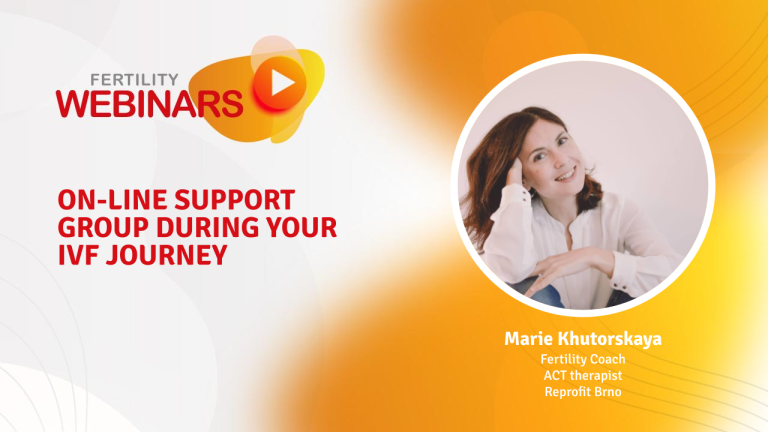
During this event, Louise Siwicki, Fertility Empowerment Coach, and Fertility Workplace Advocate shared her insights and tools to help overcome fertility fears and anxieties during your IVF journey. Louise explained what fertility anxiety is, how stress and fear impact your fertility, and what the first signs of fertility overwhelm are and provided proven strategies to reduce fertility anxiety and reclaim your balance.
First, it’s crucial to understand that stress or anxiety itself causes infertility—it does not. However, infertility causes stress and anxiety, and chronic stress and anxiety over time can cause an imbalance in the body, which in turn can affect our fertility moving forward. Therefore, stress is not causing infertility, but rather infertility is causing stress.
The mind and the body are inextricably linked; one does not function without the other. Our body works holistically. When we first start thinking about trying to conceive, the doctor will probably give us a script for a round of blood tests and talk to us about physical health, exercise, maybe giving up drinking and smoking, and how we’re physically looking after our bodies. But nobody mentions our mental health—where are we on our mental health journey? Is there anything causing us excessive stress? Is there anything in our family line that could cause stress as we progress in our fertility journey? Physical and mental health and well-being should be looked at equally. One doesn’t trump the other; we need to look at them both equally.
Everything starts as a thought in the mind. Thoughts become feelings, feelings become our belief system, and over time our belief system becomes our reality. There’s a lot of language we use as our fertility journey goes on: “I’m getting too old,” “I’m never going to become a mom,” “I failed,” “My body isn’t capable of falling or staying pregnant,” “I can’t deliver a healthy baby.” Over time, these thoughts and the language we use start to become ingrained in our nervous system, becoming part of who we are. The mind then begins to believe these thoughts, causing a lot of stress and anxiety.
Physiological effects: Stress can disrupt hormonal balance, affect ovulation, and impact sperm production. Chronic stress can lead to irregular menstrual cycles and reduced fertility. Cortisol, the stress hormone, can inhibit reproductive hormones necessary for conception. If you are living in a constant fight-or-flight stress response mode, cortisol levels are continually high.
Psychological effects: chronic anxiety can lead to negative thought patterns, emotional exhaustion, and a feeling of being overwhelmed, which can impact your overall well-being and fertility.
When you’re in constant fight-or-flight, your mind is in overdrive. You’re always going to feel emotionally exhausted or overwhelmed. You go to bed at night feeling exhausted, and you wake up in the morning feeling even more exhausted because your mind and brain have not stopped. If you feel like this, listen up—fertility overwhelm is real.
Statistics show that:
These statistics highlight the very real mental health aspect of fertility. If you’re feeling overwhelmed, remember you’re not alone.
Some strategies can help with dissolving some of the stress and anxiety. These include:
Don’t lose hope. It’s true, even though it’s hard to see a light at the end of the tunnel when you’re in the depths of it. It’s like being in the eye of a storm, wondering how you’ll get out of the chaos. But it is possible. You just need to find the right support, community, and team to help you navigate this stressful time. One day at a time, one foot in front of the other, gain momentum and navigate your way through the storm.
Related reading:
My heart goes out to you. You are not alone. Your feelings are valid and very real. It is really about finding what you need to move forward. I tell all of my clients, in the beginning, to take a step back and start to listen to their body, mind, and intuition. What is your gut telling you to do to move forward? Our body always keeps the score, and the mind is always whispering about what we need to do. Who do you need to talk to? Who is the team of people you need to surround yourself with?
Each day during your meditation time, add some breathing exercises. If your mind wanders, concentrate on the feeling of the breath in and out. Bring your mind back to the breath each time it wanders.
Ask yourself what you need to do to move forward. How can you navigate this difficult time? Maybe there is a professional or an alternative therapist you need to chat with. The healing power of the community is incredible. Maybe you need to join a community of like-minded people on a similar journey. Often, we have amazing friends and family who we love dearly, but they may not understand because they haven’t been through it. This can feel isolating. The healing power of the community is everything.
Educating yourself and trying different tools and strategies can help at the moment to bring down your stress levels. Without knowing more about your background, my advice is to ask yourself what to do to move forward. Where do you need to go? Who do you need to talk to? Who is going to help you get where you need to be? How do you want to feel when you go for your next round of IVF? You want to feel calm, empowered, and in control. So, how are you going to get there? If you listen, you will find the answers. I truly believe that.
You only need one success. You are not too old, and it’s not too late. I have many clients well into their 40s who have fallen pregnant and delivered healthy babies. I just want you to know that it’s not too late. This is an opportunity for you. Infertility is one of the toughest challenges; you wouldn’t wish it on your worst enemy. But I tell every one of my clients, let’s look at this as an opportunity to learn, heal, grow, and become the best version of ourselves for our future baby. By changing that perspective and looking at it through a fresh lens, it honestly changes everything.
I hope this has somewhat answered your question or pointed you in a direction you may not have thought of.
I think you just answered your own question. We sometimes seek outside validation, but if you feel that it’s time, then it probably is. No one can answer that question for you except yourself. My advice to you is to listen to your intuition and take that advice.
It is hard, for sure. There’s nothing easy about this. It’s about being brave and finding the courage within yourself to do what you need to do. I mean, 31 is still young, but I don’t know your medical history, and I’m not a doctor, so I can’t comment on that. However, try everything from a natural holistic approach first—assess your mental health, stress, and anxiety levels. See if anything is missing, like community support or alternative therapies such as acupuncture or dietary changes. Check-in with yourself after a couple of months. If you still feel it’s the way to go, then start the medical process. You don’t want to delay it for years and risk it becoming too late. My recommendation is to go to the GP and have a chat. Starting the process might make you feel more empowered and in control. Even doing some initial tests can give you insights and help you decide what to do next.
Try the tools I’ve mentioned, like breathing techniques. In moments of stress and anxiety, focusing on your breath can help. Make sure your out-breath is longer than your in-breath to engage the parasympathetic nervous system, calming your mind and body. This can help you think more clearly and use grounding techniques. Although it won’t permanently dissolve stress and anxiety, it can help break the state at that moment.
Reframe your thinking by shifting your focus to gratitude. The “spotlight effect” can make you fixate on one thing, like your period, but remember there are many other things in life to be grateful for. By focusing on gratitude, you shift your energy from stress to love, bringing balance and clarity to your thoughts.
Once again, I’m not a medical professional, so I can’t comment on anything medical. But for me, I would suggest taking a step back and looking at what else might be going on. In my own journey, I didn’t fall pregnant, and there was no apparent reason. Even after 6 years of IUI and IVF, month after month, I wasn’t getting pregnant. So, I took a step back and asked myself what else could be happening. That’s when I started to see different people who could help. I saw a fertility-specific acupuncturist every week for two years, a nutritionist because I had celiac disease (diagnosed as a result of the stress and anxiety I was experiencing), and I worked on my mindset, which was in a dark place due to depression, adrenal fatigue, and chronic fatigue.
Spiritually, I had a lot of work to unpack. I’m trained in hypnotherapy, timeline therapy, and NLP (neuro-linguistic programming), so I work with clients to go back in time and figure out where stress, trauma, anxiety, or grief may have originated. It could be generational, something that happened with a grandmother or mother, or stress accumulated over time. A lot of things happen behind the scenes in our unconscious mind, which runs 95% of our day. We’re only 5% consciously aware, so there’s a lot of programming we’re not aware of. It might be worth investigating that side of things to see where it takes you.
I haven’t personally struggled with this, but I know a couple of amazing women on Instagram who specialize in supporting women on the donor egg journey. One of them is a donor egg mama, and if you search for her on socials, she’s an amazing Australian coach who has been on the donor egg journey herself. She coaches women who are considering or already on this journey, specifically addressing how to come to terms with this emotional roller coaster and how to cope. I highly recommend following her and maybe reaching out for support and guidance, as she would be perfect to answer this question.
Grief has a way of following us until we allow ourselves to feel it. You have to feel it to heal it. Now is not the time to think positively or push it aside. Although I’m all about thinking positively, there is such a thing as toxic positivity, and this is the time when many of us try to keep going by forcing ourselves to stay positive. But that can be counterproductive and cause toxic energy in the body.
For you, it’s about processing the grief and coming to terms with what’s happened. Validate your loss, whether it’s a miscarriage, the loss of a baby, or even a negative pregnancy test. Every loss is significant, and you need to grieve to truly process those emotions and move through them to the other side. Grief never really leaves us; it changes us. But if you allow yourself to process it, your body is designed to handle and feel it. It will hurt, but the healing on the other side is so important. Give yourself the space to do what you need, ask yourself what you need, and focus on caring for yourself. Right now, you are the most important thing.
Once again, I’m not a medically trained professional, so I can’t comment medically. But from my own experience, there is a chance. As you get older, the percentage decreases, but there is always a chance. I know many clients who have fallen pregnant naturally well into their 40s. One of my clients was nearly 47 when she got pregnant. While that’s not the norm, it is possible. I don’t know your medical history, but yes, there is always a chance, and of course, IVF is also an option.


+ 4 more answers

+ 5 more answers

+ 1 more answers

+ 6 more answers
+ 2 more answers
Necessary cookies are absolutely essential for the website to function properly. This category only includes cookies that ensures basic functionalities and security features of the website. These cookies do not store any personal information.
Analytical cookies are used to understand how visitors interact with the website. These cookies help provide information on metrics the number of visitors, bounce rate, traffic source, etc.
| Cookie | Duration | Description |
|---|---|---|
| _ga | 2 years | This cookie is installed by Google Analytics. The cookie is used to calculate visitor, session, campaign data and keep track of site usage for the site's analytics report. The cookies store information anonymously and assign a randomly generated number to identify unique visitors. |
| _gat_UA-38575237-21 | 1 minute | No description |
| _gid | 1 day | This cookie is installed by Google Analytics. The cookie is used to store information of how visitors use a website and helps in creating an analytics report of how the website is doing. The data collected including the number visitors, the source where they have come from, and the pages visted in an anonymous form. |
Any cookies that may not be particularly necessary for the website to function and is used specifically to collect user personal data via analytics, ads, other embedded contents are termed as non-necessary cookies. It is mandatory to procure user consent prior to running these cookies on your website.
Other uncategorized cookies are those that are being analyzed and have not been classified into a category as yet.
| Cookie | Duration | Description |
|---|---|---|
| _gat_FSQM52 | 1 minute | No description |
| cf_ob_info | No description | |
| cf_use_ob | No description |
