

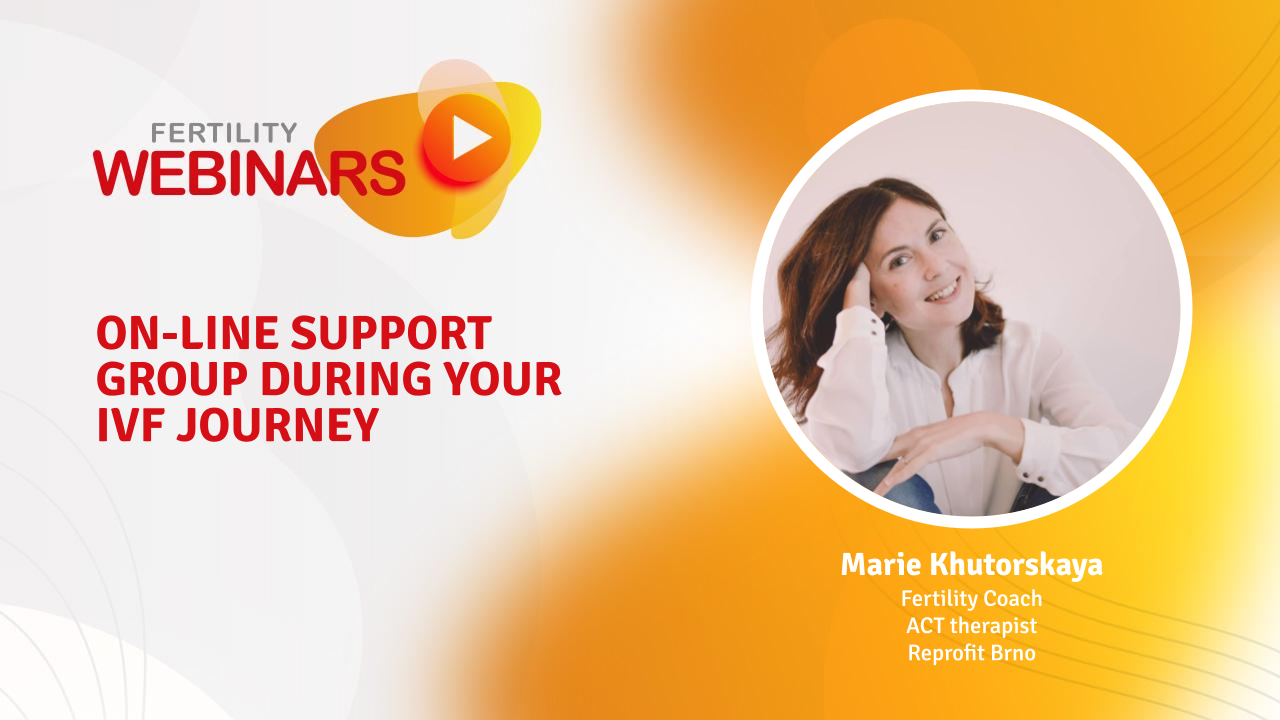
During this event, Maria Khutorskaya from Reprofit — ACT, a therapist, gynaecologist, fertility coach, and consultant, shared the benefits of support groups and guided participants through the emotional and physical challenges of IVF, pregnancy, and motherhood.
Maria showed some data that she found in the European Fertility Society guidelines. Maria mentioned that during this process, one can feel sadness, frustration, worries, stress, guilt, shame, a lack of support, and, at some point, also suicidal feelings.
Maria said that, according to the guidelines, patients experience 5 of these all the time, at the same time. The guidelines also show that women struggling with infertility experience the same level of depression as women with cancer or HIV. She mentioned that 42% of responders reported having felt suicidal at some point.
Maria said she found this very undervalued and emphasised how important emotional support is for patients.
Maria said that despite a favourable prognosis and financial capacity, up to 30% of couples decide to stop treatment before achieving pregnancy. The reason for stopping was emotional burnout. According to Maria, if these couples received adequate emotional support, they might continue and achieve pregnancy.
Maria also said that up to 70% of couples experience clinically significant anxiety disorders and depressive symptoms at some point during treatment. She said that the journey sometimes takes longer than wished, which is why, at some point, people need to have support.
Maria said that infertility is not just a classical medical diagnosis. She said it is a very emotionally complex period and that it affects all areas of life.
She mentioned that sometimes it is hard to concentrate at work and that problems can arise in relationships with partners, friends, and relatives. She added that people sometimes avoid social events because they feel overwhelmed and stressed. Maria said that from another perspective, stress influences the treatment process. People try to relax, but it’s hard, and this makes them feel even more anxious.
She emphasised that it is very important to have support during this time—support that is easily accessible, relevant, and prompt.
This was the reason the team at Reprofit created this space for everyone who needs it. She mentioned that the group was created on WhatsApp because everyone can have this application, and it is easy to access. It was important for them that people could easily join. She explained that you just need to send a request, and sometimes they talk or even without talking, she just adds people to the group.
Maria said that the group is free of charge, which is crucial because the financial aspects of treatment can be significant. People sometimes need to decide whether to pay for an additional method or a therapeutic session.
Maria mentioned that their group does not replace therapy or medication if needed, but it offers a space to join and feel supported. She said it can be anonymous if wished—participants can enter WhatsApp with a different phone number, change their avatar, or use a nickname.
Participants can also openly talk using their real names, and that participation can be at a comfortable level. Maria mentioned that the group is large, with almost 200 people in the English group. There are 2 groups—one in the local Czech/Slovak language and one in English. Some participants are very active, participating in conversations, giving feedback, and sharing tips. Others prefer just to observe, and Maria said she receives feedback that they feel good simply being part of the group. There is no pressure. You can enter, just watch, and leave at any time without explanation.
People can connect from different countries. She said that although most participants are Reprofit clients, being a client is not required to join.
The group is open 24/7, and people are in different time zones, so there’s always someone who can answer or talk. She emphasised that it’s people who understand, because they are going through the same process.
Maria emphasised that her role in the group is to help participants understand the IVF process better. She said there are many methods, techniques, treatments, and protocols, and during consultations or visits, it is easy to forget to ask something or to run out of time for a full explanation.
Many times, people start to look for information online and become overwhelmed due to the many controversial sources. Maria said that since she is a gynaecologist and used to work in an IVF clinic, she can give medical information and explain things. She emphasised that any question is welcome—whether someone forgot to take medication, started bleeding, or experienced side effects, they can ask her.
This understanding helps people feel that things are under control. She added that the lack of control and uncertainty in the process causes anxiety. Although nothing can guarantee a successful outcome, being informed can lower stress levels. She also shares information on how to manage stress and anxiety, recommending books and techniques that can help. It is important not to stay alone and to share with others.
Participants sometimes face difficult decisions, such as trying again or moving to donor options. She said she provides information based on evidence and that participants share their experiences, too. This can help others find motivation and feel supported. Communication with the clinic is also important. Although the clinic has a hotline and coordinators, she is often in contact with them too.
Maria added that she appreciates support groups led by psychologists and believes they are very helpful. However, she added that their group aims to offer complete support by combining emotional and medical information.
She said many clients ask her about methods. She said that although she shares data and her thinking, she never interferes with treatment because she may not have all the information. Maria said she helps participants prepare questions and understand how to talk with their doctor. This gives participants a sense of safety.
Maria said that her favourite part of the presentation was the feedback from participants.
She shared a few examples, including:
When my treatment did not go as planned, I felt completely lost. Late at night, it was incredibly relevant to have someone like you to listen, provide reassurance, and guide me in the right direction to solve the problem.
You can just join via the QR code shown in the presentation, or you can go to the Reprofit website. You can also find it via Google: “support group Reprofit,” and you can find it, and you can see the English one.
The English version is for the English support group. By the way, for both the English and Czech groups, I receive all requests, and I will understand that you’re looking for the English one, and then I will add you there. It’s just a WhatsApp group. We talked during this presentation about why we decided not to do it in our application or something. We wanted to make it as easy and accessible as possible.
WhatsApp—I mean, everybody has it, so anyone is welcome, and it’s free of charge, it’s open. If you send me the request today, tomorrow morning I will add you to our group.
Yes, of course. There are participants in the group who contact me privately. We have the first session, and if they understand that it can help them—and if I have time, if it matches for both of us—we can also work separately, privately.
And the group is big—it’s really big. We have almost 200 participants there, but it works really nice. Sometimes the discussion is really big, and you just need to scroll through it. But sometimes it’s also calmer.
And the important thing—when you are in the group, you don’t need to participate actively right away. You can just watch and read, and at some point, if you feel comfortable, then you can write at your own pace. If you feel like asking something, go ahead. But if not, it’s absolutely okay.
As I told you, some participants are writing to me in private. They say, “I’m here,” or “I’m just not really comfortable to share, but I’m happy to read and feel not alone.” I think that’s definitely what we always want as well.


+ 1 more answers

+ 7 more answers
Necessary cookies are absolutely essential for the website to function properly. This category only includes cookies that ensures basic functionalities and security features of the website. These cookies do not store any personal information.
Analytical cookies are used to understand how visitors interact with the website. These cookies help provide information on metrics the number of visitors, bounce rate, traffic source, etc.
| Cookie | Duration | Description |
|---|---|---|
| _ga | 2 years | This cookie is installed by Google Analytics. The cookie is used to calculate visitor, session, campaign data and keep track of site usage for the site's analytics report. The cookies store information anonymously and assign a randomly generated number to identify unique visitors. |
| _gat_UA-38575237-21 | 1 minute | No description |
| _gid | 1 day | This cookie is installed by Google Analytics. The cookie is used to store information of how visitors use a website and helps in creating an analytics report of how the website is doing. The data collected including the number visitors, the source where they have come from, and the pages visted in an anonymous form. |
Any cookies that may not be particularly necessary for the website to function and is used specifically to collect user personal data via analytics, ads, other embedded contents are termed as non-necessary cookies. It is mandatory to procure user consent prior to running these cookies on your website.
Other uncategorized cookies are those that are being analyzed and have not been classified into a category as yet.
| Cookie | Duration | Description |
|---|---|---|
| _gat_FSQM52 | 1 minute | No description |
| cf_ob_info | No description | |
| cf_use_ob | No description |

