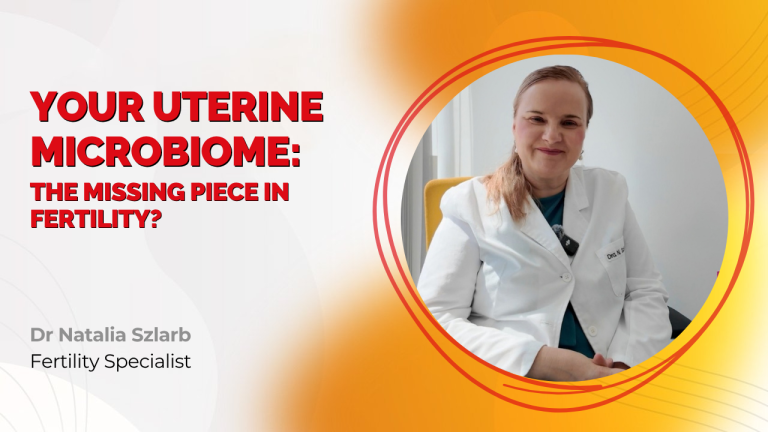


Dr Héctor Izquierdo, Gynaecologist & Fertility Specialist at Clínica Tambre discussed the latest research on how uterine microbiota impacts IVF outcomes. He covered the available tests for assessing uterine microbiota when these tests should be indicated, and the implications of the findings for personalized fertility treatments.
The endometrium, or as we call it, the endometrial lining, is the tissue that covers the inside of the womb. It is responsible for accepting an embryo, letting it grow, and supplying it with all the things it needs to allow the baby to develop until delivery. Unlike other tissues in the body, the endometrium is a tissue that’s meant to be created and released once a month. This has a cycle, and this cycle is responsible for allowing implantation. The cycle responds to two hormones: estrogen and progesterone. These two hormones come directly from the ovaries.
Once the body decides or acknowledges that the woman is not pregnant, a new cycle begins, and it starts to release FSH. FSH goes to the ovaries to make follicles grow. While these follicles grow, they produce estrogen. This estrogen acts on the lining and makes it thicken so we can prepare for a potential pregnancy. Once the egg is released, the corpus luteum starts producing progesterone. This progesterone acts on the lining, making it thick and welcoming for an embryo.
Why is this important? If the lining does not get thick or if the progesterone does not change the genetic receptors and the surface of the lining, no implantation will take place. There are different ways to prepare the lining. One is during the IVF cycle itself: since we make follicles grow, we produce estrogen, and once we trigger ovulation to retrieve eggs, we know that progesterone will start being released, and then the lining gets prepared.
A natural cycle is also a very good way to prepare the lining. We just don’t give any medications; we allow one follicle selected to produce estrogen to make that lining grow, so we can implant an embryo back or allow an embryo to implant naturally. A substituted cycle with hormones can be done with extra progesterone. There are different forms and top therapies that we can use to make the lining not only grow but become more likely to implant.
In a natural cycle, once an egg is released, the corpus luteum starts producing progesterone, changing the lining into a state that can accept an embryo. These changes are threefold:
Endometrial receptivity does not happen throughout the whole month. We know there is a specific moment when it is ideal, which is approximately five and a half days after the trigger of progesterone. Progesterone changes the lining during this time, as mentioned earlier.
Once this has been changed and the lining is capable of accepting an embryo, this is what we call the window of implantation. It is the moment when the lining is receptive to an embryo. We know that most patients are receptive about five days after they ovulate or after progesterone intake, but this is not an absolute rule. There are some patients with wider windows of implantation, receptive from day 4 to day 6. Others have narrower windows, meaning they are receptive at specific moments, and around 30% of patients experience this. This is one of the most common causes of repeated implantation failure. A display of an implantation window that is either too short or too long means that 5 days of progesterone may be insufficient or excessive. This could result in the lining being ready to allow implantation either earlier or later than needed, which may conflict with natural pregnancy since the embryo takes around five days to evolve into a blastocyst that can hatch and implant. In the context of IVF with the frozen transfer, we can synchronize both the implantation window and the development of the embryo to enhance the chances of implantation.
How can we use the ERA (Endometrial Receptivity Array) test? There is an indication for the ERA test, which we can use either when we have repeated implantation failures with good-quality embryos that produce no implantation or when there are alterations in the implantation window. The ERA test can be performed in a fresh cycle to increase the chances of implantation. This assessment of the implantation window is done through endometrial biopsy, which helps us synchronize the cycle, provide five days of progesterone (either natural or triggered), and then make a sample on day 5 to check if the receptors are available. This helps determine if the lining is receptive too early or too late.
For a long time, we used to think that the lining was an aseptic environment, meaning without bacteria and that this environment was most likely to allow implantation. We now know that certain bacteria enhance implantation. Nowadays, we perform genetic testing to amplify bacterial DNA to see what types of bacteria are present in the lining at the moment of implantation. This helps correct imbalances in the microbiome that need to be present in the lining to allow implantation. Disbalance in the microbiome has been proven to cause repeated implantation failure, miscarriage, and even complications in pregnancies, such as premature delivery, hypertension, and blood sugar issues. Studies confirm that a good balance of bacteria, especially a good proportion of lactobacillus, increases the chances of pregnancy. However, there is still some controversy. Some studies suggest that other types of bacteria might be better, but these are isolated studies and we do not have conclusive meta-analyses at the moment. Therefore, no bacteria is preferred, and any other bacteria should be treated to eliminate them. Microbiome tests allow us to see the proportions of bacteria and their species. Different species of lactobacillus are not the same, and their proportions are related to higher implantation rates and better fertility outcomes.
As mentioned before, progesterone not only triggers the window of implantation but also triggers an immune reaction that prevents the embryo from being rejected. This involves the following processes:
There is new research on the relationship between blood flow in the lining and certain characteristics of the lining, using artificial intelligence (AI). AI is being used to assess the lining through ultrasound pictures to forecast the chances of implantation. This project aims to make decisions on transfer based on AI from both the embryo and the lining itself.
The Matris project is a unique technological development of AI produced in Canada that allows thanks to ultrasound images to predict when the endometrium is ready to receive an embryo and increase the chances of pregnancy.
In conclusion, the endometrial lining is very important in the fertility journey. While a focus on producing good-quality embryos is essential, a good embryo can still be rejected if the lining is not properly assessed. Therefore, after two or three embryo transfers, I recommend a new assessment of the lining to check for any factors that might be preventing good-quality embryos from implanting.
Related reading:
What we need to understand is that humankind, human beings, are not a compartmentalized structure. We have a certain immunity, and as you know, the vagina is not that far away from the oral cavity, so there’s a communication between oral intake of lactobacilli and the increase of microbiota in the vagina naturally. Vaginal application of lactobacilli might be faster and more effective, which is why some studies claim this, but they are equally effective over time.
It depends on the time we have available. I’m not much of a fan of vaginal application unless necessary. Progesterone is something we must do because oral intake causes a lot of symptoms and discomfort. Injections aren’t ideal either since we don’t want daily injections. Oral progesterone or vaginal application is necessary because transdermal progesterone does not work as well. But if I can avoid something vaginally, I prefer to do so due to the discomfort for patients—irritation, discharge, and the general unpleasantness. If we have plenty of time for treatment, I go for the oral option. If we’re in a rush to transfer soon, we opt for the vaginal option.
Yes and no. In most cases, there is a similar balance or situation between the vaginal and endocervical microbiomes, or even the endometrial microbiome. But in pathological cases, when there’s a disbalance, it’s not the same. That’s why we don’t just use a vaginal swab to assess the microbiome; instead, we perform the more uncomfortable endometrial biopsy, as it’s not 100% related.
Many things here. First of all, yes, we do recommend vaginal probiotics. The one from Greece was good, but if it’s unavailable, most are over-the-counter and similar, so use whatever is available and good for you. Regarding the UK, it’s a known issue—they have strict regulations, and many treatments are labelled yellow or red because there isn’t enough information to assess them fully in the UK. This makes it difficult for clinics to offer these tests or treatments unless you are already their patient. Unfortunately, this is one of the challenges of performing treatments outside of your country.
It’s very important. Ureaplasma, Chlamydia, and Mycoplasma are the three most common species known to cause implantation failure and miscarriage. Depending on the sensitivity, which most tests reveal, the most common treatment is azithromycin, often a single shot. However, some doctors recommend doxycycline therapy—100 mg twice a day for 14 days—to treat Ureaplasma, as it covers a broader range of bacteria and addresses any underlying inflammation, such as chronic endometritis, which can also be a cause of recurrent implantation failure. Both options are equally effective.
Even though clinics prefer a thickness of at least 8 mm, some will attempt implantation with as low as 4-6 mm. Here’s why: A high-quality embryo can sometimes do remarkable things, like implant outside the uterus, resulting in an ectopic pregnancy. However, implantation doesn’t always mean pregnancy, and pregnancy doesn’t always result in a live birth. A thin lining, even if it allows implantation, is associated with complications such as placenta issues during pregnancy.
While some patients do get pregnant with thin linings, we cannot base medical decisions on exceptions or luck. Statistically, a lining under 7 mm or above 12 mm is associated with lower implantation rates and poorer obstetric outcomes. If no other options are available after trying everything, I might proceed with a thin lining, but I would never do so on the first attempt, especially with egg donation, without trying other methods first.
All those blood tests claim to test free DNA for bacteria released in the blood. Lactobacillus are not common in any place other than the mouth, uterus, and vagina. Therefore, calculating the approximate proportion of bacteria might be possible, but not 100% accurate nowadays. It might be useful as a discard test or some screening assessment, but as for diagnosis and therapy, the gold standard remains the biopsy.
I don’t know this medication, I am afraid. I work with patients from over 15 countries, so I’m not up to date with every single medication available. I might look into it and then let you know, but at this moment, I don’t know which type of lactobacillus is in that product. If you can tell me what type of lactobacillus is inside and how it is transported, I can help you with that. But with brand names, it’s very hard because there are so many in every country.
If we’re testing menstrual blood, we’re testing what has passed through the vagina, so it might be contaminated with bacteria from the vagina. As we said before, it’s not 100% the same as the lining, so unfortunately, it’s not possible.
Yes, it can, and it’s a very common therapy nowadays. Many doctors, including myself, tend not to transfer fresh embryos anymore for different reasons. We want to make the IVF treatment as efficient as possible, and the goal is to get the maximum number of eggs. By transferring frozen embryos instead of fresh ones, we reduce the risk of overstimulation.
Additionally, some studies suggest that transferring frozen embryos increases implantation and live birth rates because it allows synchronization between the endometrial lining and embryo development. During the egg retrieval process, we can perform the microbiome test without any pain, and the patient wouldn’t notice anything. By the time we get the results, we can proceed with the transfer, giving us plenty of time to treat any issues. It’s a very common practice in my clinic.
First of all, I want to avoid a misconception here. I haven’t said that the endometrial lining, the window of implantation, or the microbiome is a first-line therapy for any patient. As I said at the very beginning, it’s just 30% of patients with failed implantation who have a problem here. So, it’s for patients who already have a problem. There are no indications to do this type of testing before the first IVF treatment. This has become very popular with patients who just want to succeed in their very first transfer, but we have to take it easy. We don’t want to forbid things, but if we start doing procedures that could have complications and may cause damage, just because we want to test everything beforehand, first of all, we have to prepare our pockets because this is all very expensive.
Secondly, we’ll be spending a lot of money for nothing. And I think we must be cost-effective because this is a medical treatment that most of the time comes out of the patient’s pocket. We need to do the most with the least. So, I do not consider—and I might be making a couple of enemies here in certain brands—but I do not consider any of these assessments as first-line therapy. There are many things much more important than these that are not done on a general basis. For example, I am always amazed when patients come to me from the UK after 2 IVFs with no results and haven’t had any karyotyping done on the couple. That’s something I find hard to believe. But to repeat, this is not a first-line therapy. It is a very helpful assessment, helping one in three patients with failed implantation get pregnant, which is outstanding—huge numbers. But it doesn’t mean that when someone comes for IVF treatment, we should immediately do the microbiome test, ERA, or EMMA. This is just branding and publicity from those commercial labs offering these tests, and I don’t agree with that approach.
Indeed. The thing is, nowadays, it is very hard to obtain products with active Lactobacillus due to the many regulations from the Drug and Food Administrations in different countries. But classic natural yoghurts are a very potent and good way to obtain Lactobacillus.
As I said before, not all problems are related to the microbiome. Having the right endometrial microbiome doesn’t mean that you will get pregnant. There are a lot of factors that need to be taken into account. So, this is not the only option.
I would say at least 3 weeks would be recommended for this type of patient.
It takes 5 weeks.
Necessary cookies are absolutely essential for the website to function properly. This category only includes cookies that ensures basic functionalities and security features of the website. These cookies do not store any personal information.
Analytical cookies are used to understand how visitors interact with the website. These cookies help provide information on metrics the number of visitors, bounce rate, traffic source, etc.
| Cookie | Duration | Description |
|---|---|---|
| _ga | 2 years | This cookie is installed by Google Analytics. The cookie is used to calculate visitor, session, campaign data and keep track of site usage for the site's analytics report. The cookies store information anonymously and assign a randomly generated number to identify unique visitors. |
| _gat_UA-38575237-21 | 1 minute | No description |
| _gid | 1 day | This cookie is installed by Google Analytics. The cookie is used to store information of how visitors use a website and helps in creating an analytics report of how the website is doing. The data collected including the number visitors, the source where they have come from, and the pages visted in an anonymous form. |
Any cookies that may not be particularly necessary for the website to function and is used specifically to collect user personal data via analytics, ads, other embedded contents are termed as non-necessary cookies. It is mandatory to procure user consent prior to running these cookies on your website.
Other uncategorized cookies are those that are being analyzed and have not been classified into a category as yet.
| Cookie | Duration | Description |
|---|---|---|
| _gat_FSQM52 | 1 minute | No description |
| cf_ob_info | No description | |
| cf_use_ob | No description |

