

In this webinar, Dr Uliana Dorofeyeva, Director of International Cooperations at IVMED, Ukraine, and a Medical Director at OVOGENE Egg Donor Bank discussed various aspects of egg donation, embryo donation, and double donation and addressed genetic inheritance.
It’s known that everyone is different, as well as children are or will be. Before starting with a thorough explanation of the creation of the embryo, Dr Dorofeyeva talks about the cells, which are the strategic cells for the embryo creation and the future child presence.

For this, it’s important to talk about the human oocyte, which will come from:
The most important part, which consists of genetic material, is the nucleus. It’s essential to remember about the cytoplasm as well, and according to Dr Uliana, they’re learning more and more about organelles and the structure of the cells. Moreover, the mitochondria also play a crucial role in the genetic inheritance and creation of the embryo.
The mitochondria are located in the cytoplasm, and the zona pellucida, the first polar body, corona radiata (follicular cells) are very important in terms of the organelles and guarantee the safety of the creation of the cell and the development. However, they don’t have genetic material, so it’s important to remember that genetic material people have in the nucleus and the cytoplasm, meaning in mitochondria, are located in the cytoplasm.

Talking about the human sperm, there’s a head with the nucleus inside, which is the part used for ICSI. There’s the mitochondria, also located in the midpiece of the spermatozoa, but this part of the cell isn’t used for fertilization. It can be used for conventional IVF; however, through science, it can be confirmed that it doesn’t take part in fertilization.
Dr Dorofeyeva explains that inside the cell, in the nucleus, there are chromosomes created from the DNA that consists of the genes.

In addition, 99.9% of the human DNA is identical, and even though everyone’s different, 99.9% of the DNA is the same. The 0.1% difference is in personal and physical characteristics, such as appearance, height, constitution as well as the development of the disease.
DNA is the chemical inside the nucleus of the cell that carries the genetic instructions for making living organisms. It’s also the material inside the nucleus of the cell that carries genetic information, and the scientific name is deoxyribonucleic acid.

On the other hand, chromosomes are the packages of genes and other DNA in the nucleus of a cell. A chromosome contains hundreds and thousands of genes. Moreover, humans have 23 pairs of chromosomes, 46 in total, where 44 are autosomes that have different genes and also diseases, mutations, and the presence of the individual. In addition, two of them are sex chromosomes, which are responsible for male or female status.
Also, each parent contributes one chromosome to each pair, so children get half of their chromosomes from their mother and half from their father. Chromosomes are long stretches of DNA, within which lie genes. A single chromosome may contain hundreds of genes and for some genes, the doctor already knows their location as well as their coding.
You will probably know that some scientists are working on full genome sequencing; however, even though there is a lot of development, the full genome isn’t treated yet and every day, week, or month, doctors are learning more and more about this.
The gene is the functional and physical unit of the heredity passed from the parent to the offspring. It’s also a section of DNA that carries the information for a particular trait or characteristic. If you’re talking about how the baby will look, it may be the phenotypical characteristics, such as eye colour, hair colour, and production of particular enzymes as well as specific characteristics and diseases. Moreover, a trait is any gene-determined characteristic and is often determined by more than one gene. On the contrary, alleles are different forms of the same gene, for example, talking about eye colour, the alleles are responsible for blue, brown, and green colour.
Furthermore, full genome sequencing is based on a DNA molecule and, as previously mentioned by Dr. Dorofeyeva, they are developing this a lot.
Proteins are very important to take into account when talking about oocyte donation and genetics.

Proteins are also the most important class of material in the body. They aren’t just building blocks for muscles, connective tissues, skin, and other structures, they are also needed to make enzymes, which are complex proteins that control and carry out nearly all chemical processes and reactions within the body. At the same time, the body produces thousands of different enzymes and the entire structure and function of the body is governed by the types and amounts of proteins the body synthesizes.
Protein synthesis is controlled by genes which are contained on the chromosomes, meaning that the DNA is also based on the production of protein.
When talking about DNA, there’s another class of genetic material which isn’t DNA itself, but RNA, the ribonucleic acid. It’s different from DNA by the lack of one oxygen atom, and it’s involved in different cell processes, such as protein synthesis. This is like a pre-DNA.
In relation to oocyte donation, if the DNA is coming from the nucleus, RNA will be present in the mother’s body and will be synthesized by the body of the mother who’s carrying the genetic material from the donor and the father. According to Dr Dorofeyeva, they still don’t have a lot of information, but many scientists are sure about the impact of RNA on the DNA function, production, and coding as well. There will probably be more information about it in the future.
Mitochondria are tiny structures inside the cells that synthesize molecules used for energy; thus, it’s responsible for energy production for the cell and give power for development.

The development is the most important thing for embryo production, talking about IVF. Unlike other structures, inside cells each mitochondrion contains its own circular chromosome.
There’s a chromosome, which contains DNA and is called mitochondrial DNA. This codes for some, not all, of the proteins that make up the mitochondrion. Moreover, it usually comes only from the person’s mother because, generally, when an egg is fertilized, only mitochondria from an egg become part of the developing embryo. In addition, mitochondria from the sperm usually do not become part of the developing embryo.
It can also be seen that in the mitochondria there are chromosomes and also parts of genes which are detected and connected to some diseases, such as Parkinson’s, dystonia, and more. Dr Dorofeyeva mentions they have a treatment, already called mitochondrial treatment, and are working more on mitochondrial donation which gives a possibility for the intended parents to use the structure of DNA from the central DNA (from the nucleus), and also DNA for mitochondria.
With regards the phenotypical signs of the baby, such as the colour of the future child’s eyes, even if the parents will be carriers of the genes, which phenotypically produces people to have brown or dark eyes, doesn’t mean that the child will also have dark eyes 100%.

As can be seen in the image shown by Dr Dorofeyeva, in the upper line both parents have dark eyes; however, the probability for the child carrying dark eyes will be just 75% while there’s also the possibility of having green and blue eyes as well. Everyone also has strong and big genes; so, modern science can predict the physical characteristics of a baby, which will be inherited from the mother and father. All this information is encoded into the genes.

For this reason, there’s a division between strong genes and weak genes.
Strong genes:
These are just related to the phenotypical signs.
Weak genes:
Following the difference between strong and weak genes, in the following image you can see how genes work:

For instance, strong genes like brunette and curly hair come from the mother; however brown eyes come from the father and are inherited in their child.

Another example is red hair is not inherited by the boy, but instead the brown hair of the father as well as the big nose.
Moreover, Dr Dorofeyeva mentions it’s important to remember that the person’s physical characteristics are the results of the displacement of several genes of their parents, so it cannot always be predicted exactly how they will be divided and, certainly, how the baby will look like because genes can even skip several generations and reappear. This means that a person can inherit certain genes from their grandparents or great-grandparents. That’s why is important to select phenotypical characteristics when talking about oocyte donation.
In all oocyte donation programs, all the characteristics are available. In addition, egg donation is the most effective way of getting pregnant for those patients who have problems with their oocyte production, older patients and advanced maternal age, patients after having therapy or patients who have a reduced ovarian reserve. Therefore, at any age, oocyte donation is the best treatment.
Talking about egg donor selection criteria, based on the knowledge received from genetics, there are two important characteristics which usually the doctor recommends to take care of. It also depends on if you’re going to tell your baby that he or she was born due to the usage of oocyte donor or not.

If you decide not to tell the baby about the oocyte donation, you need to think about the following:
For instance, if you and your parent have blood type O, you need to select the donor with only the blood type O because the probability of getting another blood type is 0. Therefore, the baby whose mother and father have that type O will get only that blood type. However, if you have blood type A and your husband is blood type B, the child can get any blood type. For this reason, you can also select donors with any blood type.
It’s usually easy to understand this structure, but if you need to consult about this, you can ask your physician once you’re using oocyte donation. Nevertheless, it depends if you’re going to say this to your baby or not.
This is important to take into account. You also need to remember that 50% of the genome of a baby will come from your husband and also from strong or big genes, so you will get the probability of those genes being present in the baby, meaning the phenotypical characteristics.
It’s still uncertain, but mitochondria and RNA play quite an important role; thus, very often, you can ask your friends, colleagues, or patients; once a baby is born using oocyte donation, all parents say that he or she is very much looking like them even though the oocyte comes from the mother or from a donor.
This is what will be given to the baby once he or she develops in the family. There may be some examples of identical twins growing up in different families, and they’ve got different habits.
This is also important and it’s considered nowadays as a good clinical practice. Doctors can already perform a lot of tests for different gene mutations which can be done for your oocyte donor and male partner.
If you will get this genetic match, you can avoid for a baby, the fact that he or she will be carrier of the patients. It’s not obligatory; however, it’s a good clinic practice which can be offered by the clinics or by the oocyte banks.
Based on these characteristics, you may select your donor. You can also consider embryo donation while considering the points mentioned by Dr Dorofeyeva. Usually, banks or clinics offer a database of wide characteristics and important things. If oocyte donation is possible in your country, your clinic can import biological materials or your treatment. There are many successful cases like this and, if oocyte donation isn’t possible in your country, you can travel to Ukraine to get it fully done there.
Dr Dorofeyeva talks about the poor quality of eggs and the crucial role of mitochondria in older maternal age because it’s the battery of the cell and, if the mitochondria is older again, the level of the activity goes down.

If the activity goes down, this is very important for the embryo creation and embryo development. Therefore, the doctor can get fertilization arrest and low-quality embryos. For this reason, they use treatments with pronuclear transfer or mitochondrial transfer which is one of the successful treatments for advanced maternal age.
This treatment gives you a probability of keeping your genome, approximately 98% of the genome comes from the nucleus, while 2% comes from the mitochondria.
According to the doctor, each couple has a social and genetic right to carry their own genes during pregnancy, so this is a great alternative for those who still may produce a few of their own oocytes. However, the results of the treatment are inappropriate and there’ll be a probability of using a pronuclear transfer for the creation of your embryos.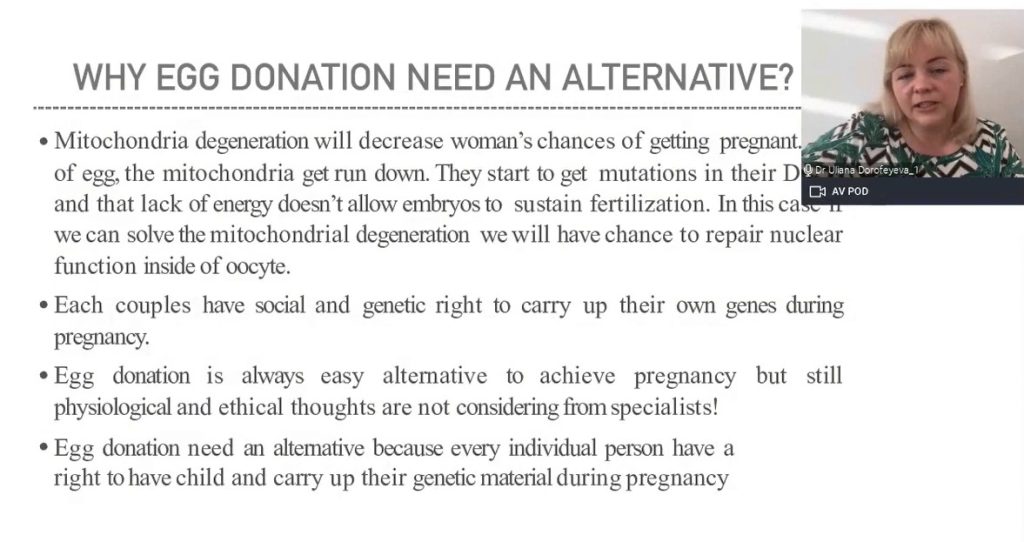 What is a pronuclear transfer?
The pronuclear transfer happens when fertilizing both your oocyte and the donor’s oocyte with your husband’s sperm. Once the doctors have two pronucleus, they’re taking pronuclei with the donor’s fertilized out, and then put them into the cytoplasm, including your mitochondria which helps to develop embryos better. Therefore, by doing this, you’re mixing the genetic material and you have probability to carry your genes.
Some of the advantages of this transfer are:
However, there are already very successful cases.

This is the rate of medical abnormalities which increases with age. However, even in oocyte donors, there’s a probability of getting oocytes which will be euploid. This probability is up to 30%.
The best clinical practice in oocyte donation, recommended by the doctor, is to perform oocyte NGS testing or NGS testing of the embryos before transferring them. This is to increase and maximize the chances for successful IVF treatment using oocyte donation.
Also, by testing the polar body of the oocyte, the doctor can be sure that it’s euploid and has the best chance to create a high quality blastocyst because if they have a high quality blastocyst and a great endometrium, well prepared and responsive, this will be the most successful case.
One of the advantages is the fact that the oocyte donation program mostly brings financial responsibilities for patients and it’s not the first IVF treatment which has happened already for the family mostly.
We would like to optimize and maximize the chances. – says the doctor.
To conclude her presentation, she mentions some important points to take into account:


