
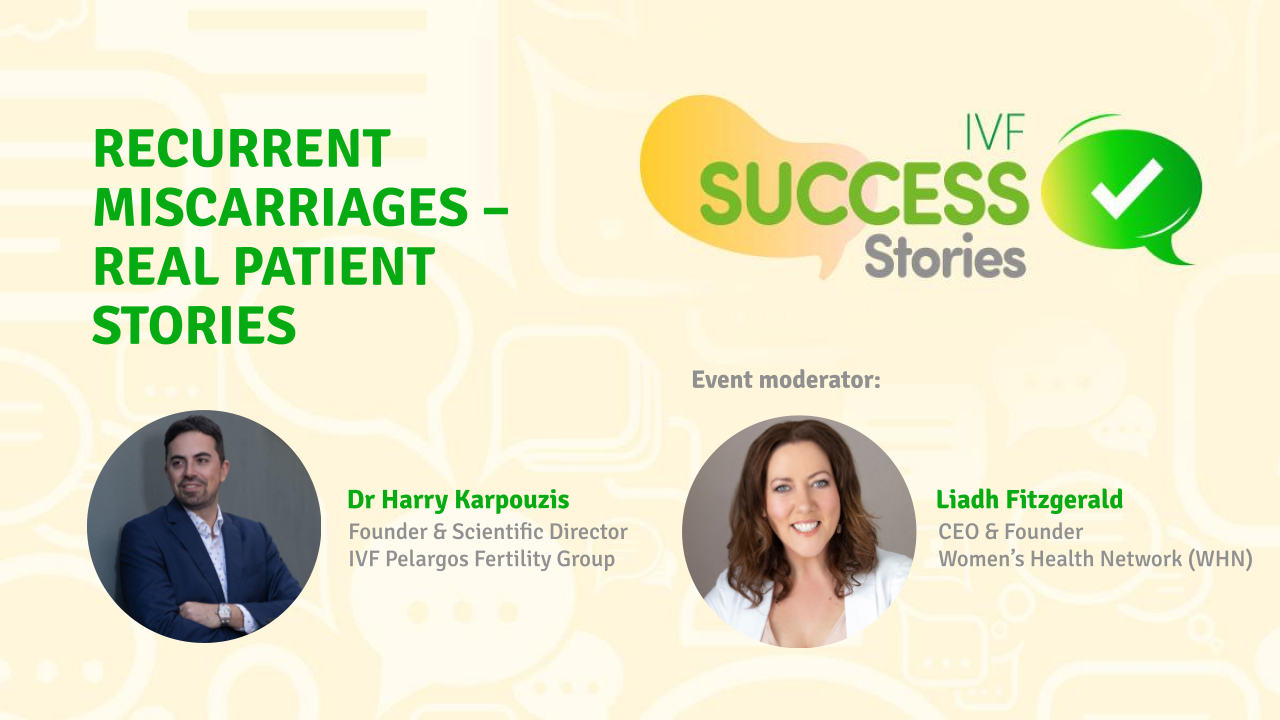
During this Success Stories event on Recurrent Miscarriages – Real Patient Stories, Dr Harry Karpouzis, Founder & Scientific Director of IVF Pelargos Fertility Group, shared expert insights into the causes of recurrent miscarriage, how to approach diagnosis and treatment, and how to maintain hope through each step of the journey.
Hosted by Liadh Fitzgerald, CEO & Founder of the Women’s Health Network (WHN), Functional Medicine Practitioner and Fertility Educator, known for her 360° approach to women’s health and emotional wellbeing.
Recurrent pregnancy loss is one of the most emotionally and medically complex challenges in reproductive medicine. In this session, Dr Harry Karpouzis, Founder and Scientific Director of IVF Pelargos Fertility Group, explored the underlying causes of recurrent miscarriages and shared real patient cases that highlight how personalised investigation and treatment can lead to success.
Drawing from clinical experience, Dr Karpouzis explained why recurrent miscarriage should never be approached with a one-size-fits-all strategy and why detailed investigation of both partners is essential.
Recurrent miscarriage is currently defined as two or more consecutive clinical pregnancy losses, confirmed by ultrasound or histology. Dr Karpouzis explained that while 15–20% of all pregnancies end in miscarriage, recurrent miscarriage affects approximately 1% of couples.
Although statistically less common, recurrent pregnancy loss has a profound emotional impact. Dr Karpouzis stressed that it is a traumatic experience that requires not only medical expertise but also careful, compassionate handling.
According to Dr Karpouzis, chromosomal abnormalities remain the most common cause, accounting for around 50% of cases. This explains why miscarriage rates increase significantly after the age of 40, when chromosomal errors become more frequent.
However, chromosomes are only part of the picture. Recurrent miscarriage can also be linked to:
• uterine abnormalities such as fibroids, polyps, septa, or adhesions
• hormonal and metabolic conditions, including PCOS and thyroid disorders
• blood clotting disorders (thrombophilia and antiphospholipid syndrome)
• immunological factors affecting implantation and placental development
• endometriosis and chronic inflammation
• infections such as chronic endometritis
• sperm factors, particularly DNA fragmentation and oxidative stress
• lifestyle factors, including smoking, obesity, and alcohol consumption
Dr Karpouzis emphasised that successful treatment depends on identifying which of these factors are relevant for each individual patient.
Recurrent miscarriage investigation requires a broad and methodical approach. Dr Karpouzis outlined the key diagnostic tools used in his clinic, including:
• hysteroscopy is the gold standard for uterine evaluation
• karyotyping of both partners
• thrombophilia and immunology testing
• sperm DNA fragmentation and oxidation assessment
• targeted biopsies to diagnose chronic endometritis
• advanced immunological tests evaluating the endometrial environment
He noted that many miscarriages remain unexplained simply because investigations are incomplete or not sufficiently targeted.
A key message of the presentation was that recurrent miscarriage is not only a female issue. Dr Karpouzis explained that sperm factors contribute in approximately 50% of cases.
Standard semen analysis is not enough in recurrent miscarriage cases. DNA fragmentation and oxidative stress must be assessed, as they can directly affect embryo quality and chromosomal stability.
Importantly, Dr Karpouzis highlighted that DNA fragmentation and oxidation do not always occur together. Treating one without assessing the other may worsen outcomes rather than improve them.
Immunology remains one of the most complex and controversial areas in reproductive medicine. Dr Karpouzis explained that successful implantation depends on a finely balanced immune environment within the endometrium.
Both overactive and underactive immune responses can cause implantation failure or miscarriage. He stressed that immune testing should only be performed in patients with a clear history of recurrent loss, as these are relatively rare conditions.
Crucially, treatment must be personalised. Steroids, intralipids, IVIG, progesterone dosing, and other interventions can be beneficial or harmful depending on the immune profile.
Dr Karpouzis was clear that IVF alone does not solve recurrent miscarriage. Without knowing the chromosomal status of embryos, repeated transfers may lead to repeated losses.
PGT-A allows identification of euploid, aneuploid, and mosaic embryos. While not perfect, it provides essential information that guides both embryo selection and counselling.
In cases involving chromosomal translocations, PGT-SR may be required to identify transferable embryos.
To illustrate how complex recurrent miscarriage can be, Dr Karpouzis shared 3 real cases.
One patient, aged 35, experienced three spontaneous miscarriages, including one confirmed euploid loss. Detailed investigation revealed an immunological imbalance and an altered endometrial microbiome. Following IVF with PGT-A and a personalised immune and hormonal protocol, she achieved a live birth.
A second patient, aged 42, had two miscarriages and a failed IVF attempt. Investigation identified sperm DNA fragmentation, chronic endometritis, and low endometrial immune activity. After tailored treatment and transfer of a single euploid embryo, she delivered a healthy baby.
A third patient, aged 39, had antiphospholipid syndrome and repeated losses despite anticoagulation and PGT-A. Only after further investigation did reveal immunogenetic incompatibility, successful personalised transfer was achieved, resulting in a full-term birth.
Dr Karpouzis concluded with several core principles:
• a detailed medical history is essential
• investigation must include embryo, uterus, sperm, and systemic factors
• PGT-A is central to understanding repeated losses
• treatment must be personalised at every step
• success often depends on combining multiple small adjustments rather than one single intervention
Above all, he encouraged patients not to lose hope. With thorough investigation, precise diagnosis, and individualised care, even complex recurrent miscarriage cases can result in successful pregnancies
CMV is transmitted when someone is right now positive for CMV. CMV leaves immunity. If someone is CMV positive and has IgG antibodies positive, it doesn’t mean that they have an infection right now — it means they have immunity. So these people do not transmit the infection.
If someone has CMV at that time, yes, it can transmit the infection. Then you need to check yourself, because many people in the past might have had CMV and they don’t know it. If you check yourself for CMV, you might find out that you had immunity to CMV in the past. If you had immunity to CMV in the past, you cannot get CMV just because you came in contact with a patient who has CMV, even if that was a current infection. Now, if you are not immune to CMV and someone you treat is CMV positive, then you might get CMV. If you get CMV during the first trimester for the first time, and it’s a new infection, then yes, this is associated both with miscarriages and with abnormalities in the baby.
When you have an infection, you can, at that time, check to see if you have CMV. If your CMV IgM test is positive, it means that you have a current infection. So, yes, it gives a possible answer for why you might have miscarried. If someone has CMV right now, it doesn’t mean that if they try after 2 or 3 months, they will have CMV again. They will have immunity to CMV. The CMV IgM antibodies will be negative, and this will not be a problem in the next pregnancy.
That’s a very tricky question because immunology is very conflicting. Some people believe in immunology. Some people do not believe in immunology. There are very good studies behind immunology. There are randomised studies in immunology. But there is no consensus on what exactly is happening.
We believe that some studies from French immunologists are very close to what is really happening in the implantation window. So, when someone goes through a history of recurrent miscarriages, like three spontaneous miscarriages, we need to go through the history as well, because three spontaneous miscarriages at the age of 42 to 45 are quite self-explanatory. The most common reason, in 90% of cases at that age, is the chromosomes.
Let’s say you go for IVF and you find a chromosomally normal embryo, for this age, for example, this is a very precious embryo, and immunology can affect a miscarriage. Before you transfer these embryos, in our protocols at Pelorus IVF (because we believe in immunology), we want to check for it. It would be very difficult to find an embryo like that again, and it’s a pity to transfer an embryo and miss something else.
Also, it’s a personalised approach. We don’t like giving steroids without really knowing that they will help. We do the testing, we know what is happening, and then we treat according to that. So the answer is: yes, if someone has recurrent miscarriages, it would be good to check immunology as well. If someone has one miscarriage or no miscarriages, of course, we don’t put people into checking immunology, because all these are very rare conditions.
Because you are at a relatively young age, 38, Trisomy 22 can happen, of course, and can be just an unlucky event. I would definitely check the karyotype for both of you, because we need to find out if there are any chromosome abnormalities in you or your husband, like translocations. These can increase the risk of confirmed chromosome abnormalities in your first pregnancies that you had.
In total, I think from your history, you had 3 miscarriages. So, you fall into the category of recurrent miscarriages at an age less than 40. First of all, if you go into IVF, especially because you had a chromosome abnormality before, I would do a PGT-A. Have you done a PGT-A? I would first want to know if I have managed to create a chromosomally normal embryo before I put it back.
So first: Karyotyping for both of you; Then IVF; Then PGT-A to find the healthy embryo.
Then, if you have this healthy embryo, I would definitely do a hysteroscopy to see that I’m not missing a chronic infection or anything else. You can discuss with your doctors if you want to go through more detailed checking of immunology or anything like that, but it’s not always a golden standard. Immunology is not for everybody. We start from the most common things, and then we narrow it down to the less common.
The first thing you need to check is that the embryo to be transferred is healthy, and to make sure that at least we don’t have anything missing inside the cavity, because an ultrasound cannot identify everything. It cannot identify a chronic infection, cannot identify the microbiome, and other things. These are the basic things I would do in the beginning.
It’s a question that cannot be answered that simply. First of all, I need to know your age, how old you are. The quality of an embryo as quality does not always indicate what the embryo has inside. Many times, we have seen an embryo of 4AA, and we do a PGT-A, and it comes back as abnormal. And we see an embryo of 4BB, and we check the PGT-A, and we find out that the embryo is normal.
If you are 42, 43, or 44, it is very difficult to find a chromosomally normal embryo. I don’t know if you have checked whether you can create a chromosomally normal embryo or not. So, your age is very important to answer this question. Definitely, for women more than 44, the treatment that gives the best results is egg donation. But egg donation is a very personal thing as well. You need to be psychologically ready to jump to this stage. And if you are not psychologically ready, you need to extend your chances to get pregnant with your own eggs.
You need to have consultation and clerking from the beginning about what these chances are. Then it’s a personal decision on what you want to do. For example, I’m very honest with women who are 44 years old or 43 years old that the chances are very low. You spend money and time going into a treatment that gives you low chances. If you are not ready to jump to donation, try it. They are not 0, but you can try it. But you need to know exactly what is happening from the beginning.
Here we have a euploid embryo. So we know that the embryo we put back is chromosomally normal. We have a fetal heart rate, and then after the fetal heart rate, with a normal chromosome embryo, the chances of miscarriage drop to less than 5%, but we still have a miscarriage.
We need to investigate other things. We need to investigate immunology. We need to investigate blood clotting, to take Clexane, aspirin. We need to do a hysteroscopy to see if there is any infection. These are things we need to investigate, because we had a miscarriage with a normal embryo.
First of all, it’s a low mosaic embryo. You need genetic advice. It’s a deletion which gives good chances sometimes of implantation and lower chances of a baby with abnormalities. I suspect — I’m not completely sure — but I suspect that if you talk with a geneticist, they will tell you that this is a transferable embryo with fewer chances, though. If you don’t have any other euploid embryo, you don’t have anything to lose by transferring a low mosaic. You need to know that this low mosaic has a chance of miscarriage.
If you don’t have any other embryos, and you cannot achieve a euploid embryo, and all the other embryos are aneuploid, it’s your last chance. You can try it. Now, if the miscarriage happened because your cervix opened, this is cervical incompetence. So we have a reason why you miscarried. If your cervix opens, you need to have good obstetric management from the beginning of the pregnancy. You need to measure your cervix. You might need to put a stitch so that doesn’t happen.
Also, when a late miscarriage happens suddenly, and it is not a matter of the length of the cervix, this might happen because you were triggered by an infection at that time. It might have been just an unlucky event, because you got pregnant, had implantation, and it kept progressing.
Either you try to achieve another euploid embryo, or if you don’t want to go through the procedure, you transfer this embryo — knowing though that it has higher chances of miscarriage — after you have genetic advice from a geneticist who will tell you exactly the risks of transferring an embryo like that. It gives you some chances, you can do it. If you get pregnant, you need very good obstetric management from the beginning, because of what happened in the previous pregnancy.
Not really. No, it will not affect the overall outcome. First of all, the natural killer cells — I don’t know if you have done a test inside the uterus or a blood test. If you have done a blood test, it doesn’t always correspond to what is really happening inside the uterus. And, as I was saying before, if you have done it at a random stage of your cycle, it doesn’t mean that you know exactly what is happening after estrogen and progesterone. You just know that you have an overactivity in the blood, and you follow the protocol your doctor gives you to treat this overactivity with steroids, intralipids, or whatever else is recommended.
Whether you do the transfer on a natural cycle or a semi-natural cycle, it wouldn’t play a big role in that. But again, you don’t know what is happening in the immunology of your uterus after estrogen and progesterone or after ovulation.
If you were doing the natural killer cells test with us, the protocol we would choose for the embryo transfer would be the same protocol used at the time of the immunology testing. So, if we had decided that we would use estrogen and then five days of progesterone, we would take the biopsy after estrogen and five days of progesterone. Then we would know exactly what was happening, and we would follow that same protocol at the time of embryo transfer. If we had decided to do an embryo transfer with Ovitrelle, we would have done the tests after Ovitrelle, and then we would follow that same process during your embryo transfer to mimic exactly the test conditions.
To summarise, since you know you have overactivity, follow the protocol. The Ovitrelle injection shouldn’t play a role in immunology, and you don’t know what role it would play anyway.
First of all, for every woman, especially with a history like that, lifestyle modifications: avoid alcohol, avoid smoking. If we have obesity, reduce our weight as much as possible. Check the thyroid and everything else, and make a good plan for the next IVF.
As I said, I would definitely check the chromosomes of the embryo before putting it back, since the decision for IVF has already been made. Rule out any other possibilities before we transfer the embryo because recurrent miscarriages are very traumatic for everyone. Imagine someone gets pregnant, feels the joy and happiness, and then miscarries. Then it happens again, and again. I feel this category of patients — psychologically as well — should not be put through more failed attempts. We should check everything before transferring an embryo.


+ 1 more answers
Necessary cookies are absolutely essential for the website to function properly. This category only includes cookies that ensures basic functionalities and security features of the website. These cookies do not store any personal information.
Analytical cookies are used to understand how visitors interact with the website. These cookies help provide information on metrics the number of visitors, bounce rate, traffic source, etc.
| Cookie | Duration | Description |
|---|---|---|
| _ga | 2 years | This cookie is installed by Google Analytics. The cookie is used to calculate visitor, session, campaign data and keep track of site usage for the site's analytics report. The cookies store information anonymously and assign a randomly generated number to identify unique visitors. |
| _gat_UA-38575237-21 | 1 minute | No description |
| _gid | 1 day | This cookie is installed by Google Analytics. The cookie is used to store information of how visitors use a website and helps in creating an analytics report of how the website is doing. The data collected including the number visitors, the source where they have come from, and the pages visted in an anonymous form. |
Any cookies that may not be particularly necessary for the website to function and is used specifically to collect user personal data via analytics, ads, other embedded contents are termed as non-necessary cookies. It is mandatory to procure user consent prior to running these cookies on your website.
Other uncategorized cookies are those that are being analyzed and have not been classified into a category as yet.
| Cookie | Duration | Description |
|---|---|---|
| _gat_FSQM52 | 1 minute | No description |
| cf_ob_info | No description | |
| cf_use_ob | No description |
