
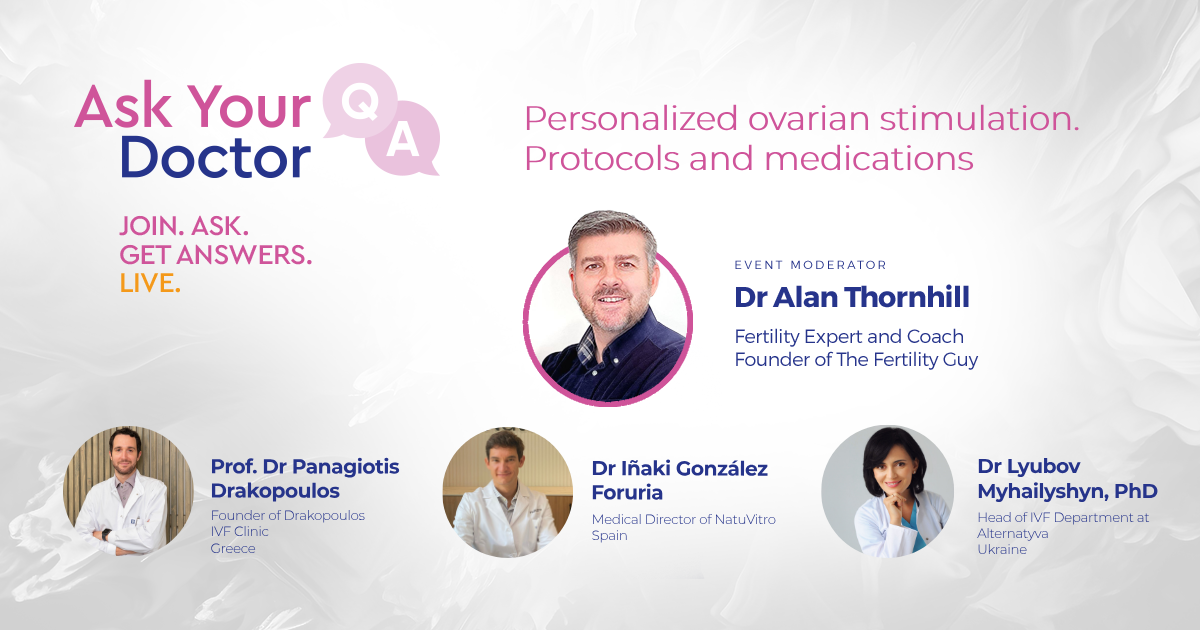
During this live Q&A, our experts discussed personalized ovarian stimulation, covering: different stimulation protocols and how they’re tailored to individual needs, medications used and their impact on ovarian response, as well as strategies to optimize IVF outcomes.
Featuring experts:
The event was hosted by: Professor Alan Thornhill, Fertility Expert & Coach, Founder of The Fertility Guy.
Prof. Dr Panagiotis Drakopoulos, Drakopoulos IVF: I’m Professor Drakopoulos. I’m located in Athens, Greece. I have a team, and I work as a collaborator. Furthermore, I collaborate with one of the biggest labs in Greece, called the Institute of Life. It’s IASO in Athens.
For me, personalized medicine is a term we use very often, sometimes without understanding what it means.
When we talk about infertility, I think it’s essential to be close to the patient. This is what we lack. Moving to Greece—because I was abroad for several years, in Switzerland and Belgium, working in public hospitals and university hospitals—I realized that private practice changes things. In private practice, we can truly be close to patients, understand their problems, and listen to them.
The issue today is that we don’t spend enough time with patients during consultations. We used to put patients on the same protocol without considering their background, age, or markers—what they need, and what their family plan is. Some patients, for instance, want to go through stimulation to build a family, not just have one baby. There are many aspects we can evaluate.
Dr Iñaki González-Foruria, NatuVitro Reproductive Centre: I’m also a gynaecologist. I’m based in Barcelona, and I’m currently the Medical Director at NatuVitro, a small clinic that started functioning just 3 years ago. I completely agree with Professor Drakopoulos. For many years, we haven’t had enough time to listen to our patients. Nowadays, we could say that personalization in medicine is not the future but the present—because we are all different.
We can see this clearly with cancer patients, for example. Cancer treatment depends largely on each case. This is also true in assisted reproduction and will likely apply to every step of the process. It won’t be the same to stimulate 2 different patients, and their luteal phase might also require different approaches. We have to understand the aims and preferences of each patient and adapt, using the best medical standards available at this moment. Of course, we must always rely on evidence-based medicine.
Dr Lyubov Myhailyshyn, PhD, Alternatyva: Firstly, it’s a great pleasure for me to be with you today. I have 22 years of experience in an IVF unit, and currently, I’m the Head of the IVF Department at Clinic Alternatyva, which is located in western Ukraine, so we are a bit safer than the rest of the country. Regarding my background, I worked for 8 years as a representative of Ukraine in the Committee of National Representatives of the European Association for Reproductive Medicine and Embryology (ESHRE).
As for the question of individualization of stimulation, we know there is huge individual variability among patients. We take everything into account—we discuss with them what they eat, their lifestyle, and what comorbidities they have. We even know that some vitamins, like folic acid or certain microelements, can have a negative impact if overdosed. Not only that, but we have studies showing this. Everything matters when we want to individualize treatment because even the same drug can act differently depending on where the injection is made. For example, in cases of abdominal obesity, some medications act more slowly compared to an injection given in the shoulder. All of us are trying to do our work in the best way possible.
Dr Lyubov Myhailyshyn, PhD, Alternatyva: I think this is a nice idea because it shortens the time frame—the period in which we harvest the oocytes. It allows us to collect the oocytes more quickly. However, it is still very controversial whether we get more euploid embryos in the second stimulation. At least, we don’t have evidence-based confirmation.
We suppose that perhaps the previous stimulation improves the response of the second stimulation, or even that during egg retrieval, the needle helps activate the ovary. We talk a lot about PRP now, and in a way, this is similar—thrombocytes are already present after retrieval, and we know about the QUADRA stimulation approach from Robert Casper.
We still use it because, in patients of advanced age, we don’t have much time. I think it’s a good option for this group of patients to shorten the time, and since we mostly use PGT-A in these couples, we freeze embryos anyway. So, I believe this is a good approach.
Dr Iñaki González-Foruria, NatuVitro Reproductive Centre: That’s a very good question. It’s something we see in daily practice. Firstly, in this case, we should know which protocol was used for stimulation. It’s not the same using a long agonist protocol—which was quite common in the past for endometriosis—or an antagonist protocol, or a PCOS protocol.
It would also be interesting to know what trigger was used in this cycle. This issue is likely related to the trigger, and it’s something that could be improved. It would also be useful to check which gonadotropins were used for stimulation. Most of the time, when we have a poor number of mature eggs, we can correct it to some extent. Sometimes, it’s a problem with the cycle itself. But in some patients, even when we change everything and try a completely different approach, the results remain the same.
From my perspective, nowadays, when we do IVF, we freeze almost all the time, and we systematically use a dual trigger—hCG and an agonist trigger at the same time. The only concern in this case is whether this patient should have been using LH activity during stimulation.
Dr Iñaki González-Foruria, NatuVitro Reproductive Centre: Normally, when people come for a second opinion, the first thing we have to do is be humble. Seeing a patient for the second time makes it easy to say that things were not done correctly, and people will believe you because you are in a privileged position. So, we must be humble, but at the same time, we have to be transparent with the patient.
As I said before, some factors will remain unchanged regardless of what we do, while others can be adjusted. Sometimes, results will be different simply because the cycle is different, not necessarily due to changes we make. However, for the patient’s peace of mind, we will make adjustments, aiming to find the best possible solutions. Still, we must also be honest that it may not always work. This is something we should explain to patients most clearly and transparently.
Prof. Dr Panagiotis Drakopoulos, Drakopoulos IVF: Contraceptives are a relatively controversial topic. Some studies suggest that pregnancy rates after using contraceptives are lower, while recent studies indicate this is not true.
I believe using contraceptives for scheduling is a perfect idea, followed by a freeze-all approach. I use contraceptives to schedule cycles—not just for the clinic’s convenience but also for the patients, for example, if they want to go on holiday. However, I do not perform fresh embryo transfers after contraceptive use due to concerns about its effect on the endometrium. For scheduling purposes, though, contraceptives are an excellent tool, and I use them very often in clinical practice.
Yes, I wouldn’t use them in a fresh cycle. However, given that 80–90% of cycles today are freeze-all, contraceptives still have a place in clinical practice.
Dr Iñaki González-Foruria, NatuVitro Reproductive Centre: This is one of the most common questions patients ask before starting stimulation: What will happen to me? Will I go crazy? Will I kill my husband?
In my experience, most patients expect the effects to be worse than they are. The stimulation period is short—typically around 10 days—so any changes are not long-lasting. I tell patients they can continue with their normal lives, but they may feel more bloated toward the end of stimulation, especially after the trigger shot, particularly if we use hCG.
If hCG is used, patients tend to feel more swollen on the day of egg retrieval and for a few days afterwards until the effect wears off. However, these hormonal changes are usually very temporary, and most patients can manage them without major issues.
Dr Lyubov Myhailyshyn, PhD, Alternatyva: I would use an antagonist protocol for this patient. With low progesterone, I’m not sure the LH level will be sufficient. So, I would stick to the antagonist protocol.
Frankly speaking, I like letrozole. You know that Nicholas McLain recently published a very nice study—a meta-analysis. We have known about these medications for decades, as we have used them in fertility preservation for oncological patients. We saw that estrogen levels remain low, but we were concerned about oocyte quality. However, McLain recently showed that in these patients, we can even increase the live birth rate by 7%.
I would use LH because we know it is extremely important for these women. I would avoid birth control pills unless it’s for a very short washout period, as we know they also reduce LH in these patients.
So, the protocol would include LH, with a 2:1 ratio of FSH to LH. I would also consider using aromatase inhibitors (AIs) with this approach. Additionally, it would include a double trigger—HCG combined with a GnRH agonist trigger.
I might also consider DuoStim for her. Sometimes, I also use what’s called “priming” with a very low dose of a GnRH agonist for 7 days in the luteal phase of the previous cycle. This can help the FSH rise slightly earlier and prepare the ovaries. I then stop it on the first day of the cycle and restart with FSH and LH, adding the antagonist at the appropriate follicle size. I would continue with a double trigger as well.
Prof. Dr Panagiotis Drakopoulos, Drakopoulos IVF: Regarding the highest dose, we have evidence that we should not go over 300 units per day. Sometimes we see patients on 450 or even 600 units per day, but for older patients above 40, a mild stimulation approach could be used.
Studies have shown that with mild stimulation compared to conventional stimulation, we get the same number of oocytes. Of course, it depends on the AMH and antral follicle count of the patient. If we consider a patient of 41 years old with low AMH and low antral follicle count, I usually use 150 units of gonadotropin per day, usually with some LH activity.
I think that, for sure, we should not exceed 300 units per day. Even with 150 units, we can definitely do our job in patients with low ovarian reserve markers.
Dr Iñaki González-Foruria, NatuVitro Reproductive Centre: The question is tricky. For those who may not know, DHEA is a precursor to testosterone. As women age, testosterone decreases, which impacts folliculogenesis and follicle development. DHEA has been suggested to improve follicle development, maturity, and egg quality. Research, including a randomized trial across Europe, has shown similar results using testosterone, the final metabolite of DHEA.
While DHEA can be used orally, evidence-based results don’t confirm it will improve outcomes. It’s safe to use, but we can’t guarantee it will work. As for age, it’s not about a specific cut-off age; we can use DHEA, but we cannot promise it will improve results. Regarding 44-year-old patients, we know live birth rates per cycle are 1-2%. It’s a difficult age group, and success is not guaranteed, though we’ve seen unexpected successes.
Dr Lyubov Myhailyshyn, PhD, Alternatyva: We know that in vivo, there are different types of LH activity, at least 50 isoforms. This makes the question complex. LH is key for stimulation because there are different types: recombinant LH, LH from highly purified HMG, and LH from chorionic HCG. Both HMG and HCG bind to the same LH receptor but have different actions. Recombinant LH works for cell proliferation and growth to prevent apoptosis, while HCG acts through steroidogenesis. Recombinant LH is more commonly used when we’re looking for follicle growth. If the patient is young and everything is normal, FSH could work just fine, especially if LH isn’t down-regulated by prolonged use of birth control pills, or if there’s no hypothalamic issue.
For older patients, especially poor responders, I would still use recombinant LH. In my practice, I use LH for all patients. We are still concerned about genetic polymorphisms that can affect stimulation. If I see a lack of response with FSH alone, I would add LH in the next stimulation cycle. Overdosing LH doesn’t seem to work, but I agree with Professor Drakopoulos that sometimes lower doses of gonadotropins give better results.
Dr Lyubov Myhailyshyn, PhD, Alternatyva: It’s complicated, but I would recommend that she tries at least because we don’t know the outcome. I would prescribe recombinant LH and recombinant FSH for stimulation. As for DHEA, she can try it, but I would first check her hormone levels. Regarding growth hormone, I might check the insulin-like growth factor and consider giving a small amount, provided there are no tumours or fibroids. I would discuss the option of double triggering and consider if she might have PCOS, hoping she could have enough eggs and potentially a euploid embryo. However, if her AMH is very low, like 0.1, I would recommend egg donation.
Prof. Dr Panagiotis Drakopoulos, Drakopoulos IVF: Based on studies and meta-analyses, we don’t see an association between IVF treatment and an increased risk of cancer. After age 40, I personally recommend a breast ultrasound or mammography for my patients. There is no upper limit of IVF cycles after which the risk of cancer increases, and I don’t have a specific cutoff regarding the number of IVF treatments.
Prof. Dr Panagiotis Drakopoulos, Drakopoulos IVF: Based on my personal experience, I would say 5 or 6 cycles is the upper limit for IVF, depending on the outcomes. It depends on the response, what we get from each cycle, and various other factors. For example, a 43-year-old who has already undergone four stimulation cycles might only get one more cycle before I recommend egg donation.
However, a 36-year-old who has had three cycles without PGT-A testing and poor-quality embryos could still try a few more cycles. The history of the patient, their age, the protocols used, comorbidities, and the outcomes all play a role in deciding the next steps.
Prof. Dr Panagiotis Drakopoulos, Drakopoulos IVF: In Greece, the age limit for using both your own eggs and donor eggs is 54. So, theoretically, a 49-year-old could still be offered IVF if she wishes. However, IVF using her own eggs, becomes impossible at 54. Legally, the cutoff age for both treatments is the same.
Dr Iñaki González-Foruria, NatuVitro Reproductive Centre: In Spain, the law is not very clear regarding the age limit for egg donation, as it refers to the natural age of menopause. However, the Spanish Society of Fertility has set 50 as the age limit for egg donation and IVF. Each clinic may have its own cutoff and protocol. Ovarian PRP is still a topic of investigation, but it shows some promise in improving egg quality in certain cases.
Regarding the PRP, for all the audience who might not know, P is the plasma or the platelet-rich plasma, which comes from a blood sampling, is purified, and then used in different types of medicine. It has been really useful in traumatology, orthopaedics, and also in cosmetics and dermatology. Now, we are starting to use it in assisted reproduction, in the ovaries, to improve the response of the ovary and the quality of the eggs. That’s the idea. Some other centres also use it in the endometrium to improve its thickness or receptivity.
The evidence is indeed quite scarce at this point. From my perspective and experience, the PRPs that might work are those performed on younger patients—patients who are 30, 32, or 35 with premature ovarian failure. It is still to be decided whether the improvement comes from the PRP itself or from the trauma created in the ovary and the activation of the hypo signalling, which induces the activation of primordial follicles within 2 or 3 months. However, it is not effective for 45-year-old patients, unfortunately.
Dr Lyubov Myhailyshyn, PhD, Alternatyva: Yes, we do perform PGT-A testing.
From studies, we know that the aneuploidy rate differs significantly from laboratory to laboratory and clinic to clinic. This study showed that a lot depends on the stimulation, the preparation of the patient, the type of stimulation, and what happens in the laboratory.
Regarding PGT-A as a method, we know that some errors can occur because we take only 5 to 10 cells from the trophectoderm, and we are not sure whether the whole embryo is the same, including the inner cell mass. Two famous studies—one from Daniel Sakkas and another from Santiago Munné —showed that in younger patients, the cumulative live birth rate was lower with PGT-A, possibly due to these so-called mistakes. However, in older patients, we recommend PGT-A, especially at the age of 41.
Maybe the dosage was too high. Some studies, not necessarily about PGT-A but about metabolic changes in the ovaries, suggest that strong stimulation can negatively impact embryo quality. So, we need to analyze this case carefully. Maybe something went wrong in the laboratory because having 10 embryos and none of them being healthy is unusual. We should also consider the male factor—perhaps the husband has a very high DNA fragmentation rate.
Regarding your last question, yes, definitely, I would agree. Studies confirm that low-dose and high-dose protocols result in similar euploid rates.
Prof. Dr Panagiotis Drakopoulos, Drakopoulos IVF: Thanks to PGT-A, we now have meaningful outcomes for patients. What I mean is that we know the optimal number of oocytes needed to obtain 1 euploid embryo, which I always use in consultations. Patients understand this concept.
I strongly recommend PGT-A to all my patients over 38. Why? Because it provides answers. We can also explain to patients how many oocytes they need. Maybe they can achieve this number in one cycle, maybe 2, or maybe 3. I try to reach this optimal number based on age and various markers to maximize the probability of obtaining at least 1 euploid embryo.
This also makes it easier for patients to move to other options, like egg donation if needed. For example, if a 42- or 43-year-old patient comes in and does not want PGT-A but just wants a transfer, there is a high chance the transfer will fail. However, if we perform PGT-A and see only aneuploid embryos, it helps the patient understand the issue and move forward.
Dr Iñaki González-Foruria, NatuVitro Reproductive Centre: Many patients ask about it, maybe because they have asked someone else before, have a nutritionist who recommended something, or were already taking supplements by themselves.
It’s nice because we have recently launched a guideline on supplements in the Spanish Fertility Society, and we tried to summarize each of the supplements very easily in a traffic light system: the green light, the orange light, and the red light. Almost all of them were orange.
Orange means that there’s not enough evidence to suggest taking those supplements to improve outcomes. I’m talking about vitamin D, melatonin, coenzyme Q10, omega-3—many supplements. This doesn’t mean they might be dangerous, and this is something we should tell our patients. You can take them but do not rely on them to create real changes in the outcome of the cycle.
If we had 1 failed attempt where we expected better results, we would wait for a second cycle. When we do the second cycle, we have to change things—maybe because it works, maybe because the patient needs to change something, rather than doing the same thing over and over and expecting different results. That’s insane.
So, when patients ask us about supplements, we tell them:
Either you can take individual pills, or you can use combined supplements that include all of these together. Unfortunately, according to the literature, the evidence is quite scarce, so we cannot recommend them as a real solution to these problems.
We cannot say whether taking 1,000 mg of coenzyme Q10 per day is too much and if 200 mg is beneficial.
As with most things in medicine and pharmacology, you have your therapeutic window. If you exceed it, it’s probably harmful. If you go below it, it’s probably useless. But with supplements, we don’t know what that window is.
For example, we have more dosage information when it comes to gonadotropins. As Professor Drakopoulos said before, if we exceed 300 units, it’s probably useless and might even be harmful in terms of ovarian response. But it’s not the same for supplements—we cannot say the same.
Prof. Dr Panagiotis Drakopoulos, Drakopoulos IVF: I think there has been a survey regarding dose adjustments during IVF, and it seems that 4 out of 5 doctors make these adjustments during IVF. I am against these adjustments. I believe we should choose the right dose from the beginning, and if we think LH supplementation is required, we should start it from the beginning.
However, sometimes, when we use the antagonist protocol, we see the patient on day five or six of stimulation and notice a suboptimal response. At that point, we have two options: either we increase the dose or we add LH activity. I never decrease the dose because, in an antagonist protocol, we are in a safe mode. We can always trigger with an agonist and practically eliminate the risk of ovarian hyperstimulation. Some patients still believe they may suffer from ovarian hyperstimulation syndrome.
To answer the question—dose adjustments are done by many doctors, but personally, I don’t believe they have a role except in specific cases. We should choose the right protocol and the right dose from the beginning, rather than adjusting the doses during stimulation.
Dr Lyubov Myhailyshyn, PhD, Alternatyva: I truly believe we need to stop freezing embryos on day 3. From what we know, laboratory evidence suggests that keeping embryos in culture until day 5 does not harm them.
There was a very interesting study published by Santiago Munné in Human Reproduction in 2018. It was an ethically complex study, but what they did was inseminate women and then wash out the embryos from the uterus. These embryos were compared to embryos obtained in the lab through IVF and stimulation. The results showed no statistically significant difference in the aneuploidy rate between blastocysts obtained from the uterus and those grown in the lab. There was only a slight increase in mosaicism in embryos grown in the laboratory.
This suggests that our culture media and incubators do not harm the embryos. So, we do not expect that an embryo will be of better quality on day 3. We are not “losing” embryos by keeping them in the lab until day 5. In my daily practice, we don’t freeze on day 3 anymore.
Dr Iñaki González-Foruria, NatuVitro Reproductive Centre: Not really at the moment. We are not using algorithms or artificial intelligence for stimulation. But I think I would like to address this question not just in stimulation, but also in general medicine.
Our work has two different parts that are attached. One is the knowledge, the know-how—how we deal with a certain problem in medicine. Artificial intelligence will easily be superior to humans in this regard, and this is something we have to understand. However, the second and equally important part is the human touch. Many doctors are losing this because we don’t have time to be with our patients, listen to them, or talk to them.
When you explain things—even if you don’t have a clear solution—at least patients understand what is happening, and that is part of the solution. If we lose this part, we are lost as doctors because artificial intelligence will do the rest, but it will not provide human touch. This is crucial, especially in our field, where we often act as psychologists as well.
I think we will reach that point. We have already seen it in other fields, not just in medicine, but also in economics and other industries.
Prof. Dr Panagiotis Drakopoulos, Drakopoulos IVF: There have been a few studies, but not many. In the lab, AI has been used more extensively for embryo development. Regarding stimulation, some studies have explored AI for determining the best day to trigger ovulation or the starting dose of medication.
I don’t use this type of algorithm. I don’t think we are there yet. Furthermore, I do see the potential for AI in deciding the trigger day, especially in very busy clinics, but otherwise, as doctors, we are capable of choosing the right dose for each patient. AI will likely help with stimulation in the future, but for now, I don’t think we are at that stage.
Dr Lyubov Myhailyshyn, PhD, Alternatyva: Frankly speaking, I don’t use AI in my daily practice. However, there are still open questions regarding the trigger. We know that follicles don’t grow simultaneously—some are larger, some are smaller. Some studies have explored dual triggers, administering one trigger earlier and another a few hours later to improve egg maturity.
But everything depends on the data used to train AI. High-quality studies need to be integrated into these systems because, ultimately, AI will make decisions, not us. Before we rely on AI, we need to provide it with high-quality studies and ensure that expert professionals design these programs. In the future, AI may play a role, but for now, it’s too early. I completely agree with Dr Iñaki and Professor Drakopoulos that the psychological connection with patients is crucial.
Patients want to talk, they want to understand everything, and it’s easier to work with them when they are informed.


+ 1 more answers

+ 4 more answers

+ 2 more answers

+ 10 more answers
Necessary cookies are absolutely essential for the website to function properly. This category only includes cookies that ensures basic functionalities and security features of the website. These cookies do not store any personal information.
Analytical cookies are used to understand how visitors interact with the website. These cookies help provide information on metrics the number of visitors, bounce rate, traffic source, etc.
| Cookie | Duration | Description |
|---|---|---|
| _ga | 2 years | This cookie is installed by Google Analytics. The cookie is used to calculate visitor, session, campaign data and keep track of site usage for the site's analytics report. The cookies store information anonymously and assign a randomly generated number to identify unique visitors. |
| _gat_UA-38575237-21 | 1 minute | No description |
| _gid | 1 day | This cookie is installed by Google Analytics. The cookie is used to store information of how visitors use a website and helps in creating an analytics report of how the website is doing. The data collected including the number visitors, the source where they have come from, and the pages visted in an anonymous form. |
Any cookies that may not be particularly necessary for the website to function and is used specifically to collect user personal data via analytics, ads, other embedded contents are termed as non-necessary cookies. It is mandatory to procure user consent prior to running these cookies on your website.
Other uncategorized cookies are those that are being analyzed and have not been classified into a category as yet.
| Cookie | Duration | Description |
|---|---|---|
| _gat_FSQM52 | 1 minute | No description |
| cf_ob_info | No description | |
| cf_use_ob | No description |