


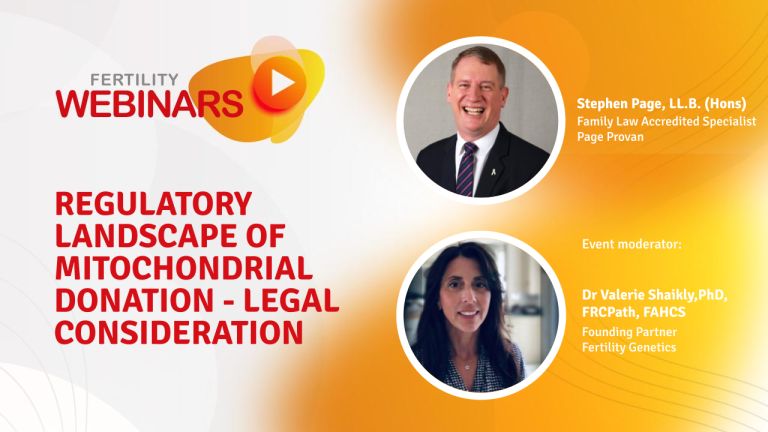
During this event, Professor Ansley Newson, a Bioethics expert at the University of Sydney discussed
bioethics and the ethical principles surrounding modern reproductive technologies and their impact on families and society as well as explained mitochondria and mitochondrial diseases, their role in human health, how mitochondrial diseases are inherited, and their impact on affected families.
Finally, Professor Newson explained key ethical questions around this innovative technology, including genetic inheritance, implications for future generations, and donor anonymity in mitochondrial donation.
The event was hosted by: Valerie Shaikly, PhD, FRCPath, FAHCS, Founder Partner of Fertility Genetics.
Professor Ansley Newson started her presentation by clarifying the scope of her presentation is focused on the perspective of considering mitochondrial donation techniques as an intervention to prevent the birth of children with mitochondrial disease not about the use of this technique as a way of other uses. Where mitochondrial donation is specifically regulated, that particular use as a fertility add-on is out of scope, and it is not recommended at this point by bodies such as the European Society for Human Reproduction and Embryology (ESHRE).
Bioethics is a field of inquiry; where the values and moral issues that happen in healthcare, research, and population health, and we offer a way of thinking through difficult issues where there might be likely to be a conflict or a concern. Questions like “Should,” “Must,” or “Ought” come up, and those types of questions use ethical reasoning and ethical argumentation. Bioethics try to justify what should happen in a particular situation and on what grounds.
A couple of methods are used in this field. One is called empirical bioethics, and that’s looking at what is going on—what’s happening in a field, what do people think? This obtains descriptive information, facts, and evidence, and usually, you can show that this is true or untrue using ways of interrogating the quality of that research from a methodological perspective. The other way that is undertaken in the research in ethics is the “ought” or the normative. This is value-laden. Bioethics try to get to the heart of the issues from an ethical and moral perspective, and they generate prescriptive (as in “this is good, we should do this”) or proscriptive (this is not good, we should not do that) statements. They defend those by looking at key concepts, and key moral theories, and engaging with the scholarship of others in the field, evaluating, using arguments.
Mitochondria are the so-called energy powerhouse of a cell. They are what’s called an organelle or a mini organ within our cells. They have their DNA, separate from the nucleus. Humans have chromosomes within their cells, but there is also DNA in mitochondria, and it’s arranged into 37 genes. There can be up to thousands and thousands of mitochondria in most people’s cells, not all of them, but there can be a few or a lot. They’re really important in doing functions like energy generation.
A really interesting aspect of mitochondria is that they don’t appear generally—or they appear in very small numbers in sperm, but they’re mainly in oocytes or eggs. As a result of that, they are only really passed down from mothers to their children, not by male reproductive partners. They have a lot of really important roles in how human bodies work. The technology of mitochondrial donation only pertains to problems with mitochondria that exist in mitochondrial DNA.
Mitochondrial donation is designed initially to help people who have mitochondrial disease themselves avoid transmitting this to their children.
Mitochondrial disease is, as the Australian Mito Foundation uses the slogan: “any symptom in any organ at any age,” so it’s a really diverse range of conditions, and this can make it tricky to diagnose.
Mitochondrial disease can be caused by either mutations in mitochondria or mutations in the nuclear DNA. They can just set aside nuclear DNA mutations for mitochondrial gene changes that cause disease for the moment because mitochondrial donation technology is set up only for mutations in mitochondria. There are other things we can think about if a mutation is in the nucleus.
It has been mentioned that there are probably a lot of people walking around on this planet who have mitochondrial disease and don’t know it, either because their health professional hasn’t thought about mitochondrial donation or because they’re not sick enough to warrant a diagnosis at this point. But it is quite a complex thing, and as well as developing treatments for mitochondrial disease, experts are attempting to help increase diagnosis rates as well.
There are a couple of different names for mitochondrial donation, and, in bioethics, there’s debate over what it should be called as well because different names might bring with them different imagery or different meanings. They are often called mitochondrial replacement therapy, mitochondrial replacement techniques, mitochondrial replacement, mitochondrial donation, human nuclear genome transfer, which is what some bioethicists have called it, and a term you might have seen in the media more than anywhere else is “three-parent babies.”
The first issue is whether mitochondrial donation is a so-called “want” or a so-called “need”. This is something that is sometimes used as a way of distinguishing maybe something that’s a moral imperative or a need, or something that’s maybe morally permissible but not a moral imperative. For example, the key reason why the mitochondrial donation was developed, is the very natural and understandable desire that most humans have if they want to have children and can have them, to have children that are genetically related to them.
Mitochondrial donation came about as a way to help people who are at risk of passing on mitochondrial disease. Usually, they have to have oocytes or eggs. They may not necessarily be people who identify as women, but this allows a child who ideally is free of mitochondrial disease but retain a genetic relationship through nuclear DNA with both parents. There are other ways that you can have a child without mitochondrial disease, but that involves egg donations, so that the genetic relationship would be lost, or adoption, where there wouldn’t be a genetic relationship with either parent.
We want to be able to offer people at risk of transmitting mitochondrial disease the option to have a child if they wish to, but at the same time, it’s always going to be challenging choices when their form of mitochondrial disease is inherited through their mitochondria.
Everybody in my bioethics field endorses that genetic relatedness is important. Does this possibility of having a genetically related child justify the use of a reproductive technology, mitochondrial donation, when its long-term safety has yet to be proven? It is not yet possible to guarantee that the safety of mitochondrial donation is proven because we just haven’t had enough children born with it over the years. The question is: how safe is safe enough, and who gets to decide this?
In the field, there could be an argument that experts should decide this, or, if there’s a safety threshold met, should the argument be that parents should decide this instead? Ultimately, we need to take care and try to manage some of the significant hope that surrounds the technology and ensure that we accurately represent to parents that it is still a technology that doesn’t have a lot of long-term data around it. We need to make sure that we don’t overhype the technology.
Another attribute of this technology is that, because we are changing the total complement of genetic material in a cell, it’s not a technology that makes changes at the level of DNA, but we are taking out certain mitochondria—those that pose the risk of mitochondrial disease—and putting in some mitochondria from a donor oocyte, or actually, you’re using the donor oocyte as a shell. The change to the composition of the genome of the person who’s born as a result of this technology could then be passed to their children as well, if they’re female, because of the inheritance from mothers to their children.
Experts tend to argue that this is a form of germ-line gene therapy and that this is not something—germ-line gene therapy generally is not something that we usually condone—because of grounds like its uncertainty, its safety considerations, and the inability of people to consent, that is, those who are born being unable to consent. If there is harm as a result of this technology, we want to try and ensure that that harm is not then transmitted down through generations. There’s been a bit of debate in the field of mitochondrial donation about how that might be secured. How should this potential heritability of the changes to the genome that are made factor into the debate?
There are some conflicting claims. Some say that mitochondrial DNA is not very significant, it’s just like swapping out a battery for something—a new battery that works a bit better. The number of children that are going to be born as a result of this technology, at least in the early years, is very small, so any impact of any potential harm is going to be small. We just need to think here about the significance of potential passing on what that might mean, and how that should factor into the debate.
Another issue that has been very prevalent in the debate, particularly in Australia, is whether oocyte or egg donors for mitochondrial donations should be anonymous. Australia is one of the first countries globally to remove donor anonymity generally in other forms of gamete donation, and it’s been done that retrospectively in some states of Australia. For mitochondrial donation, in the debate in some countries globally, there were arguments that because it was just mitochondria—that is, only 37 genes per mitochondrion—a responsibility for energy generation, it’s not the same as standard egg donation, and that as a result, it could be anonymous.
The direction that the debate took was to recognize the significance of the donation. It’s significant for the donor; the process that they go through is the same as for standard egg donation. And for the child, it has a massive impact because, if it works as intended, it would make the difference between whether a person is born and will go on to develop mitochondrial disease or not. That, combined with the growing global recognition of the right of a child to know their genetic origins, meant that in Australia, a decision was made to build non-anonymity, as in identifiability, into the donation process, and the safeguards that are in place in regulation—which is currently a clinical trial—enable the child to find this information out as they grow older.
Another debate that you might see in lots of forms of intervening to prevent the birth of a child with a genetic condition is that of disability rights and whether the existence of mitochondrial donation devalues the lives of those with mitochondrial disease, or doesn’t mean that the lives of those with mitochondrial disease are of less value because of trying to avoid having a child who will go on to develop that. We need to think here carefully about the impact that a choice to have a child free of mitochondrial disease might have on those living with the condition of mitochondrial disease.
Another debate that you might see in lots of forms of intervening to prevent the birth of a child with a genetic condition is that of disability rights and whether the existence of mitochondrial donation devalues the lives of those with mitochondrial disease or doesn’t mean that the lives of those with mitochondrial disease are of less value because we’re trying to avoid having a child who will go on to develop that.
We need to think here carefully about the impact that a choice to have a child free of mitochondrial disease might have on those living with the condition of mitochondrial disease.
There is wide agreement that these are serious genetic conditions, and that includes people living with mitochondrial disease. Those individuals are some of the key people who advocated for the legalization of mitochondrial donation, first in the United Kingdom and then in Australia. According to Professor Newson, the key thing to do is to look at the experiences and attitudes of people who’ve experienced mitochondrial disease and to let their lived experience guide development in the field. Providing support for people who live with the condition can still be maintained, and respect and avoidance of stigma and discrimination are still incredibly important.
Another aspect of the debate is surrounding equity and value for money. In the debates over mitochondrial donation, there was some discussion in the early days about the potential cost of this technology and whether it was justified to have that expense in comparison to other needs in the healthcare system. It is an expensive technology, as most assisted reproductive technologies are, but on the other hand, there will be small numbers of people who will be accessing it in the early days at least. For those who do access it, the impact could be incredibly positive if it works as intended, and as a result, it could save other costs in the future. Families of children with mitochondrial disease or families caring for adults with mitochondrial disease take time off work, so they lose income.
Those costs can be traded off and compared with each other. There is also an equity consideration around the estimates that mitochondrial donation is quite underdiagnosed in the population at the moment. The mere existence of mitochondrial donation and the public debate that happened around it is quite interesting because it means that being able to access this technology or the debate over whether it should become available.
Professor Newson also mentioned that they ran a series of citizens’ juries in Australia to ask ordinary members of the public what they felt about public funding for mitochondrial donation. All three juries that they ran supported public funding for mitochondrial donation with a few conditions. They felt that it was good value for money to offer it, it was fair to publicly fund it as opposed to only allowing those who could afford it to pay for it, and that it would also allow for more scientific innovation. However, they wanted an external review of the costs to prove that it was cost-effective. They didn’t want people to undergo unlimited cycles of mitochondrial donation, and they also wanted other pathways to parenthood, such as egg donation and adoption—to also be better funded and better promoted.
There have been between 1 and 4 babies born in the United Kingdom as a result of this technology. The professionals involved and the regulator involved have been deliberately vague about that to take every measure to protect the privacy of the child and their family. One thing that is known is that children born as a result of this technology, at least in the early years of the technology, are going to be subject to follow-up and will need to undertake some additional checks to ensure that the technology has worked as intended, that they’re not developing mitochondrial disease, and that there are no other untoward effects.
If their identity ever becomes known, there’s also likely to be significant media interest in that child and their family. Therefore, from an ethical perspective, it’s important to ask: what will that be like for the families and the children? How should the children be told about their origins, and how should the interests of these children be protected?
I think it came from early media reports. Someone without detailed knowledge of the technology, but keen to engage the public, may have looked at the genetic contributions to a child. Technically, a child born from mitochondrial donation has three genetic contributors: the parent providing the sperm, the parent providing the nucleus from the egg, and the parent providing the mitochondria in the egg.
However, the term “three-parent baby” is misleading because parenting is a social role. Many people have more than 2 parents. If you’re from a separated family where your parents have remarried, you could have 4 parents. If your parents are a same-sex couple, you likely have your social parents and a donor.
We also often have more than 2 genomes in our body. For example, if you’ve had an organ or bone marrow transplant, you carry someone else’s DNA. If you have an infection, you carry DNA that isn’t yours. So, this idea of “three parents” is not about 3 people in a household raising a child. Even if there were 3, that’s fine—many families function that way.
The term does highlight the significant contribution of mitochondrial DNA. Though it consists of only 37 genes, it plays a crucial role in determining whether someone has mitochondrial disease. It’s a small amount of DNA, but it is incredibly important.
The term may have been designed to elicit a response. As ethicists, our job is to unpack these terms, question their conceptual basis, and consider the responses they provoke. While it’s a sensationalist term with some imagery, it’s more useful to focus on the broader issues I discussed in my presentation.
Some scientists I collaborate with use that to counter the narrative. It’s good to hear it resonates with you as a scientist.
In the United Kingdom, there’s one centre licensed to provide this technology, and it’s the same centre that conducted most of the prior research. In Australia, it’s currently allowed under a research protocol. A competitive grant was awarded to a consortium based at a university in Victoria, though there were several bids.
Every bid I’m aware of involved international collaborators in some capacity. The successful consortium includes team members with global connections. There are ongoing global conversations to share expertise and experiences, which benefit patients in the long term as outcomes are discussed and shared.
It’s a tough issue. We know it’s happening in some places, likely due to regulatory gaps rather than explicit permission. If someone is considering using this technology in such circumstances, they should know it’s not yet recommended by any professional society.
It’s important to ask about the evidence supporting the procedure and ensure there are services for follow-up. This is a significant intervention in an early embryo, depending on the technique, and not something to take lightly.
For identifying donors and recipient protocols, specific guidelines depend on the regulatory framework of the country and the clinic offering the procedure. Prioritizing couples needing the procedure involves assessing medical necessity, such as in cases where there’s a significant risk of passing on mitochondrial disease. Further discussion would require understanding the specific context of the question.
I can provide some information after the fact if you want, but in Australia at least, it more or less mirrors the regulation for children born of other forms of gamete donation. In Australia, we have regulations for the offer of all assisted reproductive technologies that all clinics, whatever they’re doing, are required to adhere to. When mitochondrial donation was legalized in Australia, those guidelines were amended to include a separate chapter about mitochondrial donation. A clause within that chapter states how children born of mitochondrial donation can, in due course, access information about their donor.
I believe the UK has taken a slightly different approach. It’s more about a voluntary register for mitochondrial donation. I think Australia went further regarding the identifiability of donors than the UK did, but this could also change with time. I think that information is all in the public domain about how it’s regulated and how people find information. At least in Australia, a decision was made that people need to know they were born as a result of this intervention.
However, in Australia, the trial has only just started in the last 12 to 18 months, and there has been no announcement of any children born in Australia yet. So, that’s a bit of a fudgy answer to your first question, but those regulations do exist; I just don’t have them front of mind.
This is a small pool of patients in Australia. Based on UK data from the centre licensed to provide this technology, they estimated around 60 families per year might be interested in using it. In Australia, we have about 300,000 babies born each year, so this represents a very small proportion of couples able to have a child annually.
For each family, there would likely be a process involving counselling to learn about the technology. Some might decide they’re happy the technology exists, but won’t move forward with it for various reasons. Others might choose to proceed. Australia has set requirements around the severity of the condition and other considerations to determine eligibility.
Beyond that, it would be a question of capacity and budget. At the moment in Australia, once recruitment begins, it will be provided under a research protocol. You raised a really good point: if demand exceeds capacity—whether due to limited clinical provision or insufficient funding—how do you prioritize, and on what grounds?
This is a challenging question, and there’s a branch of bioethics focused on addressing such issues. Potential considerations might include who has the best chances of success, who has been waiting the longest, or who is the oldest, given their limited time to try the technology. Alternatively, if there are many people with equal qualifications, a lottery system might be used.
What’s important is that any prioritization process remains transparent and fair, ensuring people understand why they’ve been placed in a particular position in the queue. Ideally, even with small numbers, any couple interested in mitochondrial donation would have the opportunity to explore it.
In the UK, how it works is that each case requires a specific license. For example, they look at factors like ovarian reserve and the severity of the condition. By April 2023, 32 patients had been approved. However, funding is an issue, as it’s NHS-based. Other criteria, such as BMI, may also be factors. Regarding anonymity, in the UK, mitochondrial donors are registered, but only non-identifying information is provided to the recipient. Unlike egg and sperm donors, identifying information isn’t available at age 18.
In Australia, it is currently the same. I can quickly look up the regulation, as I don’t want to give misleading information. This was a key point of contention when I sat on a committee providing advice to the government.
The committee answered several questions, deliberated for almost a year, and conducted extensive public consultations. This included a citizens’ jury and a survey-based analysis. Based on these findings, I advocated for egg donation for mitochondrial donation to be treated the same as other forms of egg donation.
Although mitochondrial DNA constitutes a small part of a person’s DNA, it plays a critical role, and our understanding of mitochondria is evolving. For example, mitochondrial mutations can cause various diseases, and there may be potential links to conditions like Parkinson’s.
While this information is dynamic, promoting transparency is crucial. Treating it as a donation could benefit both the donor and the person born as a result of this technology. It might be incredibly meaningful for both parties to have the option to connect in the future.
I had a slide in actually that I took out, which was about the status of the embryo, or the moral status of the embryo. Like many forms of assisted reproductive technology, mitochondrial donation does involve embryo destruction and probably embryo discard as well. Because, of course, once the mitochondrial donation process has happened, then it just kind of turns into normal IVF. There are measures of embryo quality, which Valerie will know much more about than me. Then, you have to choose which embryos to implant, with a view to them hopefully implanting.
There was some debate in Australia about the fact that this was a technology that led to embryo destruction. Everybody involved in the debate was attempting to be mindful of that. I guess the comparator that we used was the fact that nothing raised here was unique or distinct over and above how we already think about embryos in assisted reproduction.
I guess the only thing is, you know, for the bioethics nerds out there, I think you could make an argument that pronuclear transfer is a kind of form of cloning, although obviously, the recipient isn’t a clone of the donor at all. But some of the techniques marry up, and there are one or two papers written about that.
Ultimately, where the debate landed in Australia was this: this is something we do all the time. We are as respectful as we can be to the status of an embryo. We take it seriously. We’re not using it frivolously. We’re doing it for families who have a debilitating condition and want to do something to try and avoid it.
I think it was handled sensitively. That said, when there was any call for submissions—there was a call for submissions to the Senate inquiry—there was a public deliberation about this technology at numerous points. There was always a collection of submissions that were opposed to the technology because an embryo is important, and we shouldn’t do anything more than we’re already doing to them, or we shouldn’t be doing it at all.
I think, I suppose, it will vary from country to country if the technology is adopted because, in some countries, even in IVF cycles, you can’t create more embryos than you can use, or that you think will grow to give you a good chance. So, I expect it will probably vary.


Necessary cookies are absolutely essential for the website to function properly. This category only includes cookies that ensures basic functionalities and security features of the website. These cookies do not store any personal information.
Analytical cookies are used to understand how visitors interact with the website. These cookies help provide information on metrics the number of visitors, bounce rate, traffic source, etc.
| Cookie | Duration | Description |
|---|---|---|
| _ga | 2 years | This cookie is installed by Google Analytics. The cookie is used to calculate visitor, session, campaign data and keep track of site usage for the site's analytics report. The cookies store information anonymously and assign a randomly generated number to identify unique visitors. |
| _gat_UA-38575237-21 | 1 minute | No description |
| _gid | 1 day | This cookie is installed by Google Analytics. The cookie is used to store information of how visitors use a website and helps in creating an analytics report of how the website is doing. The data collected including the number visitors, the source where they have come from, and the pages visted in an anonymous form. |
Any cookies that may not be particularly necessary for the website to function and is used specifically to collect user personal data via analytics, ads, other embedded contents are termed as non-necessary cookies. It is mandatory to procure user consent prior to running these cookies on your website.
Other uncategorized cookies are those that are being analyzed and have not been classified into a category as yet.
| Cookie | Duration | Description |
|---|---|---|
| _gat_FSQM52 | 1 minute | No description |
| cf_ob_info | No description | |
| cf_use_ob | No description |