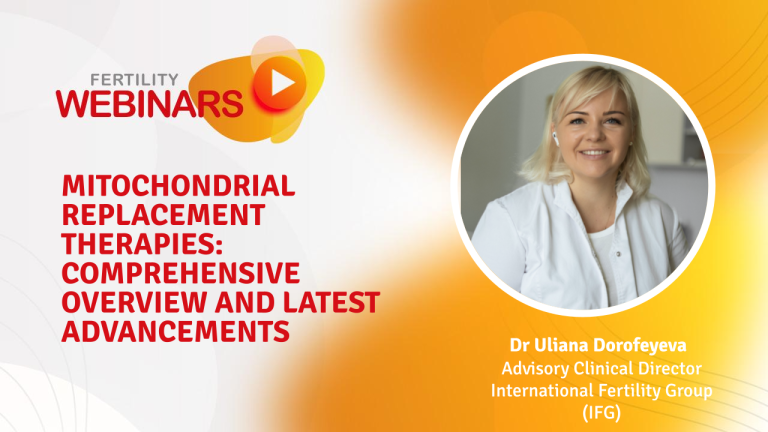
Mitochondrial Donation, also known as Mitochondrial Replacement Therapy (MRT), is an innovative fertility treatment that has attracted significant attention over the past decade. In this session, Dr Uliana Dorofeyeva shared clinical experience, data, and real patient success stories illustrating how MRT is being used in practice for patients facing repeated IVF failure, poor embryo development, or advanced maternal age.
Understanding Mitochondrial Donation: why it matters in IVF
Dr Dorofeyeva explained that MRT is designed to address problems within the intracellular environment of the egg, particularly the mitochondria. Mitochondria are responsible for energy production and play a crucial role in fertilisation, embryo development, and early implantation.
She discussed how, with increasing maternal age or repeated IVF failure, mitochondrial function may be impaired. This can lead to poor fertilisation, embryo arrest, or high rates of chromosomal abnormalities.
According to Dr Dorofeyeva, MRT aims to preserve a patient’s nuclear DNA while replacing the cytoplasmic environment with that of a healthy donor egg, thereby improving developmental potential without changing genetic parenthood.
Two main MRT techniques used in clinical practice
Dr Dorofeyeva described two established MRT techniques currently used:
Maternal spindle transfer (MST)
This technique involves removing the nuclear spindle from the patient’s egg and transferring it into an enucleated donor egg. The reconstructed egg is then fertilised with the partner’s sperm.
Pronuclear transfer (PNT)
In this approach, both patient and donor eggs are fertilised first. The pronuclei from the patient’s zygote are transferred into the donor zygote that has had its pronuclei removed.
Based on the presented data, Dr Dorofeyeva explained that no statistically significant difference was observed between MST and PNT in terms of fertilisation, blastocyst formation, clinical pregnancy, or live birth rates, once adjusted for female age.
Who may benefit from mitochondrial donation
Dr Dorofeyeva outlined patient groups that may benefit from MRT beyond those with inherited mitochondrial disease:
• Patients with repeated IVF cycles and fertilisation failure
• Embryo development arrest at early stages
• Repeated IVF cycles with no euploid embryos
• Advanced maternal age with limited egg numbers
• Recurrent implantation failure or pregnancy loss
• Patients wishing to avoid egg donation for personal, ethical, or religious reasons
She emphasised that MRT is not a universal solution and requires careful patient selection, extensive counselling, and informed consent.
The importance of laboratory expertise and donor egg selection
A recurring theme in the presentation was that MRT is highly operator-dependent. Dr Dorofeyeva stressed that excellent laboratory conditions, advanced micromanipulation skills, and strict donor selection are essential.
Donor eggs are chosen based on proven fertility outcomes, not patient matching, as the donor contributes cytoplasm rather than nuclear DNA. Fresh donor eggs are always used for MRT procedures.
Success stories: real patient journeys with MRT
Dr Dorofeyeva shared ten detailed patient cases to illustrate how MRT works in real life. These stories varied widely in age, ovarian reserve, treatment duration, and outcome.
Patient aged 42 with recurrent pregnancy loss
After multiple IVF failures, one stimulation cycle produced four mature eggs and one euploid blastocyst. Due to medical indications, the embryo was transferred to a surrogate, resulting in the birth of a healthy baby boy in February 2025.
Patient aged 44 with repeated embryo arrest
Despite good ovarian reserve, previous embryos consistently arrested. 2 MRT cycles produced 7 euploid embryos in total. The first transfer led to the birth of a healthy baby girl, with additional embryos frozen for future use.
Patient aged 37 with diminished ovarian reserve
After more than 10 failed IVF cycles across several countries, 1 retrieved egg was used for MRT alongside donor eggs. A genetically normal embryo from her own egg was transferred, resulting in the birth of a healthy baby boy.
Patient aged 43 with implantation challenges
Despite multiple euploid embryos and complex endocrine and immunological issues, both the patient and her surrogate became pregnant after tailored preparation and repeated transfers. Both pregnancies progressed successfully into the third trimester.
Patient aged 45 after 7 years of IVF
14 previously frozen eggs resulted in 3 euploid embryos after MRT. The patient achieved a successful ongoing pregnancy following transfer.
Patient aged 47–48 with preserved ovarian reserve
3 cumulative cycles produced 7 zygotes and a 50% euploid rate. Embryos are currently prepared for transfer, with implantation expected based on favourable uterine factors.
Patient aged 45, single mother by choice
After multiple failed IVF attempts, cumulative cycles produced 2 euploid embryos. The transfer resulted in an ongoing pregnancy.
Patient aged 49 with prior children
Despite advanced age, cumulative cycles resulted in 3 euploid embryos. A surrogate transfer is planned, with expectations discussed cautiously but optimistically.
Patient aged 38 with very low ovarian reserve
2 zygotes were obtained over a prolonged period. After MRT, 1 genetically related embryo was transferred unsuccessfully. A subsequent donor-egg embryo transfer resulted in an ongoing pregnancy.
These cases, as Dr Dorofeyeva explained, demonstrate not only success but also the variability, emotional complexity, and long timelines that may accompany MRT treatment.
Time to pregnancy: what patients should realistically expect
Dr Dorofeyeva highlighted that treatment timelines vary greatly. In her experience:
• The shortest journey from consultation to pregnancy confirmation was 8 weeks
• The longest ongoing journey exceeded 31 months, involving multiple stimulation cycles and embryo accumulation
She emphasised that flexibility, travel availability, and close communication with the medical team are often required.
Key factors influencing MRT success
According to Dr Dorofeyeva, age alone is not the most important predictor. Instead, clinicians assess:
• Anti-Müllerian hormone (AMH) and antral follicle count
• FSH and estradiol levels
• Ovarian response to stimulation
• Previous embryo development patterns
• Sperm quality
• Uterine health, endometrial receptivity, and immune status
Implantation success depends on correcting endocrine, immunological, and uterine factors before transfer.
A personalised approach at the core of MRT
Dr Dorofeyeva concluded by emphasising that MRT is not a replacement for standard IVF or egg donation but an additional option for carefully selected patients. She described the importance of trust, continuous communication, and truly personalised care.
She stated that while MRT does not guarantee success, it offers an alternative path for patients who may otherwise have no remaining options using their own genetic material.
Final thoughts
Mitochondrial Donation remains an evolving field, shaped by ongoing research, clinical experience, and ethical discussion. As Dr Dorofeyeva explained throughout the session, success depends on expertise, careful patient selection, and realistic expectations.
For patients facing repeated IVF failure, poor embryo development, or advanced maternal age, MRT may offer renewed hope, grounded in science, transparency, and compassionate care.