

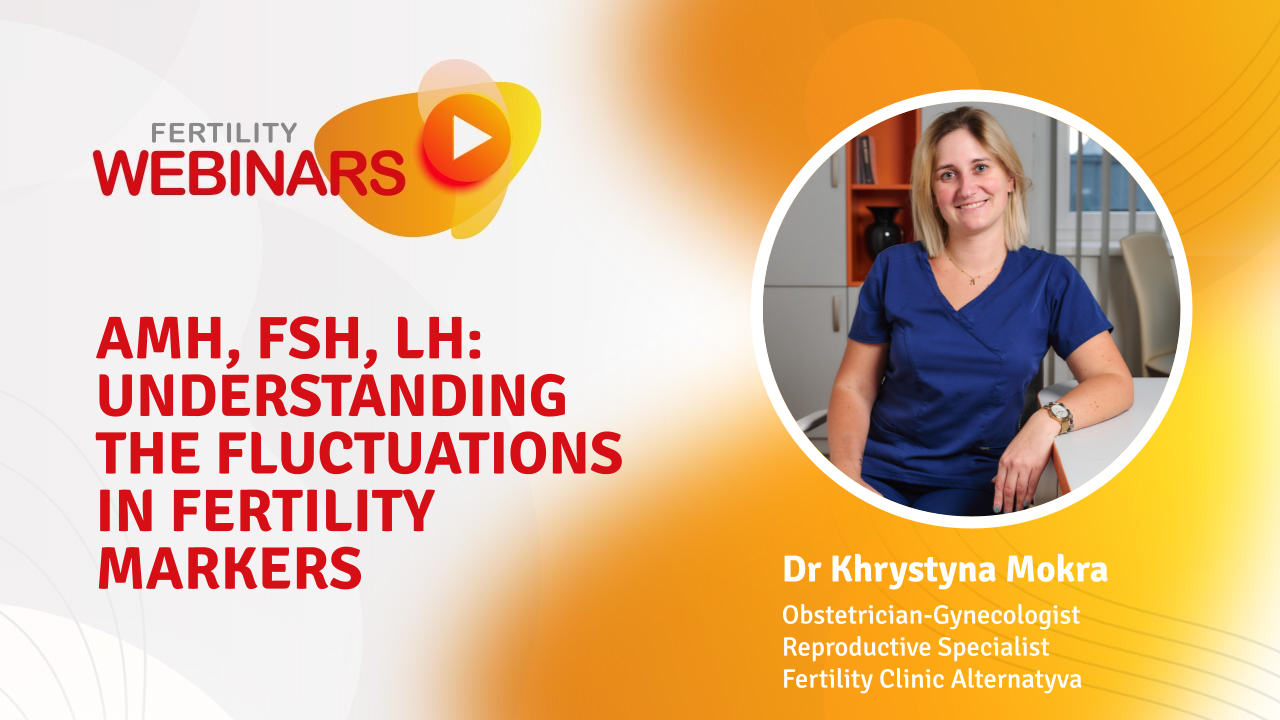
Are you curious about fertility markers and how they impact reproductive health? During this event, Dr Khrystyna Mokra, Obstetrician-Gynaecologist, Reproductive Specialist & Expert in Ultrasound Diagnostics at Fertility Clinic Alternatyva discussed the fascinating world of AMH, FSH, and LH – understanding their fluctuations and what they reveal about your fertility.
Fertility depends on the precise coordination of hormones that regulate ovarian function during the menstrual cycle. AMH, FSH, and LH stand out as key markers. Each of these hormones provides a unique piece of the puzzle regarding understanding reproductive health. AMH provides an understanding of ovarian reserve, helping to predict how many eggs a patient has left. FSH drives follicular recruitment and growth, and LH triggers ovulation, giving us an understanding of whether there will be a mature egg in this cycle.
AMH is secreted by granulosa cells in ovarian follicles. We have antral follicles, and each of these follicles can produce the AMH hormone. AMH is a marker of ovarian reserve, and this hormone can be measured during the menstrual cycle. It does not depend on the day of the cycle, which is very useful for us, as patients can come to us any day, and we can check AMH and decide what to do next.
FSH is produced by the pituitary gland, as is LH. FSH plays a central role in follicular recruitment. It helps choose the one follicle that will become dominant and ovulate. LH, also secreted by the pituitary gland, triggers ovulation. Additionally, LH supports the corpus luteum during the luteal phase, which is also very important.
AMH is the first step that is checked, and it is an individual marker of ovarian reserve. Small ovaries produce it. The level depends on a woman’s age and changes as women age. AMH remains stable throughout the menstrual cycle, AMH can indicate problems such as a decline in ovarian reserve. By observing high or low levels, we can already predict what to expect from the patient and what steps should be taken in the future.
On the slide shown, you can see how AMH levels change throughout a woman’s life. You can see values in nanograms per millilitre, but in many countries, they are measured in picomoles. When we’re talking about nanograms, the levels are as follows: younger women have higher AMH levels.
Nowadays, we face a significant problem when we see younger women, around 20-30 years old, with low AMH levels.
FSH is central to follicle recruitment and growth. During the early follicular phase of the menstrual cycle, FSH levels rise to stimulate the growth of ovarian follicles. Then, one dominant follicle emerges, and it will be ready to ovulate when it reaches the appropriate size. FSH levels peak just before ovulation and then decline in the luteal phase, but this only happens in an ideal menstrual cycle. In many cases, after 1 ovulation, FSH levels rise again, and there is another growing dominant follicle in the luteal phase.
Persistently elevated FSH levels, especially on days 2 and 3 of the cycle, can signal to us, as IVF specialists, that a patient may be heading into menopause or have a reduced ovarian reserve.
Monitoring FSH levels can provide insight into ovarian function, and during ovarian induction or controlled ovarian stimulation, it can show how fertility treatment will progress. This makes FSH very important.
Moving on to the LH hormone, which plays a critical role in the second half of the follicular phase, when we are approaching ovulation. LH levels are very low during most of the cycle, but surge dramatically around day 14, in an ideal 28-day cycle. The LH surge triggers ovulation, causing the dominant follicle to rupture and release the egg. Following ovulation, LH supports the corpus luteum, with progesterone taking over this role afterwards, but it is LH that performs this task at ovulation.
Tracking the LH surge in a natural cycle can help us predict when ovulation will occur. Therefore, when we are conducting treatments such as IUI or monitoring a natural cycle, it is crucial to know when we can perform procedures or recommend that patients have active sexual intercourse. Now, let’s continue and discuss the interplay between AMH, FSH, and LH.
These three hormones do not act in isolation. It’s important to understand that all hormones in a woman’s body work together, and AMH, FSH, and LH interact in a regulated system. AMH indirectly regulates FSH levels by limiting the recruitment of excess follicles. FSH stimulates the growth of follicles, preparing one for ovulation, and LH triggers ovulation. This balance can lead to the release of 1 major egg in a natural cycle, optimizing the chance of conception by maintaining ovarian function.
In clinical practice, these hormones serve distinct but complementary purposes. AMH helps assess ovarian reserve, making it a key tool in fertility preservation and in guiding stimulation protocols for IVF. As I mentioned earlier, AMH is the first marker we check before IVF. FSH provides insight into ovarian reserve and response to stimulation, and LH is essential for monitoring ovulation in a natural cycle, IUI, or any monitoring cycle if we are concerned about ovulation.
Together, these hormones provide a complete picture of a woman’s hormonal profile, allowing us to determine whether it’s functioning properly or if we need to intervene.
High FSH and low AMH level markers can indicate diminished ovarian reserve or menopause. High LH, when compared to FSH, is characteristic of polycystic ovary syndrome (PCOS), a very common issue. If both LH and FSH levels are suppressed, we might be dealing with hypothalamic hypogonadism, where hormones are not being produced, preventing ovulation from occurring.
What are the potential causes and what we can see with low or high levels of each hormone? If we understand these abnormalities, we can determine the best course of action. When LH is elevated, it’s often an early signal to consider polycystic ovary syndrome (PCOS). Of course, we cannot diagnose PCOS based solely on hormonal panels; we also need an ultrasound to confirm the presence of multiple ovaries, and we should look at the patient’s cycle, which is usually irregular, and ovulation is often absent.
These patients typically have ovulatory infertility, with irregular cycles. Their main problem is the lack of ovulation, and frequently, we just need to stimulate ovulation to suppress the level of LH, but it’s not as simple as it might seem.
I had such a patient last month. She thought that she had some issues with her thyroid gland, but we found that it wasn’t her thyroid. Instead, we discovered that it was hypothalamic amenorrhoea or central hypogonadism. Her hypothalamus reduced the secretion of hormones, and she didn’t have FSH or LH at all, nor did she have a cycle or ovulation. We provided her with hormonal replacement therapy, and her cycle started again because, in her case, significant stress caused the problem. She had lost around 10 kilograms in 1 or 2 months, which is a major issue.
The next slide presented elevated FSH. Elevated FSH could indicate menopause. Elevated FSH can be observed in women who are already in menopause or have diminished ovarian reserve. This is problematic when patients have a very small number of antral follicles, which can occur at both younger and older ages. In the past, we only saw this issue in older patients, but now it’s becoming more common in younger patients.
Low AMH is seen in menopause and after the age of 35, but it also doesn’t depend on age as much anymore, and it’s associated with diminished ovarian reserve. When there is a low AMH, IVF stimulation will be the best treatment, higher doses of FSH and LH to stimulate the ovaries should be used.
High AMH can be related to PCOS, however, it is not always linked to PCOS. A lot of patients with high AMH and multi-follicular ovaries have regular cycles and ovulation.
How do hormones change across the cycle? In a normal menstrual cycle, FSH rises in the early follicular phase to recruit follicles. LH remains low until mid-cycle and then surges to trigger ovulation. AMH remains stable throughout the cycle. Estrogen and progesterone regulate the first and second phases of the cycle.
Understanding these patterns helps us identify abnormalities like anovulation or issues during the luteal phase, and it helps us assist our patients.
Case 1: 38-year-old woman with low AMH and elevated FSH
She had diagnostic workups done, and in her case, we gave her high-dose stimulation with FSH to stimulate her ovaries. In her situation, we should cryopreserve the oocytes we retrieve during the puncture.
Case 2: 25-year-old woman with irregular cycle and high LH/FSH
The second case is a 25-year-old woman with an irregular cycle, a high LH to FSH ratio, and high AMH. We can diagnose her with PCOS. She wants to get pregnant, so we are considering induction of her ovulation with medication like letrozole or something similar. We are still considering and conducting diagnostics for her.
To summarize, AMH, FSH, and LH provide valuable insight into ovarian reserve, follicular development, and ovarian function overall. Their roles are very important, and their careful interpretation by doctors, IVF specialists, or gynaecologists is essential for optimizing fertility care.
Hormonal testing should be done for every patient who is starting IVF treatment or considering their fertility plans and future. These tests should be discussed with their gynaecologist, and this provides us with personalized treatment for every patient and every problem that we can observe.
We checked AMH in different labs — it was 4 labs and 5 patients. AMH was usually the same, but I will show you an example. In one lab, it was 2.4, and in the second lab, it was 2.54. So, it’s usually the same number. It cannot change in every lab. However, it can change because one lab is doing it in nanograms, and another lab is doing it in picomoles. But usually, it’s the same numbers.
Nowadays, I see patients with a fall not in one and a half years — I see the fall in 2 months. I have one patient in treatment now; in June and July, her AMH level was 2.5, and now we have 0.44. So, it’s a very big problem, and she is very young. Yes, now we see problems where AMH levels are falling. Many IVF specialists are trying to find out why this is happening. Of course, it’s because of everything happening around us. Also, it is genetic. Now we think that the main role is genetic.
There are many experimental treatments, like PRP of ovaries and some cell therapy. I had patients with all of these treatments, and I saw only better quality oocytes, but not a higher number of oocytes. AMH numbers cannot rise — only the quality of oocytes can improve.
Yes, I’m doing PRP, but not often. It is a very experimental treatment. It’s still not a standard procedure. I believe in PRP for endometrium because we see the results there.
2.1 picomoles is 0.3 nanograms.
Yes, of course, we can do it, but the protocol will require a high dosage. It can take 2 or 3 protocols to collect enough oocytes — I think around 5 or 6 would be enough.
I will give you an example. I had a patient, 47 years old, with an AMH of 0.24. We did 2 stimulations for her, and now she is carrying her own baby. So it is possible.
Our age limit is 53 years for going through IVF with carrying the baby by yourself. We are not speaking about surrogacy, of course.
Usually, when I start the protocol, I am not looking only at AMH. I am looking at ovaries because we check AMH, but we also see a good picture on ultrasound. Sometimes, I plan a protocol before the stimulation, but then I see the ultrasound before the beginning, and I say no — we are changing the protocol.
In your specific situation, only depending on AMH and BMI, I think I would start with Gonal-F 300 and maybe add Pergoveris 150.
But we should check because, with such AMH and such BMI, I try to go with a protocol using antagonists and maybe a long protocol. This can also affect the number of follicles.
In these cases, the best would be to start the Japan protocol. You know, when we do one puncture, and start the next stimulation immediately. It usually gives excellent results.
According to the AMH level, I think we can get more oocytes. But again, I don’t see the specific stimulation details. Many factors depend on the trigger for ovulation. When we use Decapeptyl or different triggers, the number of oocytes might not be as expected.
When we use hCG as the ovulation trigger, the number of oocytes will be bigger. But again, it depends on how many follicles we have. Hyperstimulation, of course, is also a consideration. So we should think about everything.
But 6 oocytes at 35 is a good result.
No. I will explain why. During a normal cycle, for example, we have in the ovaries eight antral follicles. From these eight antral follicles, one starts to grow and becomes the dominant follicle, which will be ovulated. The other seven will not go to the next cycle; they will disappear during this cycle.
In IVF treatment, with the stimulation protocol, we are stimulating all these eight follicles. We just give hormones to the follicles that would disappear in this one specific cycle. So, we are not reducing AMH levels in IVF treatment; we are just helping all the follicles we can catch in the cycle to grow.
4 to 5 follicles per month at 43 years old is a very good result. FSH 11 is absolutely normal. So, your FSH and AMH levels are absolutely normal for your age.
You can undergo an IVF protocol. Maybe for you, the Japan protocol would be great to get more follicles.
I will explain how the Japan protocol works: we stimulate the patient, do the trigger for ovulation, and perform OPU (aspiration of oocytes). Then, we start another cycle. Usually, this second stimulation cycle is more effective than the first one. This method usually works well for patients who have 5 or 6 oocytes or fewer. In the next cycle, we often get more.
We cannot say the best option for stimulation medication because stimulation protocol and stimulation medication are very individual. For some patients, I usually go with protocols that include FSH and LH, and yes, it works. But for some patients, when we give them LH, we see that follicles are not growing. Then, we remove LH from the protocol, and follicles start growing.
A protocol is a very individual thing. We cannot say this is the perfect protocol, and we will go with it. We should look at previous stimulations, and if we have them, we will analyze them. If we have the hormonal panel, we will consider that. We will also do hormonal checks during the stimulation. If we need to add LH to FSH, of course, we will give it.
I have had stimulations where I gave only LH, and we had perfect results. So, it depends on each patient.
Yes, it is true. Contraceptive pills can influence AMH levels. During the treatment period, there can be a decline in AMH levels. After stopping the pills, the level can return to its original value within a few months.
I don’t know why, but patients think that when they are taking OCP pills, AMH stays at the same level as when they started OCP pills. But this is not true.
To go back to the question about whether IVF treatment reduces AMH: when we are taking OCP pills, we do not have ovulation, but the menstrual cycle continues because we still have menstruation and hormones. However, these hormones are suppressed.
The follicles—those 8 follicles—are not growing, but they still disappear during this period. So, we are not taking OCP pills to keep our AMH at the same level. We take OCP pills for contraception or treatment, but not to maintain AMH.
Yes, of course. After 35 years old, it is a challenge not only to get oocytes but also to get a euploid embryo. However, it depends on the whole team’s work.
Why do I say this? Because I can do great stimulation, but after I take the oocytes, I give them to the lab. Then the embryologists start their work. When everything works perfectly—when we get 100% results—we get six oocytes from six follicles. Then we get six embryos. Of course, this gives us better chances to get one euploid embryo.
We cannot guarantee this, but we should try. Sometimes we need one stimulation, two, three, or more. I have had cases where it took 5 stimulations, but after the 5th stimulation, we finally got 1 euploid embryo.
It is possible, but sometimes it just takes more time. We should think, we should change something, add something, and discuss it with embryologists and colleagues. We may need to change the stimulation protocol, or we might add calcium to sperm or oocytes to improve their quality during growth.
It is not always simple, but we should try.
Yes, I think yes. But we usually think about duo-stim during the first stimulation. When we see antral follicles on the ultrasound, and we see that we can proceed with duo-stimulation after the aspiration, of course, we recommend this. So, in your case, if we see these antral follicles, and we think they can be stimulated, of course, this can be your option.
Sure, lots of details here. First of all, I think you should take a break. I always say that we need to take some time to think. I also believe you should try the long protocol again, but maybe not the classic long protocol where we give the depot injection. Instead, you can try a protocol with 0.1 Decapeptyl or Diphereline, as it could increase your chances.
I think the long protocol will work for you. Also, testing the embryos will be very important. For example, I had a patient with two embryos. One embryo was perfect—4AA as I remember—and the second embryo was 3BC. The embryologist told me not to test the 3BC, but I said, “Please test it,” because we need to have euploid embryos.
Surprisingly, the 4AB embryo was aneuploid, and the 3BC embryo was euploid. So, you should test your embryos because quality alone does not show us everything about an embryo.
I don’t usually recommend mini IVF, but again, it’s very individual. I once had patients who did not react to mini IVF. We started with a high dosage, and it was very successful, even for older patients over 45 years old. We used a high FSH dosage. On the other hand, I had a 30-year-old patient who had a successful outcome with mini IVF. So, it depends on your protocol, your hormonal levels, and the ultrasound picture.
In my practice, I always give my patients Myo-Inositol. It’s a very good medication to improve oocyte quality. I’ve had good results with it. Also, when we see poor oocyte quality after stimulation and aspiration, we can speak with the embryologist. In the lab, we can use calcium or other supplements, usually calcium, to improve oocyte quality. I don’t believe in PRP for ovaries or ovarian cell therapy because I haven’t seen evidence that it works. The best approach is to take the supplements your doctor recommends, maintain a healthy lifestyle, and improve the oocyte quality in the lab with supplements like calcium.
Yes, of course. These diseases affect hormones because they involve the ovaries, which produce hormones. For example, when we see a large endometrial cyst, especially on ultrasound, and no visible ovaries, it can affect AMH and FSH levels. This can lead to early menopause. So yes, adenomyosis and endometriosis are very much related to hormones.
Not always. Embryos are 50% of the IVF process, and the endometrium is the other 50%. Testing embryos is not always necessary to improve IVF success. For instance, if there is male infertility, low AMH, or no previous miscarriages, embryo testing might not change the outcome. I usually recommend genetic testing only when it’s necessary, such as when there are genetic diseases in the family. If a woman has a problem with male infertility, I wouldn’t recommend embryo testing unless there is another issue.
Myo-Inositol is typically used for PCOS patients because it helps regulate the connection between follicles and improves oocyte quality. It can help non-PCOS patients as well. For non-PCOS patients, the dosage is usually 200 mg, and it’s considered normal. It’s a supplement, not a medication, so it’s safe and won’t harm your health.
Yes, endometrial PRP is effective. In my practice, I’ve seen good results. After PRP treatment, the endometrium’s thickness improves, and we often see a triple lining, which is a sign of good endometrial structure. I have seen these results in just one cycle, so PRP can be a helpful option for improving endometrial health.
No, Myo-Inositol is not necessary when using egg donation. If you’re not using your own eggs, there is no need for Myo-Inositol.
For adenomyosis, a long protocol with Depo-Provera injection (3.75) is recommended. This protocol helps control hormonal levels and also helps manage adenomyosis by controlling the disease’s effects on the ovaries.
Yes, CoQ10 and Glutathione can be beneficial for improving egg quality, but I can’t guarantee they will dramatically improve oocyte quality. They are supplements and are generally safe when taken at normal dosages. They may help, but they won’t cause harm when taken as advised by your doctor.


+ 1 more answers

+ 2 more answers
+ 1 more answers
Necessary cookies are absolutely essential for the website to function properly. This category only includes cookies that ensures basic functionalities and security features of the website. These cookies do not store any personal information.
Analytical cookies are used to understand how visitors interact with the website. These cookies help provide information on metrics the number of visitors, bounce rate, traffic source, etc.
| Cookie | Duration | Description |
|---|---|---|
| _ga | 2 years | This cookie is installed by Google Analytics. The cookie is used to calculate visitor, session, campaign data and keep track of site usage for the site's analytics report. The cookies store information anonymously and assign a randomly generated number to identify unique visitors. |
| _gat_UA-38575237-21 | 1 minute | No description |
| _gid | 1 day | This cookie is installed by Google Analytics. The cookie is used to store information of how visitors use a website and helps in creating an analytics report of how the website is doing. The data collected including the number visitors, the source where they have come from, and the pages visted in an anonymous form. |
Any cookies that may not be particularly necessary for the website to function and is used specifically to collect user personal data via analytics, ads, other embedded contents are termed as non-necessary cookies. It is mandatory to procure user consent prior to running these cookies on your website.
Other uncategorized cookies are those that are being analyzed and have not been classified into a category as yet.
| Cookie | Duration | Description |
|---|---|---|
| _gat_FSQM52 | 1 minute | No description |
| cf_ob_info | No description | |
| cf_use_ob | No description |

