In this session, Vladimiro Silva, PharmD, Embryologist, CEO, Founder & IVF Lab Director at Ferticentro, & Procriar, Portugal, talked about embryology lab, what procedures are performed, and how it all works step-by-step.
Sperm samples are identified in many ways, with the name of the patient’s wife or with the name of his female partner, if applicable. If sperm is just to be frozen, it is identified with the name of the patient, always with an internal code for the patient, and always with an internal code for the patient’s wife.
In addition:
Thus, every patient can feel sure and safe about that.
Multiple procedures can be done depending on what’s the aim of the collection.
When we have a look at the sperm in the microscope, it looks like little dots, flying dots, under the microscope. These are real spermatozoa. It looks very messy, but there are ways to count control and assess its concentration.
At Ferticentro, a makler chamber is used. Also, we have a little square network and, according to the number of spermatozoa in each square, we make the proportion to assess the concentration.
There are parameters for the following:
However, roughly speaking, we use a proportion technique. Thus, when we say that there are 15 million per millilitre or 39 million spermatozoa in total in a sperm sample, we’re not counting until 39 million, it would be impossible. We work with proportions; we have these special chambers that help us to assess the amount of sperm that we have with us.
When looking at sperm under the microscope, you can see:
Normally, when sperm needs to be prepared, it’s mixed with a special culture media. Initially, the purpose is to eliminate the seminal plasma and other constituents of the sperm. Then, a special media is used that will help to enhance the sperm properties and turn it stronger, with a better ability to fertilize the egg. This depends on the quality of the sample and whether it’s being prepared for IUI, ICSI, or freezing; thus, the procedures are different.
There are a series of centrifugations where the spermatozoa can be separated from the rest of the constituents of the sperm. The spermatozoa stay here, at the bottom of the test tube, and then we suspend it in the special culture media and let the mobile sperm swim to the surface of the media where we’re able to fish the most motile, strong, and theoretically more viable spermatozoa.
How does it work?:
The ultrasound scan allows seeing through the skin, but it doesn’t allow seeing it microscopically. Therefore, in the ultrasound scan, we can see the sort of bags of liquid, we don’t know whether there’s an egg inside or not. The only way to confirm it is to aspirate this liquid and look at it under the microscope.
The cumulus is the complex between the eggs and the granules of the cells that surround them because inside those follicles there is liquid, and lost in the middle of that liquid, there are the eggs. However, the eggs aren’t alone; they’re surrounded by granulosa cells, so sometimes we see the cumulus, but the egg is so surrounded by cells that we cannot immediately tell whether the egg is viable or not. Sometimes it’s very easy to see and sometimes it’s not; thus, we have to prepare the eggs to confirm whether they are in the correct stage of maturity and so on. It will also depend on whether we’re doing a classic IVF or an ICSI, but this is how the follicular liquid looks under the stereomicroscope.
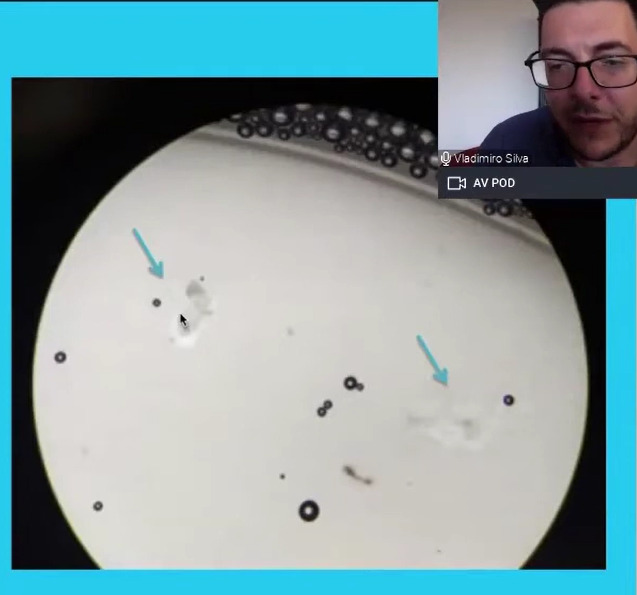
In this case, you can see small dots, which are the eggs, and probably there were some other eggs that I wasn’t paying enough attention to, but this is exactly what we see under the stereomicroscope. You see, the eggs are still very small dots in here, so it’s very difficult for us to immediately tell whether they are mature eggs or not. We will have to check for that later on.
Nevertheless, at the same time, we were able to remove all of the surrounding cells.
While we’re doing this, we’re looking for mature eggs because women, when they are born, they have around 2 million eggs which aren’t viable eggs, those are what we call primordial follicles. By the age where they have their first menstruation, women only have 400,000 primordial follicles, and in every month many of them go to the maturation process, but only one of them is ovulated and is able to be fertilized. This is in a normal, physiological cycle.
When we’re doing IVF, we’re trying to do the same thing that happens in nature; we’re giving drugs to stimulate ovaries, to produce, instead of just one, multiple eggs. We normally like to work with 8 or 10 eggs; that would be perfect. Sometimes, if we can get 15, even better, 20 is okay, but more than 20 maybe the patient’s health at risk.
Nowadays, we have techniques to avoid ovarian hyperstimulation syndrome, but ideally, we like to work with between 8 and 15 eggs. So, we give these drugs, we have multiple follicles developing, and we try to make sure that we do ultrasound scans, we do estradiol determinations, and progesterone assessments as well, all to see the characteristics of the follicles and if they are likely to have a mature egg. Therefore, when the follicles have at least 17 millimetres, we trigger ovulation. When we’re triggering the ovulation, we’re triggering the final maturation of the egg, so we’re artificially doing what happens in nature with the LH peak.
LH is one of the hormones produced by the pituitary plant and, and at the end of this process, after the final maturations, we should have a mature egg. The following is what we’re looking for.
For example, here we have three different types of eggs:
A lot of things can happen, but the take-home message is that we’re looking for the ones on the right side, the metaphase II, the mature egg.
ICSI stands for Intracytoplasmic Sperm Injection. It’s a procedure where we pick just one spermatozoon, and we will inject it inside an egg.
It’s done in the lab, and it’s a very delicate yet revolutionary procedure because before ICSI was invented, there was virtually no solution for cases where male fertility was seriously compromised. Now, it only takes one sperm for us to be able to fertilize an egg. That sperm has to be viable, and sometimes it’s very difficult to find a viable sperm in some male cases, but there’s hope, and we’ve been having babies everywhere in the world, starting with cases with very few spermatozoa.
We start by preparing the ICSI plate. This is a dish, as you can see in the picture below, that it’s from a real case. We put the eggs in these drops with a special culture media. We put the sperm in this strip which have a cultural media that will prevent sperm from moving too fast, so we can take a good look at them and get the ones who have better characteristics.
After that, we’ll then have to fertilize the eggs using a special microscope, a micromanipulator with two needles. One on the left hand which is called the holding needle, and one on the right hand which is the ICSI needle. One is sort of a vacuum cleaner who holds the egg and the other one will pick the sperm and inject it inside the eggs. I’ll show you a video on how we do it. It’s a very delicate procedure and this is a real case done.
The first thing you can see here is, on the left-hand side, the holding pipette that holds the eggs still. Then, we had to put the egg in the right position. It’s not very visible yet, but there is one small ball here which is called the polar body that helps us identify how we should insert the sperm into the egg because if we don’t introduce the needle in the right position, it can damage some structures of the egg. Therefore, a very important thing is to be able to puncture the egg in the correct place; otherwise, we risk damaging the egg and losing everything.
At the same, this is a very delicate procedure that we have to do quickly because if we take too long it won’t be good for the egg. We also have to make sure that the egg, the needle, the holding pipette, and the ICSI microinjection are all at the same level because an egg is a ball, you have to remember it, so we’re like holding a ball with a small ball on top of it and then we’re puncturing that ball.
We’re going to see that the embryologist will start to rotate that ball. Now you can see the little ball on top of it. If you take a look here, the sperm is already here, It’s a very small dot that you will see, so the sperm is already inside the ICSI needle. Then, we’re just preparing the egg to be injected. After that, we’re putting the sperm ahead. The sperm is going towards the egg. Now that he is on the tip of the microinjection pipette, we start to perforate it, we press the membrane, we aspirate a little bit, the sperm goes back, and then we leave it here. This egg has just been fertilized.
Later on, we move on to the next egg with the next sperm. We go and select another sperm which we’ll fertilize with the next egg in the next droplet. We sometimes have a lot of eggs and it takes a while for us to do it. After 18 hours, we expect to have a fertilized egg that looks like this, with the two pronuclei, one from the male side and one from the female side, with the two polar bodies that show that fertilization occurred correctly.
At Ferticentro and also at Procriar, we culture the embryos in these special incubators with built-in video cameras that allow us to do the embryo culture without any manipulation. We inject the sperm into the egg and then we put the fertilized egg inside the incubators, and we can see in real time what happens next.
Some of the embryos are starting to divide; this is life happening in real-time, in two cells, then in three, then in four cells, and finally in eight cells. Right now, they’re forming the morula, and you will see that almost all of them will form nice blastocysts. The difference is, for example, in the middle, you don’t see a blastocyst. The embryo was trying to form a blastocyst, but he failed to do it, so the one in the middle isn’t a viable embryo, while the other ones are very good-prognosis embryos.
However, not all cases go like this, but hopefully, for example, in egg donation cases we have on average four or five embryos that look like this, like good quality blasters.
One of the embryos, at the bottom side of the left corner, has already been born. The other ones are still in the freezer, waiting for the patient to move on with the embryo transfer.
After all this, we get the embryo, and we transfer it into the womb. This is a very complicated procedure that should be done by a specialized gynaecologist.
We use a very thin catheter whose diameter is only slightly larger than the embryo itself. So, the gynaecologist, normally with the help of an ultrasound scan done before, during, or just after the procedure, will put the embryo inside the wall, in the exact place where it should be implanted. It’s a very delicate procedure, it requires a lot of experience from the gynaecologist, and it’s one of the most critical steps in the whole process because if it’s not properly done, we can lose everything else.
Then, we see this small dot here that it’s actually the culture media with the embryo. We can see it and show the patient that her future family is already on the making.
If there are remaining embryos, we have to vitrify them.
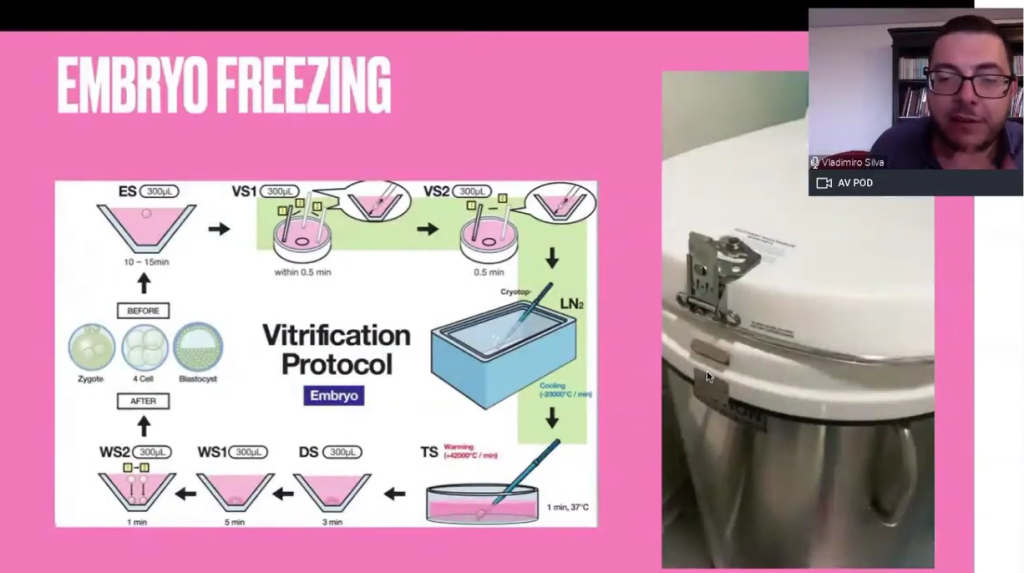
Vitrification is a very complex procedure where we replace all the water inside the embryos with a cryo-protecting agent. This is a very toxic agent that will prevent ice crystals from forming and damaging the embryo, so we have to be quick.
We start doing this very complicated procedure in the lab. This is done manually, so it requires a lot of experience from the embryologists. We do this procedure to replace all the water with the cryoprotectant agent inside the embryo, and then we immediately and very quickly dump it into liquid nitrogen, meaning that the embryos will stay at -196 degrees. To give you an idea, the cooling speed is -23 degrees Celsius per minute. It’s a procedure that we do thousands and thousands of times every year, which requires a lot of experience from embryologists. It has a very complicated learning curve, and nowadays, it’s the best system in the world.
I don’t think nobody’s using slow cooling anymore, but it provides us with fantastic survival rates with embryos. We’re now have 98% survival rates with eggs which is incredible and allows us to have a lot of flexibility.
Then, we have to do the reverse process when we’re warming. The warming speed is +42,000 degrees per minute, so we have to just dip the frozen embryo in this special culture media, and we have to do the opposite procedure. Start to quickly replace the toxic cryoprotectant agents to the water so the embryo can recover its initial characteristics. It looks complicated and it is complicated, but everybody is doing it now and we have wonderful survival rates.
After that, the embryos are put in containers like the one shown in the video. The contained shown is one of Ferticentro. You’ll see embryos stored here at -196 degrees. You can see that we leave the straws in gas nitrogen, so every straw has its own place, every straw is properly identified, and we have two of these containers. We also have a lot of several smaller ones, so it’s crazy to think that we have thousands of potential human beings in containers like this in IVF clinics all over the world.
We do a lot of embryo testing to see, for example, if an embryo has a normal genetic constitution. We do what we call the PGT-A for implementation of genetic tests for aneuploidies by next generation sequencing.
We do this because sometimes patients who do IVF, they transfer an embryo that doesn’t implant, the result is negative, the embryo was apparently very good, and we don’t know why we got a negative. Was it the embryo? Was it the uterus? Or is it an immunity condition and haematological disorder? What could be the explanation? Therefore, PGT-A, the pre-implantation genetic test for aneuploidies helps us to understand it.
The following is a graphic from Igenomix. Igenomix is one of the most well-known labs doing PGT-A analysis.
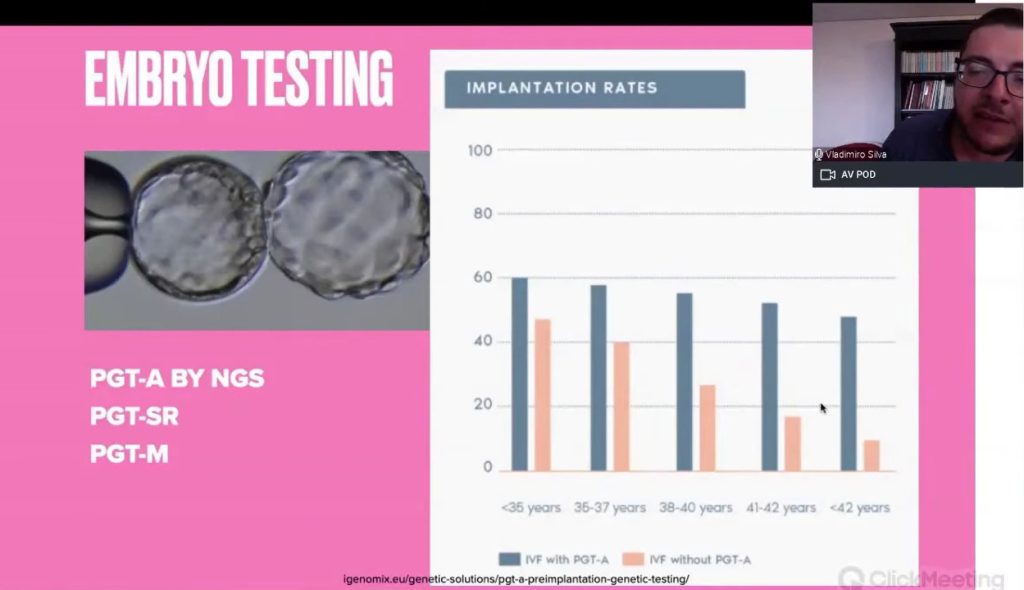
They have seen that when we’re transferring embryos without doing PGT-A, so we’re just assessing embryos based on their morphological characteristics, we have in this pinkish colour 45% below 35 years, then 40%. You have these pregnancy rates; however, when we’re able to select embryos that are genetically normal, meaning a normal chromosomal constitution, we will see that pregnancy rates are more or less the same for all age groups. This happens because a normal embryo has a very high implantation potential, this is not all about the chromosome, the uterus also plays a role and inside the embryo, other structures also play a role, but we know that if we are transferring normal embryos, the odds of having a baby are way higher.
This is why, for example, nowadays, we’re advising patients above the age of 39 to do PGT-A because they will be able to see whether their embryos are viable or not. This is a complex issue; probably, there will be some webinars dedicated to this, so I’m not going to spend much time talking about it because we do have mosaic embryos and so on.
However, one of the most important messages that we always have to tell our patients is that in medicine, embryo testing by PGT-A helps us to understand whether an embryo is good or bad, but we cannot transform a bad embryo into a nice one. Medicine is not yet, at least, capable of doing it. Knowing whether the embryo has a good or bad prognosis it’s very important information. It can help patients make decisions, and it can help us direct the diagnosis of previous implantation failures, but it will not increase the odds of pregnancy.
Therefore, if the embryo isn’t viable, it’s not because we did the PGT-A that the odds of pregnancy will increase. This shown here is just the consequence of just transferring normal embryos, but after transferring all embryos of a group, the number of good quality embryos that are implanting on the wall will be the same.
There are also other tests that we can do on embryos:
This is a very particular type of genetic abnormalities where patients are carrier, a part of their chromosome is placed on another chromosome and the other way around, so they have what we call a balanced translocation. They’re normal persons because they have all the DNA that they require, but they have a very high risk of transmitting this sick [unheard], an unbalanced translocation. Thus, we need to check the embryos to see if they are normal or not.
For example, in families that have diseases like Huntington’s disease and paramyloidosis, many monogenic diseases only affect one gene. In some cases, they have a 50% risk of passing it to their babies and it’s called an autosomal dominant disease, or maybe a 25% chance when both elements of a couple are carriers for the same rare disease. In those cases, we can create the embryos, do an analysis, and see whether they are carriers of the mutation or not.
If they’re not carriers of the mutation, we can check if they are chromosomally normal or not.
We can do the two tests in just one step. By testing the embryos in the IVF lab, we make a small hole in the embryo with the laser system, and then we aspirate the content of the embryo, and we send it to a genetics lab.
However, this is not all we do. There are some procedures that I’ve not talked about. I don’t want to bother you too much, but working in the lab is a very systematic and, sometimes, obsessive job.
We have to control the temperature, the volatile organic compounds, humidity, Co2, and lots and lots of different parameters. We also have online systems registering those temperatures and parameters continuously, and an alarm system.
For example, in the middle one there was an incubator that was disconnected, and it was immediately signaled in red. So, we get a message in our cell phone stating if everything is out of normal. We’re always checking the stability and the conditions of our embryo culture. We have quality management systems in place. In Portugal, those are legally required, and we have a total traceability of cultural conditions in both of our clinics.
Every day we check for temperature of all surfaces, we have calibrated devices that we always use before starting to work because we have to make sure that the temperature is the correct one, we also check for pH of the culture media, and so we routinely check for several parameters that allows us to be sure that our embryos are being cultured in perfect conditions .
On top of all that, we have the KIPs which are the key parameters in the lab. KPI stands for Key Performance Indicator, so we have an international consensus of experts who have defined values.
On the left column, this is the minimum that we have to reach, and on the right hand, this is what we have to reach to be considered good. We have to monitor every single one of these parameters because those indicate that everything is going well in the lab. We know that if we’re getting these parameters in our daily practice, we’re working well, so we’re going to get good results, good embryos, of course, nothing of these guarantees a pregnancy, but what we have to do in the IVF lab is to optimize the conditions of culture and the conditions for embryo development, so we can give our patients the best possible chances.
This is what we do daily. We have lots of people always going through statistics, running these numbers, seeing if there is any tendency in the bad side, if there’s something wrong, we immediately take action so we can be sure that everything goes well.
Here you can see the bottom line we do in the lab. We try to overcome the difficulties that nature gives us.
When everything goes well:
In assisted reproduction techniques, when there is a problem in one of those steps. We adapt the best technique to that problem. For example, if we have a slight quality issue with the sperm or if the sperm doesn’t get through the cervix and just needs a little help, we can do intrauterine insemination.
Moreover, if it’s a single lady trying to get a baby, obviously, before the age of 35, the chances of an IUI working with donor sperm are a lot higher than after the age of 35. If it’s a lesbian couple and so on, IUI is a very good first-line approach for not-so-serious cases.
If there’s a problem, for example, with the tubes or with sperm quality, we need to make sure that the embryo has a good quality if IUIs failed before. There are multiple number of situations.
We can do a classic IVF situation if there’s a male side issue, and we need to make sure that the fertilization occurs in order, for example, to do a pre-implantation genetic test or if we’re working with frozen eggs. If we’re not sure if the sperm can fertilize the egg itself, then we do the microinjection, and we do ICSI.
If, for example, the man is producing sperm, but they’re not getting to the outside of the testis, meaning he has sperm, but he has sperm inside the testis. We can do a testicular biopsy, which acronym is TESA. We go inside the testis, get the sperm, and inject them directly into the egg, so we can overcome the different types of difficulties that nature poses to us.
In the IVF world, we have all of these solutions. If we think that humans are not a very fertile species, a man and a woman who don’t have any health problems, they are both 25 and try to get a baby naturally, they have a success rate of 25%. So, we don’t start on a very good number. Nowadays, if we go to statistics all over the world, we can see that we’re easily over 30%, in many cases over 40%, in egg donation cases over 60%, so this is what we’re getting with IVF techniques all over the world.
In some cases, we’re more than doubling the problem the odds that nature gives us, but we’re still not at 100%. Therefore, we still depend on chance. It’s a lottery. Our job in the lab is to make sure that all the odds are in favor of our patients, and this is what we do daily with a lot of work.
We started fighting nature 43 years ago, a long time ago when Louise Brown was born. Robert Edwards won the Nobel Prize for Medicine in 2010 for discovering IVF. We’re still fighting nature. I like to quote one of the most well-known embryologists in the world because he said that:
Every single person who works in IVF feels like they’ve got the best job in the world.
There is a technique called in vitro maturation that we sometimes use. It’s not the first-line approach. A few years ago, when we started talking about IVM, we thought some people were defending that it would be useful for some cancer patients, where we need to retrieve eggs at a very early stage of development or in some cases where patients have a risk of developing a hyperstimulation syndrome, so we were maturing eggs in vitro. It still works, and it’s a technique that can be helpful in some very specific groups of patients; however, its success rates are not as good as the other eggs.
If the patient is at risk for having a hyperstimulation syndrome, it’s preferable to trigger with Decapeptyl or some Agonists to stop the GnRH hormone because that will virtually eliminate all risk of ovarian hyperstimulation syndrome and, at the same time, allowing us to have mature eggs without putting the health of the patient at risk.
If we have a cancer patient, freezing ovarian tissue is providing better results, in my opinion. There could be someone thinking otherwise, but we can do it when there’s nothing else we can do. It’s always sort of a resource technique.
Well, I wasn’t aware of that, but I mean, it’s a question of faith in science. As long as patients know what we’re doing or at least what they’re doing, they and make an informed decision on that question. We cannot put too much hope on this. In light of the actual scientific knowledge, MI eggs could be matured in vitro, or MII to mature eggs to germinal states. It’s not impossible, but way more difficult, and both have way fewer chances than MII eggs.
I don’t think there’s an indication to freeze these immature eggs because we also don’t know one of the possible reasons why they are immature. It’s an important part of them; they would most likely have genetic abnormalities, but obviously, we don’t know what science will bring us in the future. Anyway, I wouldn’t put too much hope on this, and I wouldn’t say it’s necessarily wrong, but it should be seen as an experimental procedure and not something to be used as a part of routine care.
It’s extremely rare. If a lab is experienced while doing ICSI, I would say it rarely happens. Nowadays, we have, I don’t remember by heart, but it’s very common to have more than 90% and lots and lots of cases with 100% fertilization. So, with experienced embryologists doing ICSI every day, I would say the odds are no. No one can say never, but I would say that it’s extremely unlikely. I can even give you a percentage, it’s certainly less than 1%, but I cannot give you a number.
The ball type area it’s the egg and it has to be in a particular position so we can insert the sperm without damaging other structures. When we think of the egg, it is a ball, a ball with a very small ball on top of it which is a byproduct of the egg development, it’s called the polar body, it’s not used for the embryo development and it will not participate in that. We have to insert the sperm inside the egg, inside that ball.
The ball on top is a by-product, we don’t use it. It’s just an indicator that the egg has developed well, that it’s a mature egg, but then it will go away. It will not be part of the embryo that will be formed.
There are multiple grading systems. In Europe, there are maybe two more used grading systems.
One of them is the Istanbul consensus. There was a meeting in Istanbul, where a lot of specialists from all over the world got together and defined a series of parameters that should be used to classify embryos; however, for example, here we prefer to use the Association for the Study of Reproductive Biology (ASEBIR) system which is also very used in Spain. Maybe it’s more a cultural thing, we feel more comfortable classifying embryos according to that classification.
We also classify our embryos according to Morphokinetic parameters, we are grading them with the Embryoscope, which is yet another grading classification, but the most important information here is this: When we are classifying embryos, there’s always a certain degree of subjectiveness, so different embryologists looking at the same embryo might have different opinions. We don’t know; we’re humans, and the human eyes don’t always see the same things.
We’re actually taking part in some research studies, but there are research being done in many places in the world towards the automatizing the embryo grading system. So, towards automation of the embryo grading systems, we’re working on that. When I say “we”, I say science is working on that. We’re doing our very small part of it, but it’s still very independent of individual subjectivity.
When every clinic has its own grading system, and every embryologist knows based on his experience, what are the good embryos and the not-so-good embryos, the better prognosis embryos, and so on. This is something that we acquire with experience, but it has a lot of subjectivity. We have to rely on the embryologist’s opinion, every clinic has its culture, and they know what they used to have, but at the end of the day, we have to have criteria of what embryos should we freeze, or transfer, what embryos should we classify as non-viable, we have to think about that.
This is what grading embryos are for, but we have to acknowledge that different people can have different opinions on the same embryo.
That’s the million-dollar question. Here at Ferticentro, and also at Procriar, what we do since we do the embryo culture in the Embryoscope, and we see the formation of the embryo. The Embryoscope is the name of the incubator with the video time-lapse system. This is where we get a video camera filming the embryos continuously, 24 hours a day.
The best blastocyst has to result for from a very good embryo that has divided in the correct way, without having intermediary problems, reaching the blastocysts stage in time, having a good expansion, and having good morphological characteristics. Sometimes, it’s not easy, this is why automated systems based on artificial intelligence are starting to show up in the market because we know that there are things that the human eye can’t see. I don’t think we’re there yet.
In my opinion, the human eye is still the best system to identify the best blastocyst, but we’ll eventually get there. I don’t think there’s any reason to believe otherwise. I think, ultimately, it will be possible to have a machine indicating what is the best blastocyst. Furthermore, I honestly don’t know if I’m going to trust that machine because we do rely a lot on our personal experience after many years of looking into embryos every day, but sometimes we think that happens a lot, for example, in PGT for implantation genetic testing treatments, sometimes we look at the blastocysts and we say, “well, this is the best one”, and then when we get the results from the PGT it’s not the one that looks best, that has a normal chromosomal constitution. That happens a lot.
We’re always learning, we’re always getting this experience. The time-lapse is an incredibly useful tool that allowed us to make a big step in this direction, but at the end of the day, the truth is that nobody knows. I would say that the best blastocyst is the one that has been tested, which is euploid, meaning that it has a normal chromosomal constitution. I would prefer to rely on the results of PGT-A instead of the embryologist’s opinion to classify the best blastocyst. Sometimes, that’s not possible, that’s expensive, that’s invasive, so in those situations, we have to trust not only our instinct but our parameters, our systematic observation, registries, and our experience.
Yes, it’s done on an embryo, which is a fertilized egg. It’s done on day 5 or 6, meaning at the blastocyst stage. We use a sort of laser ray that will make a hole in the embryo, and via that hole we’ll insert a very small aspiration needle that we use to remove around five cells from the embryo. Those cells are then sent into a genetics lab, and we’ll assess the chromosomal content of those cells.
We know that a human being has to have 46 chromosomes, so it will be either 46, and it’ll be either a boy or a girl. We’re not doing this tool for gender identification; it’s not allowed in Europe unless for a medical reason, but we know that the embryos have to have a normal constitution. If the embryo has an extra chromosome, for example, the most common chromosomal disorder is Trisomy 21, where we have three 21 chromosomes. In that case, the embryo isn’t considered to be viable, but there is a chromosome missing. You can also have, for example, a monosomy 21, 20, or 10. We need to know the genetic constitution of the embryo.
So, we create the embryo, we cover it until day five or six, we do that hole with the laser ray, we remove the cells, we freeze the embryo on that same day, we wait about 3 weeks for the genetics results, and then we will know which embryos are viable and which are not. There are situations in between where we have mosaic embryos that have different cell lines, namely, a normal cell line and an abnormal cell line.
Nowadays, scientific research and the most recent studies indicate that most mosaic embryos are viable. It’s a question of defining the cut-off for the degree of mosaicism from which we consider the embryo not viable. This is something that the genetics lab works a lot on, and we have to rely on their work. It’s their speciality, we just have to give them the embryos and wait for their conclusions.
I would need more information, but yes. I don’t see any parameter that’s outside the normal. Likewise, I can imagine that concentration is 43 million instead of 43%, but apparently, everything is okay. Obviously, we need to think about the egg; other parameters might need to be assessed, but in principle, these values, assuming that concentration is 43 million per millilitre, are all normal.
Yes, DNA fragmentation it’s sometimes a very frustrating parameter because we don’t have a way to make it go down. We can use antioxidants, we can take special medication, and so on. It’s very associated with lifestyle factors, exposure to pollution, alcohol, smoking, and so on. It’s very directly related to lifestyle issues, but we do have patients that, even after moving on with a very healthy lifestyle, that are controlling the exposure to potential agents, still have high DNA fragmentation.
For those cases, ICSI is indicated. Some studies seem to indicate that ICSI yields better results than classic IVF in samples with a high DNA fragmentation index. That’s not something undisputable. There is some evidence in that direction, but we cannot be completely sure. We would do ICSI at our clinics in such a case. We would start to advise this patient to take action in terms of lifestyle, antioxidants, and so on. If that doesn’t result and we end up still with 40% DNA fragmentation, this is not too much; I’ve seen a lot worse. We would do ICSI anyway because the egg also has some capacity to repair the DNA fragmentation problems in the sperm.
We know that a healthy egg will most likely be able to correct these problems. Furthermore, we will have to have a look at the couple, also at the egg side because if the female patient is, for instance, 38 or 39, it’s probably better to move on anyway than to lose time trying to work on the male side and lose ovarian reserve on the female side. It’s always a very hard call for the gynaecologist to make.
My personal opinion is that if patients are young, we can try, we should try. If we’ve reached a certain point where these measures have had no result, it’s preferable to move on and do ICSI, and hope that the egg could correct these problems. There are also techniques of sperm selection techniques that, theoretically, can help us to identify the better sperm or the sperm that are less likely affected by DNA fragmentation, but the evidence available is not so good, so it’s always arguable whether those methods work or not. There are plenty of systems in the market, I will not start discussing all of them because it will be another debate, but I don’t think there is strong evidence towards any system, yet there are some systems with promising results.
Usually, no because we’ve been freezing sperm for decades now, I believe for more than 30 years, so we have a lot of it. When I say “we”, I’m saying the IVF world. We have a lot of experience freezing and warming sperm, and it has been shown that sperm preserves its characteristics for a long time. We don’t even know whether there is a limit to sperm preservation.
If we have a sperm that has a borderline quality, sometimes we have patients with what we call cryptozoospermia, with very poor quality, very few numbers, morphological abnormalities, and so, in those bad quality samples, freezing can have an impact, but usually it shouldn’t have an impact on the quality of the sperm.
I would say that I can give you a number, but maybe 98-99% of the patients freezing and working with frozen sperm wouldn’t have an impact. It’s only for those cases with very poor sperm quality.
We’ve been doing that a lot, and there are, especially in the United States, a lot of clinics that do it routinely. I would prefer to do the biopsy on fresh embryos. If that’s not possible anymore because the embryos are already frozen, we’re comfortable doing it.
For example, at our clinics, we’ve handled many cases like this. Maybe it was just luck, but we’ve never lost an embryo that was frozen, that was warm to the PGT-A, that was frozen again and warmed again to be transferred. The more we manipulate an embryo, the bigger the risk of losing it in the middle of the process. I would say that with the survival rates that we’re having in vitrification techniques nowadays, it seems perfectly safe to do it. Still, I would prefer to do it in fresh embryos, but as I said, we do it a lot in embryos that were previously frozen, and we have never had a problem. Potentially we were just lucky, I don’t know, but a lot of people are doing that, for example, in the United States, I know clinics that are freezing all the embryos, and then, once a week, they do all of their biopsies, so they warm all the embryos, they do all of their biopsies, they will freeze them again. That’s just part of a routine in many places, and I don’t think that’s wrong. Still, I would prefer to do it fresh.
Yes, definitely because we’re now more focused on optimizing the uterine condition because when we’re doing, nowadays, a lot of the focus on medical research in this area is on the endometrium, and we’re talking about windows of implantations, we’re talking about progesterone influence, we’re talking about many important parameters, and since it’s roughly the same to work with fresh and frozen eggs, sometimes it’s preferable to push the ovaries as hard as we can and trigger the ovulation with Decapeptyl or Agonist that will not allow us to do the embryo transfer on that same cycle because it promotes incomplete luteinization, let’s say the corpus luteum doesn’t produce enough progesterone to prepare the endometrium, but we can get more eggs and the better ovarian response. It’s preferable to push more on the ovarian side and try to get more embryos and better-quality embryos, and then on a different cycle and a dedicated cycle, aim to get a better endometrium.
In egg donation cycles, it’s preferable to wait for a good stimulation under the egg donor side and get good quality embryos, and then do the embryo transfer later instead of trying to synchronize like we used to do in the past, the ovarian stimulation of the donor with endometrial preparation of the egg recipient. 10 years ago, we were all doing that in 100% of the cases. Now, I think probably 70% or 80% of egg donation cycles are done with frozen embryos because it provides better results as most of these patients have gone a long way until they get to the egg donation stage, they have had miscarriages, multiple surgeries, multiple failed attempts, even at the environmental level their uterus has passed through a lot, so it’s preferable to optimize the endometrium conditions before transferring. We’re definitely in favour of the freeze-all policies where we first get the embryos, then we’re going to transfer them. It’s a tendency worldwide, I think in five or ten years maybe, I don’t even know if we would still be doing fresh transfers, but frozen is the future.
Normally, according to all studies, ICSI should be reserved for cases with male side infertility. In our clinics, we don’t like to take risks, especially when we have very few eggs; we prefer not to risk having a failed fertilization. For example, for random factors like two sperm entering the same egg or not having fertilization just out of coincidence.
ICSI is more efficient while fertilizing the egg. There are studies indicating that children born from ICSI have increased risks of certain disorders compared with classic IVF patients; however, what these studies have failed to prove until now is whether those differences come from the infertility cases itself because, in ICSI population, there’s a reason why those men don’t have enough good quality sperm. I think that the take-home message here is this: Every year, there are millions of children born from ICSI that are perfectly healthy, and ICSI is considered to be a very healthy procedure.
The choice of ICSI or IVF will depend on many factors, including the past of the patient, the number of available eggs, whether we’re working with frozen or fresh eggs, and whether we’re doing PGT-A or not. So, there are multiple parameters to be analysed. I would say that there’s a tendency to use ICSI a lot, more than classic IVF: I know that a lot of people will kill me for saying this, but in my personal opinion, I’m more in favour of doing ICSI when we have doubts, when we’re confident that we have a great sperm, very good quality eggs. We can do classic IVF; however, because we work in the private sector, maybe because we’re getting a lot of bad prognosis patients, we end up doing ICSI almost all the time.
It has to be discussed on a patient-by-patient basis. I cannot say this. If there’s a male factor, there’s no doubt that ICSI is better. If the sperm is good and we have a good number of good-looking eggs, classic IVF is as effective as ICSI.
This is a question we’ve been having studies on this topic for more than 20 years now, and the results are generally the same. Results don’t differ much between classic IVF and ICSI, but if we evaluate it on an individual patient’s basis, we can decide to do one or the other. I would say that there is no definitive or clear answer to this. We have to evaluate on an individual patient basis.
I wouldn’t say that the egg is not mature; I would probably say that the egg is not viable. I would say that the expression disintegrates probably means degenerates, which is normally a sign that the egg is not working. There is a problem with the way the egg works, so I would say that probably that egg is not viable, and that’s the reason why it would degenerate. I don’t see any other reason.
No, I don’t agree with it because let’s look at the statistics. If we go and see all studies working with PGT-A tested embryos, like the graph that I’ve shown you, you will see that if you transfer tested embryos, you will get 60% or 70% of pregnancy rates, which is exactly what you get in egg-donation cycles.
I don’t think it pays off the cost because egg donors are young, and not only they are young but also they have been selected. Theoretically. Because they’re more fertile than the general population. I would say that, as a first-line approach, embryo testing for egg donation doesn’t make sense. For example, there was a case a few months ago of a patient that had, I think it was eight blastocysts, and we transferred her four and she didn’t get pregnant. All results were negative. Then, we tested the remaining four embryos, and the four of them were viable, so either we were really bad while selecting the embryos and we chose four bad ones, or there was another problem with that patient, which I believe was the case.
Embryo testing for egg donation could make sense if we want to direct the diagnosis to understand whether treatments are missing because of the endometrium or because of the embryo or if there are situations where it makes sense, but as a general first-line approach, I don’t think it makes sense. I think it’s a waste of money, and it’s doing invasive procedures on embryos that will not increase the pregnancy rates. We will not advise it.
This is a subjective opinion that I talk to fellow embryologists from other European countries, but I think this is a worldwide tendency.
We’ve talked a little about this already. I would say that if a men has a high DNA fragmentation, I would prefer ISCI over classic IVF. Whether it makes a difference or not, I don’t think anybody knows, but it would be just a cautionary measure, at least.
This is a very interesting question. Firstly, there are studies comparing sperm analysis parameters through the years that seem to indicate that there’s a downward. We cannot be sure whether the criteria that were used in all of those studies were the same throughout the years. It’s very unlikely that this was the case, and still, we know that we don’t see an increase in male side infertility. The incidence is rising, especially because of women getting pregnant later in life, so we all know that in the 60s, for example, in Portugal, the average age for women at the birth of their first child was 25. Nowadays, it’s way over 30, it’s maybe 31. So, that has a major impact on infertility, and that’s the main cause.
Regarding that specific question, we all know that we live more stressful lives. We’re more exposed to pollution, our lifestyle is getting more dangerous, maybe, than 20 years ago. That could be a reason, but at the same time, I have some difficulty to believe on this because it’s very difficult. I’ll give you an example when we’re comparing sperm analysis from two different IVF clinics of the same patient done a month apart. Sometimes we get very different results, and we know that the other clinic also works well; they’re very experienced, and we all know that men themselves have variations.
Winter is different from summer, usually, the sperm is better in winter than in the summer, and we don’t know why. There are so many confounding factors that it’s difficult to believe that this could be the case. I mean, many studies seem to indicate it, but like I said, in my personal experience, I don’t see an increase in male side infertility. Either it’s lifestyle or it’s some confounding factor from the studies. I don’t know the details to answer this.
No, I mean, for women with low ovarian reserve, I would say yes and no. Yes, because we have to work on the medical protocol, the type of medication that we give the patients, the stimulation protocol, and so on. Once we get the eggs, there’s little we can do, we have to do it the same way that we would with an egg donation patient. So, I would say that what we can do to help these patients is, before the eggs enter the lab, it’s on the medical side, the ovarian stimulation side, and on.
Women with low ovarian reserve can benefit from egg banking. We can do stimulations, freeze the eggs, accumulate the eggs, and then fertilize them all at the same time. Since they’re more likely to have lower quality eggs, we can do PGT-A on the embryos that are formed. We can resource to egg donation if we’re not getting good quality eggs from the ovaries.
There are multiple different approaches, but in the lab while fertilizing the egg it’s, it’s the same to work with a 25-year-old very fertile woman and a 43-year-old patient with only two or three eggs; we fertilize them the same way. Maybe if we had fewer eggs, we would prefer to do ICSI because it’s more efficient, but still, some clinics prefer the classic IVF instead. Those are all respectable positions; no one has the definitive truth on this, but I would say that in terms of what happens in the lab, which is the title of this webinar, I wouldn’t say there aren’t many different procedures.
That risk will always exist; however, if we’re working with egg donors and sperm donors, in principle, it shouldn’t happen. MOT 30 is way more than we need. I would say that MOT 10 would be already enough to do an ICSI in perfect conditions, and even MOT 5. If you want to be sure, MOT 10 it is. There’s no reason to be afraid of doing classic IVF. In a case like this, if the eggs of the donor are frozen, we have to do it. It’s impossible to do classic IVF.
I’m a little suspicious to talk about this, I always sleep better when we do ICSI because we know that a good quality sperm has been selected and has entered the egg, and we know when it enters, we will be able to monitor the embryo from that moment onwards. We have better control over the process, but it’s perfectly respectable to do classic IVF in cases like this. I mean, we’re not even dealing with any fertility case here because the egg donor is not infertile, and the sperm donor is not infertile as well, so if we’re not doing classic IVF in cases like this, we wouldn’t be doing classic IVF at all. This is sort of a textbook case indication for classic IVF and it’s sometimes on the psychological aspect of trying to have an optimization of the process. To be honest, I don’t think it makes sense to do 50/50. I don’t like it. We’ve done it in the past, but I would either do it all classic IVF or all ICSI. I wouldn’t mix it.
No. There are multiple techniques that can theoretically help us in the lab. I believe that a Polescope is something that will show us some information on the genetics of the egg. I honestly don’t know much about it, it’s not something that we use, but it also helps us to assess the maturity of the egg, and to help us identify how we should do the ICSI in order not to damage the egg.
Likewise, I’m not a specialist on this, it’s something that we’re not using daily. There are some promising studies to try to find what we call the mitotic spindle, based on this technology, because the problem when we’re doing ICSI is that we might damage the egg, by damaging the mitotic spindle. Theoretically, this kind of technology helps us to identify where. It’s always in the same place, but I’m not against it. I just don’t have enough experience to talk about this because we don’t use it.
I believe that it could be interesting, and I’ve seen some interesting results from the use of this technology; however, those are still initial studies, and we have to see where they go.
I don’t know. I mean, in the IVF lab, we always do the same. We do the biopsy, we take the cells out, and we send them to the genetics lab. The most complex work is done before the procedure because we need to know what we’re looking for and then, maybe, in terms of result interpretation.
We might need to think about the results. Sometimes, results are not clear, especially when we get mosaic embryos and so on. So, I would say that the most complex work is done by the geneticists before the process is done. In the IVF lab, we just remove the cells and send them to the genetic lab, so it’s not part of the embryologist’s work to do the genetic assessment. We all work in relationships as a team, but I would say that in terms regardless of the genetic complexity of every case, we in the lab always do the same. We create embryos, take cells out of embryos, freeze those embryos, and send them to the genetics lab, then it’s either before or after that the real more complex intellectual work on genetics is done.
I don’t know if there are long-term studies, at least not that I’m aware of, but it has been proven that doing the embryo biopsy on day five is way safer than doing it on day three. The risks are a lot lower than doing it before that. I think it’s unlikely that there are risks to the health of children, but remember, the first IVF baby is not even 43 years old. We’re talking about a relatively recent domain of medicine, so we have 43 years of experience doing IVF.
ICSI was discovered in ’92, so even for ICS, it’s not even 30 years; it’s 29 years now. It seems quite a long time, but we’re in the early days of all of these technologies. There is no one aged 80 or 90 that was born from IVF. The long term here means, for example, in the case of embryo biopsy it could mean like 20 or 25 years, I don’t even know, but there are no reports of the opposite of risks happening in children born from PGT, even from the early days when biopsies were being done on day three embryos.
It declines a lot. I can’t give you a percentage, but it is declining.
I don’t know this machine. I can google it, but I’ve heard of it. Likewise, I’ve never tried to use it, as I said moments ago. There are lots of different systems and theories, and what I know is that there are no good quality large-scale studies for any of these techniques.
Maybe it’s just a question of time. We don’t know, possibly with time, one of these techniques will prove to be very useful, but at this very moment, for example, I’ve never used this one and I honestly don’t know the results. We have to wait for larger studies. It’s a very recent system, we have to see how it works.
I don’t understand the question, but I mean, embryos will always be the same regardless of whether you do a dual stimulation or just one egg pick-up. If Sally wants to know whether dual stimulation can be better than just one stimulation or two consecutive stimulations, nobody knows. In my personal experience, I would prefer to do two independent, good-quality stimulations instead of a dual stimulation; however, there are patients for which dual stimulation can be beneficial.
Firstly, this is relatively recent. It’s a sort of tendency that appeared three or four years ago, and we don’t know if it makes sense, but the embryos will talk for themselves. We have to see the quality of the embryos, and I would say this is the final parameter. What happens in the lab will be the same, we have to have a look at the quality of the embryos, so I would say that’s more of a medical question whether it makes sense to do a dual stimulation or not because normally it is done when patients have sort of two populations of follicles one that goes ahead of the smaller ones.
In my personal experience, I would say that it’s preferable to do two independent stimulations, but from an embryo point of view, we really have to wait and see.
The slow freezing method has been abandoned these days, obviously until 2010, 2012 or so. We were still doing it. Back in those days, the survival rates were about 60%, 70%. That was the usual survival rate. I would say 70% was. It will depend on whether they were blastocysts. It will depend on the machine that was used for slow cooling with this slow cooling system because there were major differences in different devices that were available in the market in those days, so it could range from 50% to 70%.
I would say it’s unlikely that it is higher than 80%, but I mean, two embryos can both survive, even our clinic for example this is from 19 years. We’ve had, from the beginning, cases where all embryos survived. When we’re talking about 60% or 70% or 80%, it’s a question of luck as well. If it was vitrification we would be more confident, but we had hundreds or thousands of babies born from slow-cooling embryos, so they might survive. It’s not ideal, but we can’t do anything about it; we have to work with what we have.
+ 1 more answers
+ 2 more answers
+ 1 more answers
+ 4 more answers
Necessary cookies are absolutely essential for the website to function properly. This category only includes cookies that ensures basic functionalities and security features of the website. These cookies do not store any personal information.
Analytical cookies are used to understand how visitors interact with the website. These cookies help provide information on metrics the number of visitors, bounce rate, traffic source, etc.
| Cookie | Duration | Description |
|---|---|---|
| _ga | 2 years | This cookie is installed by Google Analytics. The cookie is used to calculate visitor, session, campaign data and keep track of site usage for the site's analytics report. The cookies store information anonymously and assign a randomly generated number to identify unique visitors. |
| _gat_UA-38575237-21 | 1 minute | No description |
| _gid | 1 day | This cookie is installed by Google Analytics. The cookie is used to store information of how visitors use a website and helps in creating an analytics report of how the website is doing. The data collected including the number visitors, the source where they have come from, and the pages visted in an anonymous form. |
Any cookies that may not be particularly necessary for the website to function and is used specifically to collect user personal data via analytics, ads, other embedded contents are termed as non-necessary cookies. It is mandatory to procure user consent prior to running these cookies on your website.
Other uncategorized cookies are those that are being analyzed and have not been classified into a category as yet.
| Cookie | Duration | Description |
|---|---|---|
| _gat_FSQM52 | 1 minute | No description |
| cf_ob_info | No description | |
| cf_use_ob | No description |