


In this webinar, Dr Ana Puigvert, Andrologist at Reproclinic, Barcelona, Spain, has discussed toxins, oxidative stress and how it influences sperm quality.
Spermatozoa of infertile men are suggested to carry more DNA damage that increases the transmission of genetic disease. This is also due to oxidative stress, which is an imbalance between the amount of reactive oxygen species and the major cause of male infertility nowadays, and then we can even measure it.
For those elements that produce this oxidative stress, they are called chemical endocrine disruptors which are estrogen-like and/or anti-androgen substances that interfere in all aspects of the reproductive and sexual hormonal mechanism in men. It’s a great problem nowadays because we are surrounded by all those kinds of elements that produce not only toxins in fertility but also in the health of people. What they can do, they can imitate, replace, and transmute the side hormonal control system, and they can become an antagonist of the natural function of those hormones in the target organs. One of the most important of them is in the testicles.

They act in the hypothalamus through different hormones that FSH produce, the activity of certain cells that help to maturate the spermatogenesis. They can change it. They can irritate it. They can change the attitude, the feedback. They can do all what they want, and that is the great problem that sometimes we even don’t know what is happening. We only know they disorganize the normal activity of these hormones.
What do they look like? All that they, in our society, we are surrounded, produce directly or indirectly oxidative products or endocrinological products that can produce this alteration of fertility. What we are, the respiration, what we are eating, the leakage through the water, all of those kinds of things can produce these endocrine disruptors.
They sometimes don’t act directly. They sometimes need, for example, water or different kinds of plastics that produce these kinds of alterations. Here you have all the pathologies that produce the oxidative stress directly to the spermatozoa. In-systems are infection, pollution, smoking, and drugs.
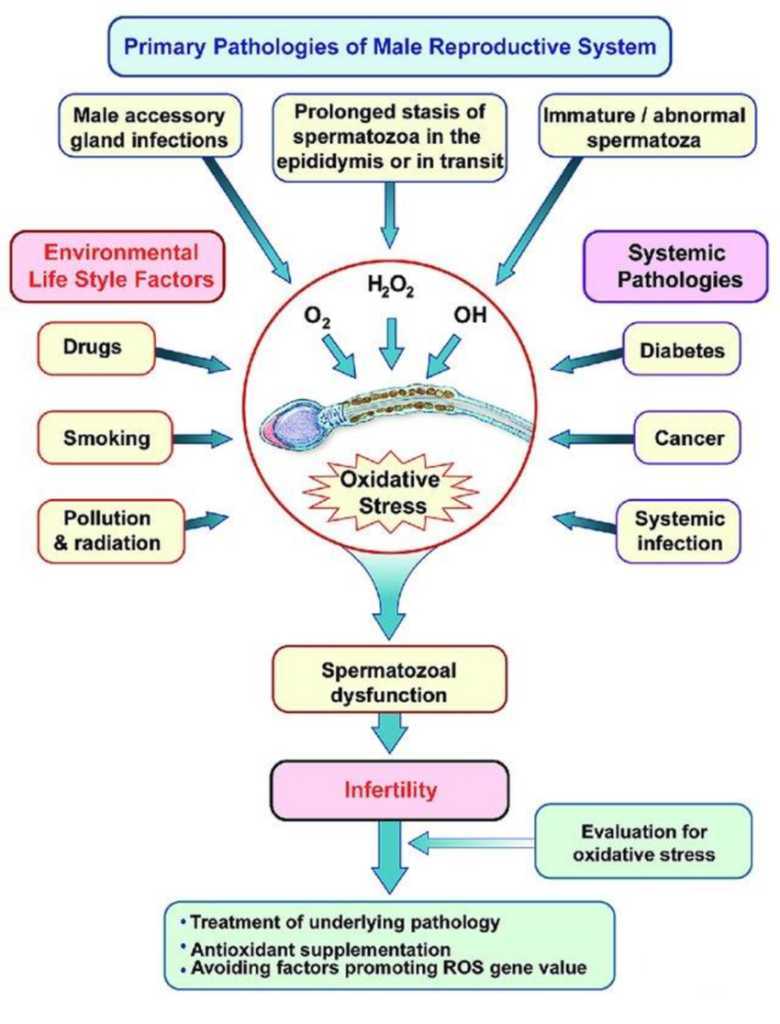
Our way, how we are living nowadays, diabetes, the quality, what you are eating also affects this. They produce abnormal spermatozoa. They alter the transit through epididymis that we have been talking about last week. And they affect the prostate, and they produce then finally infertility that we must evaluate when we have someone who has infertility.
How do they act? Through inhalation, skin contact, direct or indirect, have we seen intake, can be concentrated dependent. If it is more concentrated, it can be worse. It can indirectly through its metabolites and can act in a specific environmental situation. I remember one kind of plastic that was used for vegetables that don’t produce infertility or oxidative stress in men, but the metabolites in four degrees in the freezer can’t produce it.
It has been changed and removed nowadays. We don’t have this kind of plastic. Each of them can act in a specific or a summatory effect. If you have more than one of these substances, the summary effect of all of them can produce this kind of situation. They are very difficult to study and even to identify because we must know exactly how they can act, where they can act, and which kinds of different toxics can act more severely.
They produce:
The impact is terrible because they act, as you see here, in all those hormones that produce or participate in the production of the spermatozoa.
In the testicular history, the histology is the match we can see inside the testicle. It produces:
Here you can have a normal tubule, a seminiferous tubule, where you see the sperms, the mature spermatozoa, and here you have the Sertoli cells that help to mature these stem cells to become sperms.

Who is exposed? Everyone, all the time, is exposed to the intoxication of this kind of product. From the embryo, the evolution of the embryo, before the birth, that’s terrible. We are not protected, but the most important victims are the testicles of men.
The testicles act as target organs where these disruptors of endocrine have the best affinity because it’s very protected. Testicles, as you know, are very protected, so they can act directly. They have a very straight relationship between testicles and toxins.
We have seen already that they act in all those areas, in the testicles, in the seminiferous tubule, in the development of the stem cells until the mature sperm. In all the derivation of spermatogenesis, they can produce different types of mutations and the quality of the spermatozoa. They can change the quantity, movement, motility, and morphology of these spermatozoa. It’s very difficult to detect where they are.

Already in 1980, the World Health Organization determined that reproductive toxicology has a very important speciality because every year we have more than 30,000 new products that can become, in the future, toxic for fertile people. This is terrible because almost all those kinds of studies look for different types of toxicity, but there are very low studies to protect the fertility of human beings.
One of the persons that have worked a lot about it is Laura Valdenberg from Australia, and look what she says in 2017.
Early life exposure to chemical and chemical mixtures can predispose individuals to diseases that manifest later in life.
In the embryo, and when you are another, you can have a dose of duration already.
How low doses of chemicals during critical windows of development, like in embryos or just before becoming a baby, can alter gene expression, cell differentiation, tissue organization, and subtle ways that can lead to other diseases such as cancer, obesity, or infertility.
We know one of the most important is Bisphenol, which we can find already in the lactate memory gland, but even in women nowadays we can detect it and it’s very toxic for kids.
It has been defined today, generally accepted as the study of changes in gene function that are mitotic, in one of the moments of the division of the meiosis, and do not entail a change in DNA sequence.
Well, these endocrine disruptors can change it. It’s a pathology, a very severe and difficult way to treat them.
Another thing that is really very dangerous is that even you can have some generational inheritance of epigenetics. This means that the grandmother, if you have been in very straight contact of these kinds of products, can be transmitted to her descendants through those changes or mutations of these genes for chromosomes.
These epigenetic changes produce male fertility and now we know it. The exposure of a gestating female rat during the period of gonadal sex determination is produced by an anti-androgenic compound that we can found it in some types in food or on different kinds of plastic, or methoxychlor, an estrogen compound. They act over the hormones and this produce alteration of the spermatogenic capacity and increase the incidence of male infertility. It can be transferred through the male germ to nearly all males of the subsequent generations examined.
Why? Because those changes of genetic alteration, the changes of the epigenetic is transmitted directly through the spermatozoa, and they produce different types of patterns of germlines. That is the reason that why kids can have these changes produced by their own father.
The ability of an environmental factor as an endocrine interrupter to reprogram the germ is terrible because they change directly the genetics of these persons.
Here you have the different types of vegetable that can have a very high number of pesticides that can affect directly to human beings like tomatoes, pears, orange, lettuce, some teas like red or green tea from China, strawberries, we have it all around us. So, we must look how we can be protected of them.
Eggs are one of the foods that usually have pesticides received higher than the European Union standard. Even in June 2017, German authorities in Hannover moved more than 73,000 Dutch eggs from supermarkets after they were found to be contaminated with fipronil. That is terrible because eggs are normal food that we eat very frequently.
Phthalates are a sort of plastic that also can be very dangerous because they produce anti-androgenic, so they reduce the production of testosterone and affect the target organs, such as the testicle, even during the fetal development period until the puberty phase.
So, through all the growing of people can be affected. Nowadays, they are very controlled, but we are finding the phthylates in urine analysis.
Human urinary phthalates, what I am telling, we can find those metabolites labelled in higher quantities in urine even in seven parameters as chromatins factor, sperm or reproductive hormones. They act in different ways, as you see in the chromatin of the sperm, in the spermatozoa or even in those hormones that help the production of those spermatozoa.
So, it is terrible because they not only act in one way, they act in different ways. It’s very important for human reproductive health the widespread usage of phthalates. The investigation needs to correlate them, but we know exactly what is happening nowadays.
What can we do? Clinicians, and andrologists, must always attempt to identify the etiology of the possible testicular toxicity, and where it is acting and what they are doing to try to change this situation.
Assess the degree of risk to the patient being evaluated for infertility, to know exactly what we can do to change this situation, and initiate a plan to control and prevent exposure to others once an association between occupation/toxicant and infertility has been established. That is very important because we can change some of those things.
What are we doing?
What can we do?
We must be informed, and we must inform.

Here you have different types of information about plastic that, nowadays, we’re using. This one can contain bisphenol, so don’t use it or even don’t buy food that has this kind of product in its plastic.
This is another indication, if they have phthalate please don’t use it.
Don’t drink water directly through the plastic bottles, it is better to protect it without having light directly and drink it in normal water crystal water.
What we can measure?
Even nowadays, we can measure the quantity of PVC which is plastic in lipids that can cause severe oligozoospermia We must:
The patient must know where is the limit and where we can do reproduction techniques.
What are the recommendations?
I think this is the most important thing we’re talking about, such as:
What are the conclusions?
We must protect the future generation.
The scientific society will have to position itself to protect lobbies of power. That’s very important. We must be seriously taking care because, nowadays, more than 40% of people are looking to have kids and most of them have many fertility issues due to toxic products that the governments must take it out from the market to protect the future generations because alteration, quantity and quality, clearly puts human reproduction really at risk as we have seen already.
Moreover, the increased incidence of oncological pathology in young people as cryptorchidism, alterations of spermatogenesis and many other alterations are marking us that we must take into account professional responsibility and changes of approach in infertility treatments.

These are almost new studies that we are already making to detect and to know what is happening with these endocrine disrupting chemical products and how they are attacking. It’s an attack against the spermatozoa and they use their own testicles as a target organ to destroy the testicle.


