
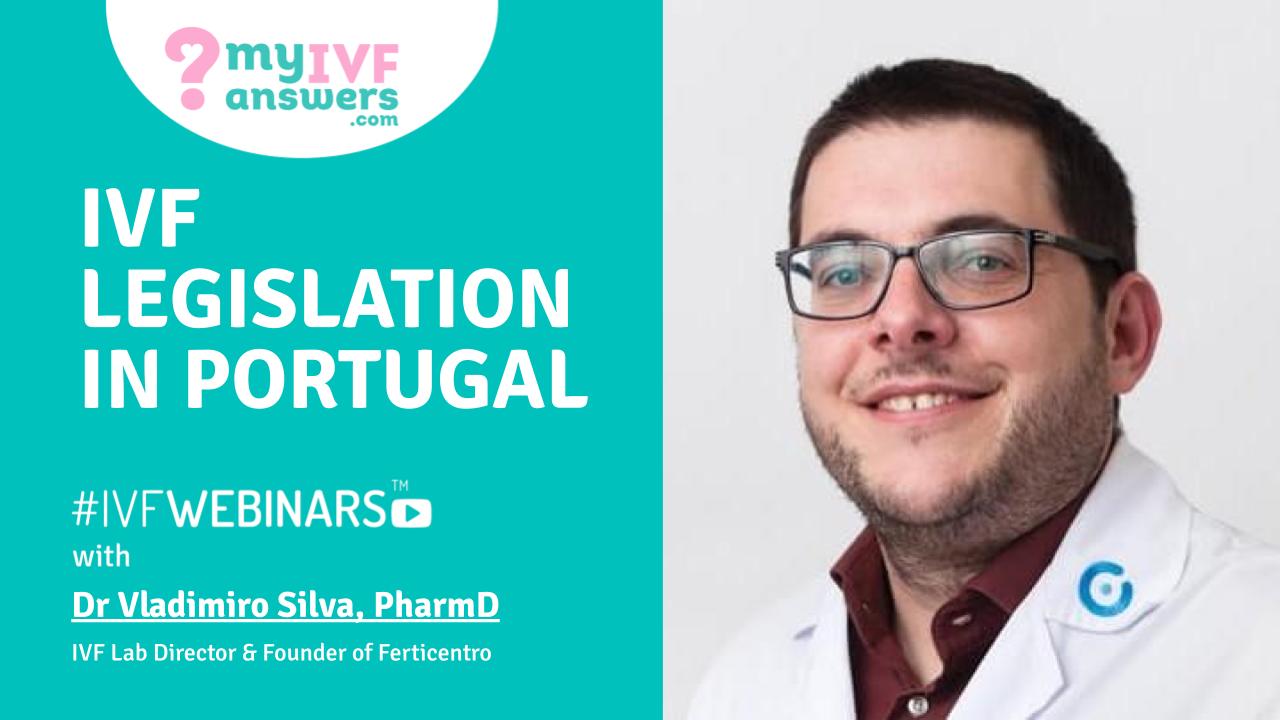
In this session, Vladimiro Silva, PharmD, Embryologist, CEO, Founder & IVF Lab Director at Ferticentro & ProCrear, Portugal, discussed IVF and non-anonymous egg donation laws and regulations in Portugal.
Dr Vladimiro expresses Portugal has a very special IVF legislation that creates a perfect environment not only from a technical point of view but also from an ethical patient’s rights and donors’ rights point of view.
He regards this kind of progressive IVF legislation is what will be the new normal in probably 10 years from now. By that time, he believes all countries will have laws that resemble the current Portuguese legislation. Furthermore, topics about anonymous donors and treatments that are forbidden in certain locations will be considered outdated and completely nonsensical for future generations.
It all starts with ethics and the importance of respecting the old process’s ethics because patients go to an IVF clinic because they want to have a baby. Naturally, when these patients go to fertility centres, they believe the treatment to become parents will work, and so they are willing to make sacrifices to build their families. This is the reason why Vladimiro affirms it is very important for patients to begin this next step in their lives with a good start and not in the wrong way because it’s certain that at some moment in time, some of these patients were not treated correctly.
When it comes to the ethics of accessibility, in Portugal, fertility treatments can be done for heterosexual and lesbian couples and single women. However, gay men couples are still not authorized to have IVF treatment in Portugal, which means that there are still some groups of people who are left outside the law for whom there still are legislation matters to work on.
Moreover, marriage is not a requirement to access treatments because, in the real world, you don’t need to get married to have a baby if you are not infertile. Vladimiro explains that ethics is also about non-discrimination towards people’s sexual orientation or marital status. Meanwhile, there are still some countries, in Europe, for example, where marriage is still a requirement to undergo IVF procedures. For instance, for lesbian couples who want to do the ROPA method, some countries still require that they have to be married, which makes absolutely no sense from a social and ethical point of view.
The other important factor in Portuguese legislation is that families are protected. In Portugal, there is a very strong regulatory environment with the IVF authority, which is called CNPMA, in Portuguese, which stands for National Council for Assisted Reproductive Technology, equivalent to the British HFEA or the French Agence de la Biomédecine and many other authorities across Europe. This is an authority that monitors, inspects and sets the rules by which IVF centres abide. This regulatory body also establishes quality standards, which are very demanding requirements that all IVF centres must comply with to be licensed.

Later, Vladimiro adds that Portugal has a system where IVF cycles are registered online and in real-time. On this web-based database from the national IVF authority, the identity of the patients is protected, only codes are registered, and the keys to those codes are only in each clinic’s system. In this way, the IVF authority knows exactly what clinics are doing and then when inspections take place, they can verify if all data was properly registered. All this monitoring gives assurance to the patients so they know that clinics cannot operate outside regulations and quality standards set by the Portuguese IVF authority. Vladimiro affirms that quality management systems have been legally required in Portugal for more than ten years, meaning all IVF clinics, whether public or private, must be certified.
The IVF Portuguese authority also grants access to transparent medical information. They make sure that the patient’s information is kept for 75 years. In terms of traceability, if something occurs in the life of a child born from IVF, the baseline information from the treatment where that person was born will still be available for most of the life of that person.
In addition, Vladimir emphasises traceability’s importance in treatments involving donors because the donor’s identity and traceability are also available for 75 years. Vladimir exemplifies this importance with a hypothetical case in which a patient gets pregnant after undergoing an IVF treatment using sperm donor 12345. And then another patient also gets pregnant from the same donor. In this case, if the first patient reports that a health condition was identified in their son at the age of two, for example, the second patient is immediately informed about it. This is possible, first, because IVF clinics are legally required to notify the Portuguese IVF authority, and second, all patients in Europe who have been treated with those straws are informed about the possibility of their baby being a carrier of some defective gene.
Dr Vladimiro explains that the difference with donations is that in Portugal there is this system in place that assures full traceability for those 75 years, so all families are notified in real-time. The reason why this system works particularly is because we have a law where donors are not anonymous. Advantageously, donors are people who know their identity will be revealed and people aware that the family to whom they donated will be happy with the process. This is not the case when patients deal with anonymous donors.
Donors’ rights are protected in Portugal. All donors receive proper counselling before and after donating. They also must agree with non-anonymity, and trust in the donation process, knowing that in the future someone, claiming to be their biological child, might contact them. This is something that will most inevitably happen.
Donors receive financial compensation that is transparent and it’s fixed by law. It is destined to compensate them for the time and loss of income that donors receive during the process. This compensation is fixed at 878 euros per egg donation and 44 euros per sperm collection. It is the same for both public and private IVF centres. Payments are done by bank transfer only. For this, donors must sign a receipt, which is kept as proof of payment.

Dr Vladimiro emphasises that:
The transparency of the process, stating there is no money under the table, everyone knows how much donors are paid, and there is no auction between clinics to seduce donors.
When it comes to the number of times donors can donate, egg donors can only donate four times in their lifetime, each donation being separated by at least three months from the other. Regarding sperm donors, they can donate to eight families. The number of times is regulated in real-time, which does not happen in all countries, where people can donate freely without monitoring,

This is regulated in Portugal since, before starting an egg donation cycle, for example, we must log in to the Portuguese IVF authority’s website, introduce the donor’s national ID code if the donor is Portuguese or the passport number if the donor is not Portuguese, and check for eligibility. Consequently, if the donor can donate, we get the donation code that assures the donor’s traceability. From the moment we get the donation code, that code will connect the results of the treatment with the ID of the donor, which will be particularly important if the child born from the donation wants to have access to it.
Vladimiro assures that in the hypothetical situation where the clinic where the treatment to a cell no longer exists, that information will always be available from the Portuguese state. It is a guarantee from the Portuguese state that access to the ID of the donor will always be granted.
From a donor’s perspective, donors should not be surprised if, at the age of 18, a child run from IVF wants to access their donor’s ID. Children born from IVF treatments want to get the name of someone fully aware of their existence and happy with this possibility. Donors know that they can be contacted in the future, and they are sort of expecting that.
However, donors do not have any rights over the children that are born. They cannot take the initiative to contact the children. This is the right of the child born from the IVF treatment, not the right of the donor or the children’s parents. Any possible contact will always be the initiative of the children.
It is widely known that we are a country known for being friendly to the LGBTQ+ community. Especially for lesbian couples because we even have this website called Pride Babies. This is an ongoing new project where we are already sharing information and testimonials. It is sort of a survival guide for both women’s couples and other people who are willing to have a child. We can explain what can and cannot be done, also since nowadays we have transgender patients for whom the Portuguese legislation has solutions.
For this project, former and current patients are helping us with this fascinating process. In the upcoming months, we will be conducting many webinars and initiatives.
Vladimiro says Portugal has very inclusive legislation in the case of lesbian families, in which both parties in the couple share the same rights over the embryos created and the children that are born. He explains that there exist multiple designations for the fertility treatment lesbian couples submit to. This treatment is known as the ROPA method, reciprocal IVF or shared motherhood. In this treatment, a lady carries a pregnancy that was obtained from her wife’s or her girlfriend’s egg and the sperm donor.
This is of paramount importance because in some countries, when a lesbian couple splits and there are still embryos available, the embryos belong to the person who donated the eggs. This would never happen in Portugal because, regardless of who donates the egg or who carries the pregnancy, and since marriage is not required, the woman who is not carrying the baby has the same rights over either the embryos or the children.
However, the rights over the children are a different issue because they depend on the country where the patient gives birth. If they deliver in Portugal, both are the legal mothers of that child. If they deliver in France or the UK, it is local regulations that apply.
People’s curiosity arises towards Portugal’s non-anonymous donor system, especially since it is a country often seen as very catholic and traditional. Vladimiro funnily adds that this system was created by accident. Some time ago, a very strict surrogacy law was approved in Portugal. Then, a group of conservative members of the parliament filed a complaint to the constitutional court against surrogacy, indicating what points in the Portuguese IVF law were wrong according to them. Afterwards, the constitutional court made a very original and curious decision by saying that surrogacy was possible in Portugal because it wasn’t against Portuguese legislation in the end; the law had to be rebuilt, and so they eliminated all the points from the law that were on that conservatives’ request. Later assumed by those members of parliament, they had accidentally added the anonymity matter to the list of points that were eliminated.
In the end and by an absolute accident, from one day to the other all donors were lost. Vladimiro explains this occurred because donors were anonymous and then, with this decision which became effective immediately, treatments that were supposed to be done the next day had to be cancelled because those donors had signed a document where they were supposed to remain anonymous.
Vladimiro says that in the first two weeks after that court ruling, they called more than 600 people and received the most pleasant surprise. 97% of our generous registered egg donors accepted to be non-anonymous. These were even people who had already donated a long time ago and had just signed a document stating that the children born from their donation could later have access to their identity. 70% of our sperm donors also agreed to become non-anonymous.
We, alongside public hospitals and the Portuguese Society for Reproductive Medicine, started campaigns to get new donors. Although there was a lot of debate going on, we have never had this many donors as we had after anonymity was removed from the law.
Currently, there is no shortage of gametes in private centres. We have even established the first private tagging sperm bank in Portugal which now other clinics are doing as well. He says it is thanks to the generosity of all of those young ladies and young men, we have been able to help thousands of patients from all countries and continents, especially European countries.
Dr Vladimiro explains it is a question of right because getting to know your origins is every person’s right, and it’s also something that you cannot prevent nowadays and certainly not in the future. There are DNA banks everywhere in the world that are collecting DNA from multiple individuals. You can order a DNA kit from home, which will cost you 99 euros, and then you can send your DNA to a bank. Afterwards, you will get a response saying, for example, that you are 20% African and 10% Nordic and have 27 cousins.
It takes sometimes just an afternoon to identify who your so-called anonymous donor is. It is very simple, you just send your DNA to those banks, and with the technology available nowadays, it is relatively simple to identify a donor, even if the donor has never sent his DNA to one of these banks.
There is no such thing as an anonymous donor.
Vladimiro affirms this has been the object of a debate in the scientific community. One of the main scientific publications in Europe indicates that genetic testing is likely to drive anonymous donation out of business because the reality is that there’s no such thing as an anonymous donor.

It will certainly become easier in the future with the fast development of genetic technologies. Vladimiro mentions as an example from 2019, banks with 15 million people on their database; and another one with 95 million users, 3.9 billion family trees and 12.4 billion historical records.
Vladimiro quotes the press story of a man from the Netherlands who already had 106 kids and probably a lot more on the way because of his uncontrolled sperm donations everywhere. Then he adds that one day that information will reach these children born from supposedly an anonymous donor. Eventually, it is preferable to do it in a controlled way instead of moving into the jungle of anonymous donations.
To further support his idea, Vladimiro mentions the study of the Y chromosome in which geneticists from the University of Leicester in England have found that millions of men living currently in Asian countries are descended from 11 very powerful dynastic leaders, as well as the well-known Mongolian warlord Genghis Khan. We can also use mitochondrial DNA studies, which go from your mother, who has received it from your grandmother, and so on and based on it, you can identify where your family comes from, since it is a part of the DNA that is only passed to us by our mother’s egg. These examples illustrate how relatively easy it is to identify donors.
Moreover, there are countries, for example, the USA, Canada and the Netherlands, where there are donor detectives. People are paying these companies to find their supposedly anonymous sperm donors’ identities. These services are being offered online so there is no way to end this because this is essentially a question of human rights. Also, there is a declaration from the parliamentary assembly of the Council of Europe that says that international and European human rights law has moved towards the recognition of a right to know one’s origins. They cannot make laws because every country defines their own, but they have a recommendation that anonymity should be waived for all future gamete donations. However, anonymity shouldn’t be lifted retrospectively unless donors want to experience what happened in Portugal.

It is all a matter of human rights. Of course, everyone who wants to have a child prefers to use their own gametes. But if for some reason a donor is needed, that donor’s DNA is part of the identity of their children, and children deal very well with that kind of information. This is why it is so important that we are transparent, that our children do not find out about this matter accidentally, and especially that the donors that have helped us to build our families are not confronted unexpectedly, without them even imagining that this could be possible.
To conclude, Vladimiro points out that the Portuguese system is the best solution, and he firmly believes it will be the standard regulation in 10 or 15 years. This is because it is a very ethical system where donors and families have their mutual rights respected, and where families have control about the moment on how and when the information is disclosed.
In Portugal with this environment and with the fact that we do not have any shortage of donors, we do not have waiting lists, and that has allowed us to keep our treatments affordable. So, it’s sort of a win-win combination.
You may be interested in reading: IVF in Portugal – legal aspects, availability and costs