
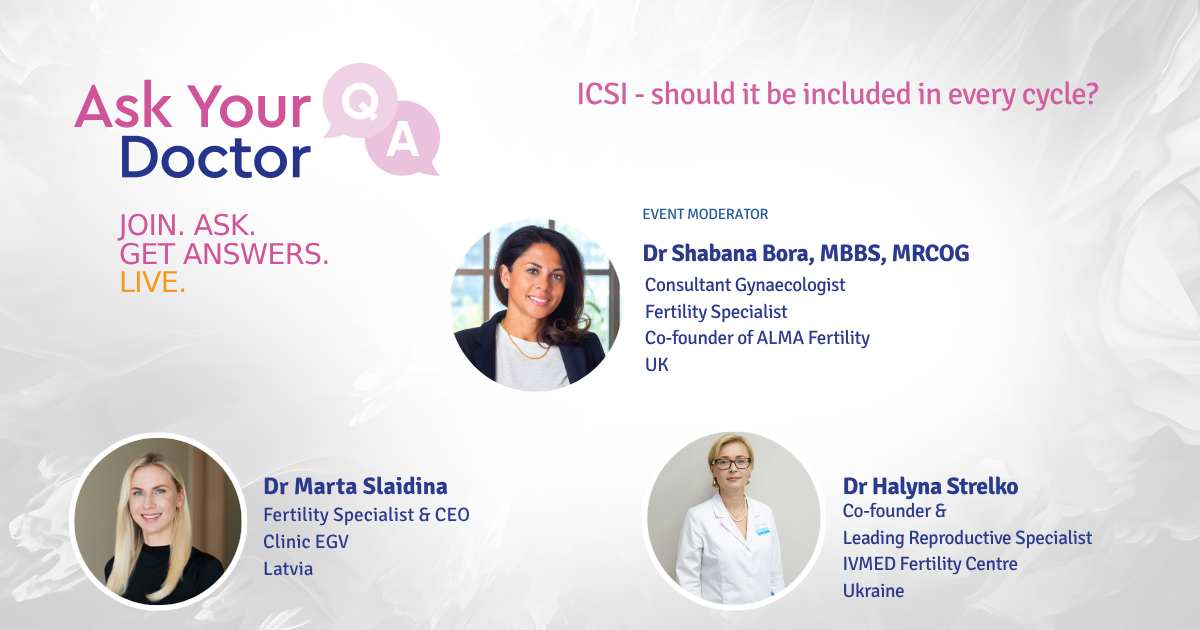
During this LIVE Q&A session, three leading fertility experts shared their insights on the use of ICSI across different countries and clinical scenarios:
Featured Experts:
Dr Marta Slaidina – Fertility Specialist & CEO, Clinic EGV, Latvia.
Dr Halyna Strelko – Co-founder & Leading Reproductive Specialist, IVMED Fertility Centre, Ukraine.
Hosted by: Dr Shabana Bora, MBBS, MRCOG – Consultant Gynaecologist, Fertility Specialist & Co-founder of ALMA Fertility, UK.
The doctors discussed how ICSI can help reduce the risk of total fertilisation failure, especially in cases of unexplained infertility. They also explored its role for women over 40 and those with low ovarian reserve, where minimising fertilisation risks is crucial. This session offered a powerful international perspective on how evolving clinical practices and policies are shaping fertility care — and how ICSI is becoming much more than just a solution for male-factor infertility.
Dr Shabana Bora, MBBS, MRCOG, ALMA Fertility, UK: ICSI was primarily introduced to place sperm into the egg and reduce the risk of failed fertilisation in couples with male factor infertility, low count, low motility, or higher concentration of abnormal sperm.
However, we are moving towards a more Western approach, even within the UK, where many cycles are now performed with ICSI as the first course of action, not just for male factor infertility. The drive for this is to reduce the risk of failed fertilisation. It will be interesting to hear what our experts from Europe have to say.
For our audience: approximately 95% of cycles in the US are now ICSI, and approximately 75% in Dubai. In the UK, we have always been fairly conservative, so it is about 50/50. Often, 50% of patients have IVF if they have normal sperm, and ICSI is reserved for male factor problems.
Dr Marta Slaidina, Clinic EGV, Latvia: I’m Dr Slaidina from EGV in Latvia. We are one of the biggest clinics in Latvia and the number one choice for patients whose expenses are covered by the government.
Approximately 10 years ago, we also had 50/50 IVF and ICSI for patients. When the government started to cover ICSI, this proportion changed. Now, for example, if we have approximately 5600 cycles per year, last year there were about 15 IVFs and 4500 ICSI. So you can see the proportion.
We also discuss when we should or should not use IVF or ICSI, and it is definitely connected with the quality of sperm, the number of eggs the woman has, and the age of both female and male partners. If the patient pays for treatment, they usually choose ICSI.
Dr Halyna Strelko, IVMED Fertility Centre, Ukraine: I am Dr Strelko. I have been working in IVF since 1999, so quite a long history.
It is true that for the last 10 years, most clinics have been doing ICSI, mostly because of financial issues, as patients paid for their cycles themselves. Only in the last two years have we had support from the government, where we receive a fixed amount of money regardless of IVF or ICSI. For ICSI, they pay a little bit more, but the difference is not big. We have the opposite situation compared to Dr Marta. In the last 2 years, the proportion of IVF has increased a little, but still, most of the cycles in our country are ICSI.
I agree with this because in standard IVF, there is a risk of unexplained absence of fertilisation. On the other hand, IVF is a more natural process, and the selection of the sperm cell is more natural. Some patients ask about that. It is also necessary to add that ICSI changes human evolution. In a natural cycle, sperm cells must survive and move for a long time. In ICSI, the sperm cell only needs to move for a short time. So, by choosing the sperm cell, we change the evolutionary process.
Dr Marta Slaidina, Clinic EGV, Latvia: As our embryologists say: “We are cool, but natural selection is the coolest.”
Dr Halyna Strelko, IVMED Fertility Centre, Ukraine: We have very good fertilization rates with ICSI—92% to 95% depending on the month. We have monthly statistics. In most cases, fertilization is very good, so we try not to change something that is working well.
Second, we do a lot of PGT cycles. For this purpose, it is better to do ICSI because before ICSI, we clean the egg, which avoids contamination of cumulus cells. This results in less abnormal fertilization compared to IVF. Sometimes abnormal fertilization still occurs, for example 3PN (3 pronuclei), 0PN (0 pronuclei), or 1PN, but the proportion is less than with IVF.
Dr Marta Slaidina, Clinic EGV, Latvia: We also performed PGT-A for IVF embryos in the last 3 to 4 years. It is something you can do, and we had good results. Usually, if you want to do PGT-A, you will do ICSI, but this trend has changed slightly now.
Dr Halyna Strelko, IVMED Fertility Centre, Ukraine: My patients sometimes ask to do ICSI because IVF can feel artificial and stressful, with injections and surgical procedures. They would like to have a more natural selection of eggs.
Some patients also mention medical reasons. Publications are reporting a small increase (1–1.5%) in cardiological problems in children born after ICSI. However, many studies comparing patients of the same age, sperm parameters, and pregnancy conditions with IVF suggest that this risk is likely related to IVF itself or medication, not the fertilisation method.
Dr Shabana Bora, MBBS, MRCOG, ALMA Fertility, UK: I tell my patients that the act of doing ICSI does not increase the risk of congenital abnormalities. Rather, creating a cohort of embryos in assisted conception means the resulting population of children includes cases that would not exist naturally. For example, in male factor infertility, offspring may have a slightly higher risk of male factor issues.
Dr Marta Slaidina, Clinic EGV, Latvia: We also check echocardiograms at 20 weeks and after birth, and at the anomaly scan, to monitor these risks.
Dr Marta Slaidina, Clinic EGV, Latvia: I think the patient should know, and my patients always know what choice they have. I am also a fan of ICSI. I like it. I love it, and my patients choose it. But for all my patients, I inform them that they can have IVF and why I chose for them to do the ICSI procedure.
Usually, for patients who come, if there is a fallopian tube factor, great sperm, great egg count, and young patients, yes, I can say we can try IVF. But then I say, for example, if something happens, let’s go with ICSI next time.
Dr Shabana Bora, MBBS, MRCOG, ALMA Fertility, UK: It effectively reduces the risk of having a failed cycle, especially because cost is often a significant factor. If you are trying to save money from having to do a second cycle, you want to optimise your chances from the first cycle by increasing the chances of fertilisation.
Dr Halyna Strelko, IVMED Fertility Centre, Ukraine: We are doing a lot of things in our clinic. We are doing IMSI, we are doing ICSI, we are doing spindle view before fertilisation. We are also doing microfluidic selection of sperm cells using a device we call the Sperm Chip, which permits selecting faster and more mature sperm cells.
For all these techniques, we can do only by ICSI. For example, with the Spindle Viewer, some eggs appear mature, but with the device we can see they have no spindle, or the spindle is formed later, or the spindle is abnormal. Sometimes we wait for fertilisation, but it is necessary to clean the egg to see it with the spindle viewer. After that, it is impossible to fertilise by standard IVF. For all these modern techniques, we should use ICSI.
Regarding 31% DNA fragmentation, it depends on the method because some methods give the cut-off at 26%, some at 30%, and some less. 31% is not very high. For me, the Sperm Chip microfluidic method of sperm selection will be the best way. ICSI or IMSI will not change a lot in this case.
It is also important to consider how many eggs there are, the age of the woman, and the quality of the eggs. Most sperm DNA damage may be repaired by eggs of good quality. If the eggs are poor and not very strong, it will increase the problem and decrease embryo quality.
Dr Marta Slaidina, Clinic EGV, Latvia: Other functional tests may also be considered, like MAR test (Mixed Antiglobulin Reaction) or HBA test (Hyaluronan Binding Assay), depending on the patient. I would definitely suggest microfluidics for this patient, and ICSI for me.
Dr Halyna Strelko, IVMED Fertility Centre, Ukraine: 31% is not a very high percentage, and with good quality eggs, normal ICSI should give a good result. But if we have only 2 eggs and a 41-year-old woman, it may be necessary to select sperm cells better or do some treatment before.
Dr Marta Slaidina, Clinic EGV, Latvia: Also, we advise adjusting abstinence before giving sperm. For cases with high DNA fragmentation, we suggest a maximum of 2 days, usually 1 day, maybe even half a day. Less abstinence results in younger sperm cells and less DNA fragmentation.
Dr Halyna Strelko, IVMED Fertility Centre, Ukraine: It also depends on sperm concentration. If there is a problem like infection, smoking, varicocele, or something else, it is necessary to see the context.
Dr Marta Slaidina, Clinic EGV, Latvia: I think it can be a concern, but for us, we don’t have any experience of damaging oocytes. Of course, there are many factors, and one of them is the qualification of the embryologist and operator.
Dr Halyna Strelko, IVMED Fertility Centre, Ukraine: There are even specific needles for ICSI with very thin points for fragile oocytes. For some patients with very fragile oocytes, it may be better to do IVF or do ICSI with these specific needles. But it is not very often. We do approximately 1,000 to 1,200 cycles per year. Maybe 3 or 4 patients per year have this situation.
Dr Halyna Strelko, IVMED Fertility Centre, Ukraine: There is a problem that DNA fragmentation may be due to different reasons. Some causes may improve after a secondary ejaculation, but some will not. For some damages, like external influence or varicocele, yes, it can help. But sometimes the problem arises during the maturation of the sperm cell, and it will not change a lot.
Dr Marta Slaidina, Clinic EGV, Latvia: We have experience advising on earlier ejaculation, but it does not improve results for all high DNA fragmentation cases.
Dr Halyna Strelko, IVMED Fertility Centre, Ukraine: We can have abnormal fertilisation with ICSI or without. For example, we have seen abnormal fertilisation with ICSI, and even after NGS, there can be tetraploid embryos. This may not be related to the method of fertilisation. Some eggs may give an abnormal number of chromosomal copies, or sometimes, to activate an oocyte, we need to do something extra. For example, we use calcium to activate the oocyte after ICSI when the sperm cell is not good enough to activate it. So this is not a problem of technique, but may be related to sperm cell quality.
Dr Marta Slaidina, Clinic EGV, Latvia: You can avoid some unpleasant surprises by choosing ICSI. You will see more controlled results by doing ICSI than IVF.
Dr Halyna Strelko, IVMED Fertility Centre, Ukraine: You are sure the sperm cell is inside, and if it is not, probably something is wrong.
Dr Marta Slaidina, Clinic EGV, Latvia: It is always your decision. You need to gather information. Usually, recommendations come by word of mouth. Patients also have forums where they share their experiences in different clinics. Of course, they may not always share the best experience, so we need to filter that.
It is also important to look for certifications, for example, ISO certification.
Dr Shabana Bora, MBBS, MRCOG, ALMA Fertility, UK: Some patients ask whether certain elements or add-ons are offered in countries outside of the UK that are not offered in the UK for various reasons. If she is going to do ICSI, choosing a good clinic in a foreign country is almost impossible.
Dr Halyna Strelko, IVMED Fertility Centre, Ukraine: Even for me, as a doctor, to choose a good clinic in my own country, I need to work there and see results from inside.
Dr Shabana Bora, MBBS, MRCOG, ALMA Fertility, UK: You can look at other people’s patient experiences and word of mouth, but it is difficult.
Dr Halyna Strelko, IVMED Fertility Centre, Ukraine: It is necessary to see statistics if the clinic provides them, especially if they do a lot of cycles. Certifications, including foreign certifications, can help, but it is still difficult to choose.
Dr Shabana Bora, MBBS, MRCOG, ALMA Fertility, UK: The patient mentioned she had ICSI for the first round due to poor sperm motility, and then no ICSI for the second cycle. For me, this is unusual because we tend not to go backwards. If IVF fails, you move on to ICSI. You don’t do ICSI and then go back to IVF.
There is so much cycle-to-cycle variation. Even from one cycle to another, you can get radically different results. Moving to another country will not necessarily improve your outcome. The reason might be cost or cost-benefit considerations.
Dr Marta Slaidina, Clinic EGV, Latvia: Online consultations can be very helpful. Connecting with the patient coordinator or doctor beforehand allows you to assess their responses, attitude, and whether you want a further relationship and trust with the clinic.
Dr Shabana Bora, MBBS, MRCOG, ALMA Fertility, UK: Personally, I think there is so much cycle-to-cycle variability. One cycle may not be the same as another, particularly if you have a low ovarian reserve because you have a lower cohort of eggs.
Dr Marta Slaidina, Clinic EGV, Latvia: If a woman is 50, we need to consider egg donors. For women over 43, we check ovarian reserves and always inform patients about the high risk of mutation and the higher risk of poor-quality eggs. Getting pregnant with her own eggs after 43 has about a 4 or 5% chance.
Dr Halyna Strelko, IVMED Fertility Centre, Ukraine: Recent articles show that for women who want to become pregnant after 42, cumulative pregnancy rates after 10 IVF cycles are very low. For ages 44–45, the rate after 10 attempts was around 6 to 7%. After 45, it is mostly zero. Another publication reported that 0.2% of women over 42–43 have a realistic chance of becoming pregnant with their own eggs. So it is possible, but the probability is very low.
Dr Marta Slaidina, Clinic EGV, Latvia: For women in this age group, you should act rather than wait. Usually, this involves donor eggs. Partner or donor sperm can also be discussed.
Dr Shabana Bora, MBBS, MRCOG, ALMA Fertility, UK: Some clinics have an age cut-off, even for donor eggs. In the UK, the majority of clinics have a cut-off at 50, even with donor eggs.
Dr Marta Slaidina, Clinic EGV, Latvia: In Latvia, we don’t have an official cutoff, but we have a cutoff in our clinic, and it is also 50 years old.
Dr Halyna Strelko, IVMED Fertility Centre, Ukraine: In Ukraine, there is no official cut-off, but after 50, it requires a kind of council. 3 or 4 doctors should agree that the woman is able to carry a pregnancy. Carrying a pregnancy after 50 carries very high risks of preeclampsia, diabetes, thrombosis, premature births, and other obstetrical problems. Preeclampsia is approximately 50–60%, and diabetes is around 10%, which is quite high. For women over 55, there are some ethical and moral objections.
Dr Marta Slaidina, Clinic EGV, Latvia: For patients wanting to try with their own eggs after 40, we definitely suggest PGT-A.
Dr Halyna Strelko, IVMED Fertility Centre, Ukraine: Yes. It is better to do ICSI. There are articles about the benefits of ICSI in younger women and in women over 38. For younger women, the benefit is not so high because they have more eggs of better quality, and even with not excellent sperm, the overall result is good. For older women with fewer eggs and lower quality, an additional fertilised egg may improve their results. Late reproductive age is more beneficial for ICSI than the younger category of patients.
Dr Marta Slaidina, Clinic EGV, Latvia: Women after 40 usually have lower ovarian reserves, which is another reason to suggest ICSI, perhaps after 35.
Dr Halyna Strelko, IVMED Fertility Centre, Ukraine: It is necessary to see the biography of the embryologist: publications, participation in conferences, and activity on social media. If an embryologist shows interesting cases and achievements, it can be helpful.
Dr Marta Slaidina, Clinic EGV, Latvia: All embryologists in our country are great, and this is also true for other concurrent clinics. They are passionate about their work and love being in the lab.
Dr Shabana Bora, MBBS, MRCOG, ALMA Fertility, UK: Embryology training is very rigorous. Embryologists must train for many years before they are qualified. Gametes donated for research are sometimes used to practice ICSI and biopsy. For a patient looking for a clinic, the number one thing is to look at success rates. The laboratory is paramount. The most important question is where the eggs and sperm will be fertilised and how the embryos will be handled.
Dr Marta Slaidina, Clinic EGV, Latvia: The best clinics usually have the best embryologists, and the best embryologists go where the best equipment is available, such as Embryoscopes.
Dr Halyna Strelko, IVMED Fertility Centre, Ukraine: We ordered it 2 weeks ago; it has not arrived yet. I use a lot of colony-stimulating factor before and after transfer because it improves the implantation rate. I prepared a presentation about it months ago.
It is very promising. Comparing results in egg donation programs with PGT-tested embryos, we observed a 30–40% improvement in implantation rate and a slight increase in miscarriage rate. With patients’ own eggs, implantation improves slightly, but the miscarriage rate is higher because fewer embryos are genetically tested. Overall, the results are better, but it is necessary to use good-quality embryos.
Dr Marta Slaidina, Clinic EGV, Latvia: Our embryologists also found that using this environment works better for frozen embryo transfer. They advised the protocol for GM medium, and now I can advise it to patients. I only advise things I believe in.
Dr Halyna Strelko, IVMED Fertility Centre, Ukraine: Normally, we use these substances for implantation; they are natural and will not be worse. It is something the patient pays for, so the couple needs to be informed.
Dr Halyna Strelko, IVMED Fertility Centre, Ukraine: Overall, during the year, pregnancy rates are around 45–47% for all patients. Egg donation is approximately 65% for young women.
For a woman at 39 using her own eggs, if ovarian reserve and egg quality are good, results will be good. Sometimes only 1 or 2 eggs are available, or quality is poor, making it difficult to predict. For women aged 39–40 with a good number of eggs, pregnancy rate is approximately 20–27%, depending on quality and quantity.
Dr Halyna Strelko, IVMED Fertility Centre, Ukraine: At 40, about 25% of embryos are genetically viable, equating to a 25% pregnancy rate. At 43, the rate decreases to about 5%.
Dr Marta Slaidina, Clinic EGV, Latvia: Patients often prefer to use their own eggs, and we usually advise trying with their own eggs first. If needed, donor eggs can be considered later. Sometimes patients need to go through this process themselves.
Dr Halyna Strelko, IVMED Fertility Centre, Ukraine: In 1996, my master’s thesis was on the genetic risk of ICSI. It was very new at the time, and we still discuss genetic risk today because some genetic problems can be transmitted to future generations.
For example, a mutation on the Y chromosome can reduce sperm number. Fertilising with this sperm will pass the problem to all male offspring. The genetic risk is not huge, but some sperm problems are genetically determined. Using ICSI can spread these problems in the population by producing embryos with these sperm cells.
I had a discussion with a man with such a problem. He said that if we can help me now, we may help his son in 20–25 years.


+ 1 more answers
+ 2 more answers

+ 1 more answers
Necessary cookies are absolutely essential for the website to function properly. This category only includes cookies that ensures basic functionalities and security features of the website. These cookies do not store any personal information.
Analytical cookies are used to understand how visitors interact with the website. These cookies help provide information on metrics the number of visitors, bounce rate, traffic source, etc.
| Cookie | Duration | Description |
|---|---|---|
| _ga | 2 years | This cookie is installed by Google Analytics. The cookie is used to calculate visitor, session, campaign data and keep track of site usage for the site's analytics report. The cookies store information anonymously and assign a randomly generated number to identify unique visitors. |
| _gat_UA-38575237-21 | 1 minute | No description |
| _gid | 1 day | This cookie is installed by Google Analytics. The cookie is used to store information of how visitors use a website and helps in creating an analytics report of how the website is doing. The data collected including the number visitors, the source where they have come from, and the pages visted in an anonymous form. |
Any cookies that may not be particularly necessary for the website to function and is used specifically to collect user personal data via analytics, ads, other embedded contents are termed as non-necessary cookies. It is mandatory to procure user consent prior to running these cookies on your website.
Other uncategorized cookies are those that are being analyzed and have not been classified into a category as yet.
| Cookie | Duration | Description |
|---|---|---|
| _gat_FSQM52 | 1 minute | No description |
| cf_ob_info | No description | |
| cf_use_ob | No description |


