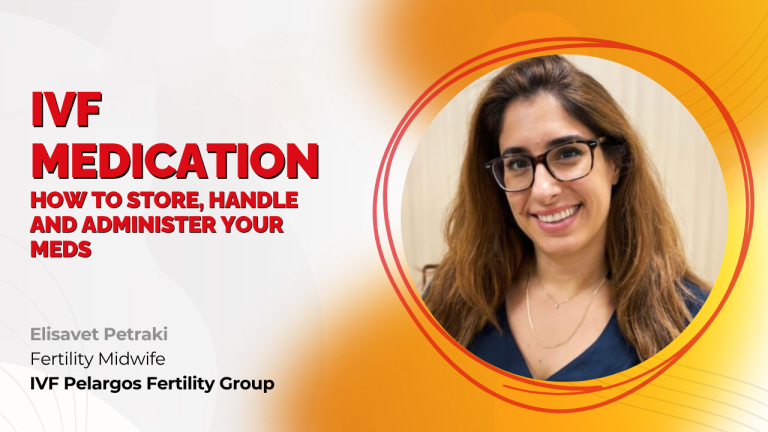


During this event, Dr Harry Karpouzis, Founder and Scientific Director of IVF Pelargos Fertility Group, explained everything you need to know about IVF with your own egg process, explained common myths and facts, as well as how to prepare for your IVF journey to obtain a successful outcome.
In this introductory webinar, Dr Harry Karpouzis explained the fundamentals of IVF with a woman’s own eggs, focusing on the basic principles every patient should understand before starting treatment. The session was designed as a step-by-step overview, especially for people at the beginning of their fertility journey.
Dr Karpouzis emphasised that while IVF can become complex, understanding the basics helps patients feel more informed, prepared, and confident throughout the process.
IVF stands for in vitro fertilisation. Dr Karpouzis explained that IVF means fertilisation happens outside the body, in a laboratory.
In practical terms, eggs are collected from the ovaries and sperm is collected from the male partner. These are combined in the laboratory under controlled conditions so fertilisation can occur. Once embryos are created, one or more embryos are transferred into the uterus, and any remaining embryos can be frozen for future use using vitrification, a modern freezing technique that does not compromise embryo quality.
Dr Karpouzis clarified that there are two main fertilisation techniques used in IVF:
In conventional IVF, eggs and sperm are placed together in the laboratory, and fertilisation occurs naturally.
In ICSI (intracytoplasmic sperm injection), a single sperm is injected directly into each egg. This technique was originally developed for severe male factor infertility but is now commonly used even when sperm parameters are normal.
As Dr Karpouzis explained, ICSI is often preferred when there are few eggs available, because it reduces the risk of failed fertilisation.
According to Dr Karpouzis, IVF is recommended in several common situations, including:
Blocked fallopian tubes, where natural conception is not possible
Severe male factor infertility, such as very low sperm count, motility, or morphology
Age-related fertility decline affecting both egg number and quality
Endometriosis, where IVF often offers the best chance of pregnancy
Unexplained infertility, especially when other treatments have failed
Polycystic ovary syndrome (PCOS) that does not respond to ovulation induction or IUI
He noted that IVF is also advised when less invasive treatments, such as ovulation induction or intrauterine insemination (IUI), have already failed.
Dr Karpouzis explained that fertility is assessed differently depending on age:
For women under 35, a couple is considered subfertile after one year of regular, unprotected intercourse without pregnancy.
For women over 35, investigation and treatment should begin after six months, as time becomes a more critical factor.
In older patients or in situations where time is limited, such as before cancer treatment, IVF may be recommended sooner to maximise success.
Dr Karpouzis highlighted that IVF is often the most effective next step when:
Other treatments, such as IUI have failed
There is unexplained infertility with low ovarian reserve
Both fallopian tubes are blocked
Rapid conception is medically necessary
He also noted that current clinical guidelines do not strongly support IUI in unexplained infertility, particularly when ovarian reserve is low, making IVF a more effective option.
IVF begins with ovarian stimulation using hormones similar to natural FSH and LH. These medications encourage multiple follicles to grow in the ovaries.
Stimulation can be done in different ways:
Conventional stimulation with injectable hormones
Semi-natural cycles using tablets
Natural cycles without medication
The goal is to allow follicles to grow to maturity.
Once follicles are ready, eggs are collected through a minor procedure known as egg retrieval. Dr Karpouzis explained that this procedure is straightforward and usually performed under sedation, especially when multiple follicles are present.
After egg retrieval, eggs are fertilised using IVF or ICSI. Embryos are then cultured in the laboratory.
At Pelargos, embryos are typically grown to the blastocyst stage (day 5), which allows better selection of embryos with higher implantation potential.
Embryos can be transferred in the same cycle (fresh transfer) or frozen for transfer in a later cycle.
Dr Karpouzis explained that freeze-all strategies are increasingly common, as frozen embryo transfers often result in equal or better success rates. Freezing may be necessary in cases of:
PCOS with high hormone levels
Elevated progesterone on trigger day
Endometriosis
Inadequate endometrial thickness
Throughout the presentation, Dr Karpouzis stressed that IVF success depends heavily on personalised treatment.
He explained that protocols should be adjusted based on:
AMH levels
Antral follicle count
Hormone blood tests during stimulation
Ultrasound monitoring
Medication doses, timing, trigger choice, and even the number of hours between trigger and egg retrieval can affect egg maturity and outcomes.
The main advantages of using one’s own eggs include:
A genetic link to the child
Emotional satisfaction of biological parenthood
However, Dr Karpouzis noted that success rates depend strongly on age and ovarian reserve. After age 40, both egg quantity and quality decline significantly, reducing the chances of success per cycle.
Before starting IVF, Dr Karpouzis recommended a thorough assessment, including:
AMH testing
Antral follicle count
Thyroid function (TSH ideally below 2.5)
FSH, LH, and oestradiol
Semen analysis
Ultrasound to exclude fibroids or polyps
Additional tests may be advised based on medical history, such as sperm DNA fragmentation, thrombophilia screening, immunological testing, hysteroscopy, or microbiome analysis.
Dr Karpouzis highlighted several key factors:
Evidence shows that egg number matters, especially with increasing age:
Under 35: around 12 eggs may be sufficient
35–37: 15–20 eggs
38–40: around 20 eggs
Over 40: often more than 20 eggs may be needed to obtain one chromosomally normal embryo
He stressed that while pregnancy is still possible with fewer eggs, statistically, “the more eggs, the better” in older age groups.
Embryo grading, embryologist experience, laboratory quality, and time-lapse technology all play a major role. At Pelargos, artificial intelligence systems are also used to support embryo selection and implantation prediction.
Preimplantation genetic testing for aneuploidy (PGT-A) involves biopsying embryos to check chromosome numbers.
Dr Karpouzis explained that PGT-A is usually recommended for:
Women over 40
Recurrent miscarriages
Recurrent implantation failure
PGT-A may reduce miscarriage risk and improve the chance of success per transfer, although it does not increase cumulative pregnancy rates from all embryos.
If IVF fails, Dr Karpouzis explained that further cycles are often needed. Additional investigations may include:
Genetic testing
Hysteroscopy
Endometrial tests
Immunology assessments
Advanced sperm testing
Supportive approaches such as acupuncture, lifestyle modification, and stress management may also play a role.
When the prognosis is very poor, alternative options such as egg donation or surrogacy may be discussed.
Dr Karpouzis acknowledged that IVF is emotionally demanding. He stressed the importance of psychological support, whether through professionals, family, support groups, or patient communities.
“IVF is stressful,” he explained, “and no one should go through it alone.”
Dr Karpouzis concluded by highlighting ongoing advances in fertility treatment, including AI-based embryo selection, new endometrial tests, PRP, mitochondrial therapies, and stem cell research.
While IVF is challenging, he emphasised that success rates continue to improve, offering real hope for many patients.
Hyperstimulation was a significant problem in the past. However, I haven’t seen severe cases in our unit for over 3 and a half years. The reason is that we now use vitrification, a freezing method that does not compromise embryo quality. When we suspect hyperstimulation, we freeze all embryos, which greatly reduces the risk—sometimes bringing it close to 0.
Additionally, we use special triggers when hyperstimulation is suspected. That’s why it is crucial to accurately measure follicle numbers and estrogen levels. By using the correct trigger and opting for freezing instead of fresh transfer, we minimize the risk of hyperstimulation. Clinics should have zero tolerance for hyperstimulation because modern methods allow us to prevent it.
We do not cancel cycles due to high estrogen levels. Instead, we can adjust the medication dosage, reduce the dose, or use other strategies to control the response. There are ways to prevent complications, so cycle cancellation is generally unnecessary nowadays.
Unfortunately, in Greece, the upper age limit for IVF is currently 54. Therefore, we are unable to offer treatment to patients aged 55 or older.
That’s a complex question. If we are talking about risks or problems for the baby, the answer aligns with what we explained earlier. However, if we focus on the chances of a positive pregnancy test, the situation varies. Nowadays, because ICSI improves fertilization rates, conventional IVF has been somewhat overlooked. However, in cases where sperm quality is excellent, without hidden issues such as DNA fragmentation or oxidative damage, conventional IVF may have benefits due to natural selection.
If the sperm is thoroughly assessed and no hidden issues are found, and if the patient is young with a good number of eggs, splitting between ICSI and IVF can sometimes be beneficial. However, as a general rule, when the egg count is lower or there is any male factor infertility—whether mild or severe—ICSI provides advantages in fertilization and the conversion rate to day-five embryos.
This is a difficult question to answer with clear evidence. It depends on the severity of the illness. If it’s just a simple cold without a fever, it shouldn’t have any impact. However, if it’s a severe flu, influenza A/B, or a COVID-19 infection, it could potentially cause issues, though the long-term effects are unclear.
A mild cold should not be a reason to delay stimulation. If there is no fever or other severe symptoms, I wouldn’t recommend postponing the process.
Yes, if more than one embryo is transferred, the likelihood of twins or triplets increases. That’s why it’s important to have a thorough consultation with your doctor before making this decision.
It depends on the age group and legal regulations in each country. For example, in Greece:
The law allows a specific number of embryos to be transferred depending on age. In egg donation cases, no more than 2 embryos can be transferred. However, it’s essential to balance the benefits and risks. Twin pregnancies come with higher risks, such as hypertension, preeclampsia, gestational diabetes, and an increased likelihood of a Cesarean section. If a high-quality embryo is available, transferring one can still provide a good chance of success while reducing complications.
ICSI is a variation of IVF—it’s still in vitro fertilization, but we inject the sperm directly into the egg. If the fertilization rate with conventional IVF is poor, then switching to ICSI is the logical next step. The decision depends on how many eggs were fertilized and the overall fertilization rate. The goal of ICSI is to increase fertilization success.
This is not a straightforward IVF case. While downregulation can help with adenomyosis and endometriosis, the timing is crucial. It’s generally better to first stimulate the ovaries, collect as many eggs as possible, freeze the embryos, and then downregulate before the embryo transfer. If downregulation is done before stimulation, it may reduce the number of eggs retrieved, which is particularly concerning in cases where endometriosis is associated with low ovarian reserve.
Endometriosis is a complex condition often linked to immunological and chronic infection issues. We use specific protocols tailored for endometriosis, which may include immunological treatments or antibiotics if chronic infection is suspected.
Egg quality is another challenge. Sometimes, improving sperm selection techniques can help, but if poor-quality embryos are consistently an issue, it may indicate an egg quality problem. In such cases, retrieving more eggs increases the chances of finding a viable one.
For severe endometriosis, surgical intervention before embryo transfer may be considered in rare cases. However, treatment should be highly individualized based on the full medical history.
Usually, we advise leaving a period before starting again to allow the body to return to normal hormonal levels. However, you can wait longer if needed. The length of the break depends on factors such as age and ovarian reserve. In cases of poor responders, especially women with low ovarian reserve, we sometimes apply double stimulation protocols. This means that immediately after egg collection, a second stimulation is performed to retrieve more eggs in one cycle. As a general rule, most patients wait for a full period before starting the next stimulation, rather than beginning immediately after the egg collection.
IVF is the only solution in this case. If one tube has been removed and the other is blocked, natural conception is not possible.
Regarding the fibroid, whether it needs to be removed is a separate issue. There are differing opinions on this. Fibroids larger than 5 cm may affect uterine contractility and could require removal before embryo transfer. However, if the fibroid is outside the uterine cavity, IVF can be attempted without removal.
If the question relates to whether removing the fibroid would unblock the tube and allow for natural conception, the answer is that even if the tube becomes patent, it may not function properly afterwards. Given the circumstances, I would recommend a proactive approach with IVF to maximize the chances of success.
We have not worked with this treatment. It is something I would need to review in more detail to assess the available evidence. While some studies exist, this treatment is not currently applied in practice in Greece. Before considering its use, we would need to thoroughly examine the scientific data supporting its effectiveness.
As of now, there is no conclusive evidence on how exosome injections would help improve fertility outcomes. It remains an experimental treatment, similar to stem cells from adipose tissue, which have been used but also lack definitive proof of success. Ovarian PRP and stem cell treatments have shown some promise in increasing egg quantity, but we cannot yet confirm their impact on egg quality or pregnancy rates. The same applies to exosomes.
Egg quality is a significant concern. Lifestyle modifications, including a healthy diet and fertility-focused nutrition plans designed by dietitians, can help. Certain vitamins have some supporting evidence, though no treatment is miraculous. The most well-researched supplements include melatonin, coenzyme Q10, vitamin D, and folic acid.
A combination of these vitamins may help reduce oxidative stress and potentially improve egg quality. However, the primary determinants of egg quality are age and genetic factors, and there is no guaranteed way to improve it. Experimental treatments like stem cells and PRP show some promise, but their effects on quality are not yet fully proven.
It depends on the individual case. For women with very low ovarian reserve, it may be better to use a natural cycle or estrogen priming rather than a pill.
For those with irregular cycles due to polycystic ovaries, the pill does not negatively affect outcomes and may even help regulate follicular growth, reducing the risk of dominant follicles disrupting stimulation.
In general, if the pill is used, we advise stopping it at least six days before starting stimulation. This is typically enough time for the ovaries to recover and maximize egg retrieval, unless the ovarian reserve is extremely low.
In the past, freezing techniques were challenging. Today, we use vitrification, a fast-freezing method that prevents ice crystal formation inside the embryo. This technique preserves embryo quality much better than slow freezing.
When embryos are thawed, some may not survive the process. However, in most cases, embryos that do not survive are of poor quality and would likely not result in pregnancy even if transferred fresh.
For the majority of embryos, vitrification does not negatively affect their quality. It is similar to storing food in a freezer—when done correctly, embryos can remain viable for several years and still have the same potential for implantation.
Okay, it’s a protocol. I don’t understand exactly the protocol. Most probably, it was a combination of Clomid and Menopur. We use it many times, especially in women with low ovarian reserve, because you do have a low ovarian reserve with an AMH of 6.5. We go a lot with the size and the number of the follicles as well. Usually, when we have more than 4 follicles, we prefer to go on high doses. When we have less than 4 follicles, there is no reason to use high doses because, even if we do, we will not get more than 3 or 4 eggs. These eggs can be obtained even with lower doses or pills.
Going ahead with a combination of a low dose of Menopur and Clomid is a protocol that we also use in women with low ovarian reserve with a few follicles initially. It works sometimes. We can also combine it with Duphaston, which prevents ovulation. It is a protocol that can give good results. There are other protocols as well, and always, one IVF cycle is experimental because we observe how you react and use this information for our benefit in a second attempt.
PGT-A involves removing some cells from an embryo, making it an intrusive procedure. In well-experienced laboratories, the risk of traumatizing or injuring the embryo is minimal. However, there is always a human factor involved, and sometimes, an embryo might be harmed by removing some cells.
You need to balance this risk against the risk of chromosomal abnormalities. The risk of chromosomal abnormalities in women aged 33-34 is relatively low, but it increases significantly in women aged 37-40. For women around 38–40 years old, the advantages of PGT-A outweigh the disadvantages. For women under 35, we lack clear evidence.
Additionally, PGT-A can sometimes yield conflicting results. It may indicate that an embryo is euploid (normal), aneuploid (abnormal and not transferred), or mosaic (partially abnormal). Some mosaic embryos may still be transferable after genetic counselling because they might develop into healthy embryos later. Since the biopsy is taken from the outer part of the embryo, rather than the nucleus, it is not 100% accurate.
Sometimes, PGT-A may rule out embryos that could have resulted in a pregnancy if transferred. It is a complex discussion. I am a big supporter of PGT-A because it helps determine the embryo’s genetic status and the reasons for failure. However, we typically recommend it for recurrent implantation failures, recurrent miscarriages, and patients close to 40.
Nowadays, some clinics use AI-based embryo selection, like the CHLOE system, which prioritizes embryos based on statistical data without causing trauma. This can be useful in cases where PGT-A is not necessary.
If someone has 9–15 follicles, they might be able to retrieve 9–15 eggs in one go. However, retrieving all 15 is challenging because not all will reach the right size at the same time. Realistically, you might get around 9 eggs per cycle.
At age 35, to have a 70% chance of success, studies suggest collecting around 15 eggs in total. This doesn’t mean that if you collect only 9 eggs, one of them won’t lead to a pregnancy—35 is still a good age with decent egg quality. Even 8 eggs might result in a pregnancy.
The number of embryos you obtain depends on sperm quality, egg quality (which is unpredictable), and other factors like genetics, hidden endometriosis, etc. You might get around 8–10 embryos, but this depends on the right protocol. Check the final embryo grading—if you have a high-quality blastocyst (e.g., a 4AA), your chances are good.
Herpes and other infections can affect sperm quality at the time of collection. However, if stimulation has already started, I wouldn’t stop the fertilization process because of a herpes infection. Instead, I would treat the herpes while proceeding with the cycle. If the concern is about passing the virus to the embryo—this does not happen through sperm.
Infections during sperm collection can impact sperm quality, but they do not necessarily justify cancelling the fertilization process.
I don’t know the grading of the embryos or the full details. If they were good-quality day-5 embryos, the issue might not be the embryos themselves. If you are open to egg donation, your chances would be much higher. However, if you are not ready for this step, another attempt with PGT-A might help identify if the embryos are chromosomally normal.
If failures continue, consider investigating other factors such as endometrial issues, chronic infections, implantation window, and immunology before another transfer. The patient mentioned having five good-to-medium quality embryos, meaning embryo development is not the issue. If the problem is not the embryo, even donor eggs might not solve it—so further investigation is necessary.
Some clinics do it, but in a high-quality lab, embryos should ideally be left to develop until day 5. The reason is that embryos reaching day 5 have undergone natural selection, eliminating weaker ones. Freezing on day 3 may result in transferring embryos that wouldn’t have developed further.
In our lab, we do not freeze embryos on day 3. The goal is not just to transfer an embryo, but to achieve a pregnancy. Day-5 embryos have higher implantation potential, so unless there is a risk of having no embryos at all, freezing on day 3 is not recommended.


Necessary cookies are absolutely essential for the website to function properly. This category only includes cookies that ensures basic functionalities and security features of the website. These cookies do not store any personal information.
Analytical cookies are used to understand how visitors interact with the website. These cookies help provide information on metrics the number of visitors, bounce rate, traffic source, etc.
| Cookie | Duration | Description |
|---|---|---|
| _ga | 2 years | This cookie is installed by Google Analytics. The cookie is used to calculate visitor, session, campaign data and keep track of site usage for the site's analytics report. The cookies store information anonymously and assign a randomly generated number to identify unique visitors. |
| _gat_UA-38575237-21 | 1 minute | No description |
| _gid | 1 day | This cookie is installed by Google Analytics. The cookie is used to store information of how visitors use a website and helps in creating an analytics report of how the website is doing. The data collected including the number visitors, the source where they have come from, and the pages visted in an anonymous form. |
Any cookies that may not be particularly necessary for the website to function and is used specifically to collect user personal data via analytics, ads, other embedded contents are termed as non-necessary cookies. It is mandatory to procure user consent prior to running these cookies on your website.
Other uncategorized cookies are those that are being analyzed and have not been classified into a category as yet.
| Cookie | Duration | Description |
|---|---|---|
| _gat_FSQM52 | 1 minute | No description |
| cf_ob_info | No description | |
| cf_use_ob | No description |
