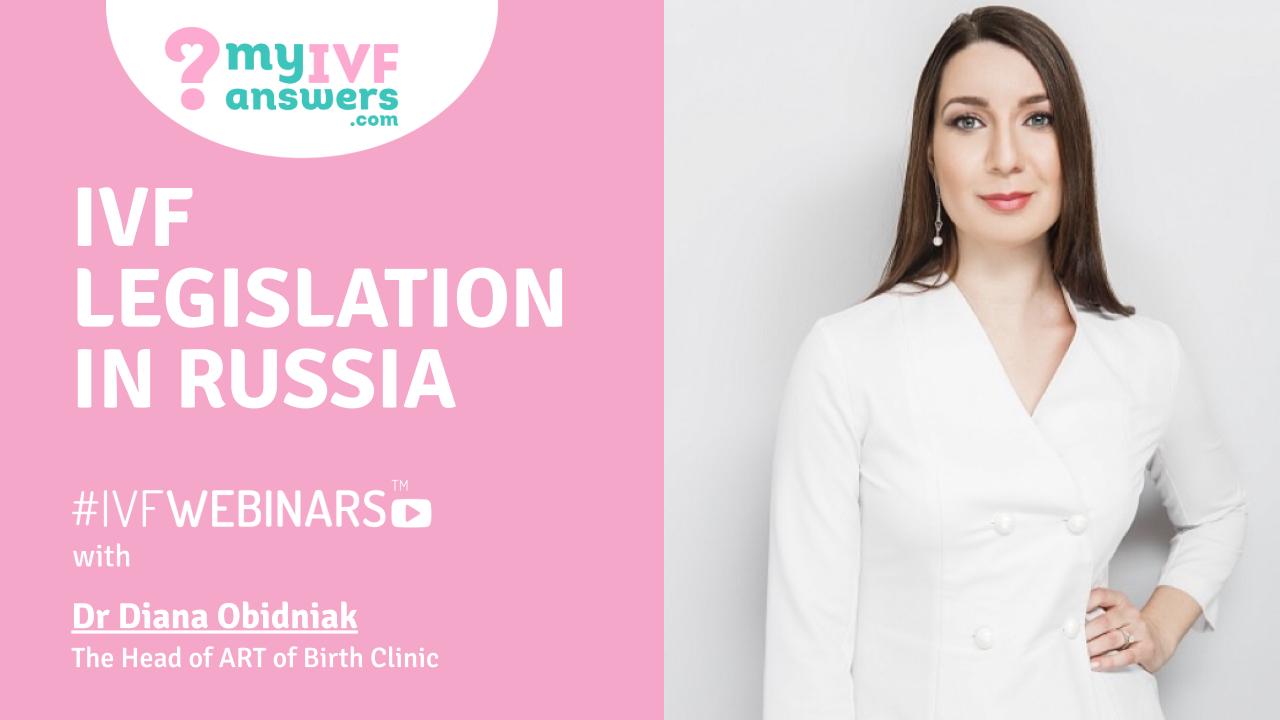
In this webinar, Dr Diana Obidniak, Fertility Specialist, The Head of ART of Birth Clinic in St. Petersburg, Russia, and National Representative of Russia at the ESHRE Committee, discussed IVF, egg donation, surrogacy, and legislation in Russia.
Nowadays, tolerance and respect are standard in medicine, but discussing IVF from the first approach, ethics, and IVF are very connected. Unfortunately, in the very beginning of the appearance of the medical area, the perception of patients, of social, and public wasn’t friendly in 1930.
The second wave of antagonism and haters appeared when the first IVF baby resulted in 1978. John Biggers, one of the pioneers of IVF in the USA, described public discussions in Virginia where the entire meeting turned out to be a shouting match; the two groups pro-lifers and IVF proponents hurling inside each other.
Today, we have the same issues because there are a lot of questions around IVF which require legal regulation; however, in Dr Obidniak’s opinion, physicians’ opinions, patients’ opinions, international associations of IVF specialists or fertility specialists, take part in this legal regulation.
The American Society of Reproductive Medicine sets a hard line:
Embryo transfer should be strongly discouraged or denied to any woman over age 50 with underlying issues that could increase or further obstacle risks, and discourage women over age 55 without such issues.
In Russia, there are no legal age limits. The decision is taken according to the individual status of the organism and to international IVF guidelines. However, usually after 50 years old, they recommend a surrogacy program because their aim is not only to get pregnant and to help you to get pregnant, their aim is to bring a healthy baby and not to jeopardize any risk to your health.
Is IVF allowed for single women or lesbian couples? The second question in terms of a legal regulation in each country is associated with treatment with practice on single women and one-sex couples.
In 2013, in the USA, the Committee opinion of the American Society for Reproductive Medicine called for programs providing IVF and other fertility services to treat all requests for assisted reproduction equally without regard to marital/partner status or sexual orientation. Therefore, this is thought in the same way in Russia. Here, IVF is legal in all cases, except embryo adoption plus surrogacy, because in Russia, they have to defend that there is a genetic association between the baby and at least one of the patients. So, in case a single woman has a donor sperm and uses her own eggs, they can undergo surrogacy. On the other hand, a single woman can use egg donation and sperm donation, but the embryo transfer will be done into your uterus.
This treatment isn’t as widespread in all countries, as in the US or Russia. However, Dr Obidniak states that very recently, in 1990, there was a worldwide discussion in terms of ‘catalogue babies’. It wasn’t considered as a good idea, even though there were several cases with sanctions precisely in Italy and Latvia, when patients were rejected to perform PGT-A and the law was always on the side of the patient.
Fortunately, according to Dr Obidniak, in Russia, it’s legal. They implement PGT-A in their everyday practice, very widely because they aim to help you to become a happy parent.
As a woman, I always think not only about the pregnancy or positive HCG test, we also think about the live birth rate. That’s how we measure our KPI and our effectiveness.
Is sex-selection possible? Sex selection, meaning nonmedical sex selection, isn’t allowed in terms of discrimination. For some people, the idea of utilising embryos of a specific gender isn’t allowed in Russia, but there are some cases where they can receive PGT-A. According to Dr Obidniak, they examine all the chromosomes, including the genital ones; so, in a standardized international report on PGT-A, there is an indication of which of the embryos is the male or female gender. In case they have both a healthy baby, a healthy boy or a healthy girl, they can ask if it’s important for the intended parents.
What is PGT-P, and when is it indicated? Another important and very interesting thing is the new technology called PGT-P that allows to select the embryos. Fertility specialists can provide genetic testing for polygenic diseases, for example, diabetes. Later on, Dr Obidniak shows one of the papers dedicated to this trial about pre-implantation genetic testing and relative risk reduction.
Nowadays, they have approached the way to select embryos with minimal risk of diabetes which is extremely important in cases when there’s some risk, for example, one of the intended parents has a medical history of diabetes and he or she doesn’t want such a destiny for the baby.
On the other hand, this is related to the question made by Dr Obidniak: being born is better than not being born? Thus, is it ethical and normal to make this PGT-P testing? Is it a discrimination for a new normal?
Nowadays we have no answer and I think that each of us can make a response, I bet that there is no right or false answer, but I want to invite you to think over our technology and think just precisely for you, either normal or not because I want you to play a game.
Very recently fertility specialists have seen that, in 1930, IVF technology was considered as something strange and not associated with science. So, now they have more abilities and more approach, not just to help you to get pregnant, but also to guarantee your baby will be healthy. However, sometimes it provides different concerns.
Egg Donation in Russia is legal, and Dr Obidniak shares a preview of good practice recommendations for information provision for those using and participating in reproductive donation.
Dr Obidniak is a national representative of Russia in the ESHRE committee, a European society for reproduction and embryology, so you can check and read this preview.
According to Dr Obidniak, this was a bit strange for her because these were very new guidelines for practice in donation, but there was no mention of COVID-19. However, in each country, there are a lot of guidelines that have similar clauses from countries to know how to minimize the risk and give new status in the world. This is also taken into account.
Furthermore, Dr Obidniak shares some general indications and terms of who is the donor in Russia. According to their law, the following are the requirements to become a donor:
About the surrogacy program in Russia, fertility specialists have extensive experience because the first one was implemented in 1995 in Saint Petersburg. The general public opinion is very surrogacy-friendly.
According to Dr Obidniak, with egg donation, PGT-A, or surrogacy programs, they always have to approve medical indications. The medical indications for the surrogacy program are:
For this reason, Dr Obidniak believes there should be contraindications for childbearing or inability to have successful implantation.
Fertility specialists consider certain individuals eligible to be surrogates:
Furthermore, surrogacy is regulated by the Family Code of Russia; therefore, persons who are married to each other and who have given their consent in written form to the implantation of an embryo in another woman for bearing may be entered as parents.
In regard to the law features, Dr Obidniak mentions the following:
Dr Obidniak recommends to not waste your embryos. Nowadays, due to the pandemic situation, they have a lot of inquiries and tasks from the intended parents that could not reach them. For this reason, they always have experience in shipping the embryos of sperm, which is legal and available. For the shipping, it’s just necessary to provide all the medical tests and embryo vitrification protocol.
It’s just different technologies. NGS24 is also called PGT-A, so uh can investigate all the chromosomes, and PGT-P is a pre-implantation genetic testing for polygenic diseases, for example diabetes, so it’s just different technologies. The aim of each of these investigations are very different; NGS24 is like a screening method, we investigate all the chromosomes and PGT-P is investigation for specific diseases, for example, diabetes.
Yes, for sure. All the donors have a screening method for the karyotype, it’s like a very rough testing, but all the donors also undergo genetic carrier testing for the panel, which includes more than 200 diseases. But, to complete this disease, we should do the same testing for the intended parent, the intended father, and then we analyse both data, not only from the donor, but we should exclude the match for any monogenic diseases. So, we always provide this data for the karyotype, but to complete the data if we have any risk for managing disease, we should also complete this same testing on man of on this panel for the intended father.
As we guarantee at least 15 eggs, we always measure AMH. According to the European guidelines, lower than 1.0 is considered to be low; so for sure we make examinations of the donor, but we measure AMH level, which should be at least 1.5. We also assess antral follicle count, so this rate AFC, because we also have to be sure that we have enough follicles according to the ultrasound. Usually we make two tests, I want to assess ovarian reserve image and ultrasound.
To tell the truth, the embryos are stored in specific so-called Dewar vessels, which are fully specific, so there are specific regulations. In our experience, the longest transportation was from Australia, it was more than 40 hours because it was just in the heart of the pandemic. We got stuck in the UK, but everything was good, and nowadays, we already have the embryos. What I want to say is that we have a specific courier system which has a lot of experience in transportation and shipping the embryos, so they have their regulations, and everything is very good and safe for the embryos.
Usually, preparation for shipping takes about two weeks, so about two weeks from receiving the documents from your side, but usually we take one month. According to the contract, we take responsibility for one month, but usually it takes no longer than two weeks.
I should clarify, in terms of Ukraine specifically, but in all other countries, it’s not necessary.
I agree that this size of adenomyoma is not an indication of operation for surgery, no doubt, but to tell you the truth, I need more information about the location of this adenomyoma. If it’s very close to the cavity, and it alters the cavity or the endometrium sometimes, we recommend making a preliminary before embryo transfer to provide conservative treatment, for example, because I want to clarify if it’s just leiomyoma or adenomyoma. If it’s adenomyoma, and we talk about adenomyosis, it’s better to make conservative treatment.
I’m a bit concerned about the doctor, about the last message that the doctor opened and saw because if we talk about adenomyoma, it should be approved according to the surgical examination and hysteroscopy. If we talk about such a case, it’s better to make conservative treatment according to all the guidelines of treatment of endometriosis, it’s better to make treatment from three to six months given your specific case. It’s better to listen to your physician, but it’s better to make treatment before planning embryo transfer.
I do love ERA tests to say the truth, but I agree that it’s not a routine method, and we have specific indications for performing ERA tests. If you had several biochemical pregnancies or molar pregnancies, sure it’s an indication to make an ERA test, and sometimes biochemical pregnancy can occur if we do not match to the middle of our implantation window. You also have a good point that the implantation has already started, but sometimes it’s just not the middle of the implantation window, that’s why pregnancy is initiated but stopped. I have very limited data about your case, so I do love the ERA test, but I do believe that we always have strong arguments and indications for each test.
We have a very good experience working with PRP technology, but I should also clarify because there are different methods associated with PRP technology, so by this moment, according to evidence-based medicine, there is evidence only for a PRP in terms of recurrent implantation failure or so-called thin or resistant endometria.
We use such a technology, so it can be perfusion or injection. If we talk about PRP as a stimulation of the ovaries, it doesn’t provide good results, I mean pregnancy because, according to the papers and our trial experiments, we obtain eggs, but it is usually called ‘activation of ovaries’ in women of advanced age and productive age. To say the truth we cannot fight with nature, and we cannot obtain healthy embryos, and, as we cannot obtain healthy embryos, we cannot provide a good pregnancy. So, unfortunately, by this time, PRP technology is limited by use only in terms of recurrent implantation failure or in cases of thin endometrium. If we talk about IVIG, we also implement it in our practice, but to say the truth they are very rare indications also according to evidence-based medicine.
It’s only an autoimmune disease, and it’s not associated with recurrent implantation failure or infertility. When we talk about pronuclear transfer or mitochondrial donation, we should consider them as a very prospective technology, but they are both experimental ones. So we perform such trials in the university, because I’m also an affiliated professor at the university, and we make it, but we do not perform it as a routine method, and we do not implement it in our work and our practice with patients because it’s a worldwide technology which is rather limited with evidence. I think that these methods are prospective, but still, there is a lack of information and evidence.
Yes, embryo adoption is legal. We make the transfer into the uterus of the intended mother, so we do not talk about surrogacy, but to say the truth, there is no waiting time. We cultivate all the embryos and just preside individually for each couple because we should select the donor who is very close to your phenotype and a sperm donor who is typically very close to your partner. To tell the truth, there is no waiting time, we need some time, for example, a week, to perform all the logistic details to select the donors and start cultivation, so it doesn’t take much time. Maybe it’s more correct to say that, depending only on your preferences and the speed of selection of the door.
When we talk about fresh cycles with egg donation, we always recommend to make pre-implantation genetic testing. As in your case, you have already frozen embryos, we should also weigh the risks and advantages of anti-freezing taking a biopsy, and then freezing once again. If there are no severe defects in sperm and there is no severe male factor, for example, when there is a low count of spermatozoa or 0% of normal spermatozoa, I wouldn’t recommend defreezing, making a biopsy, and freezing once again because in all the situations it can affect the quality of the embryo and its potential for the implantation. However, if, for any reason, unfortunately, this embryo will not implant, think about making another simulation with PGT testing.
Necessary cookies are absolutely essential for the website to function properly. This category only includes cookies that ensures basic functionalities and security features of the website. These cookies do not store any personal information.
Analytical cookies are used to understand how visitors interact with the website. These cookies help provide information on metrics the number of visitors, bounce rate, traffic source, etc.
| Cookie | Duration | Description |
|---|---|---|
| _ga | 2 years | This cookie is installed by Google Analytics. The cookie is used to calculate visitor, session, campaign data and keep track of site usage for the site's analytics report. The cookies store information anonymously and assign a randomly generated number to identify unique visitors. |
| _gat_UA-38575237-21 | 1 minute | No description |
| _gid | 1 day | This cookie is installed by Google Analytics. The cookie is used to store information of how visitors use a website and helps in creating an analytics report of how the website is doing. The data collected including the number visitors, the source where they have come from, and the pages visted in an anonymous form. |
Any cookies that may not be particularly necessary for the website to function and is used specifically to collect user personal data via analytics, ads, other embedded contents are termed as non-necessary cookies. It is mandatory to procure user consent prior to running these cookies on your website.
Other uncategorized cookies are those that are being analyzed and have not been classified into a category as yet.
| Cookie | Duration | Description |
|---|---|---|
| _gat_FSQM52 | 1 minute | No description |
| cf_ob_info | No description | |
| cf_use_ob | No description |