

In this session, Dr Uliana Dorofeyeva, Director of International Cooperations at IVMED, Ukraine, and a Medical Director at OVOGENE Egg Donor Bank, talked about IVF, egg donation and other treatments’ legislation in Ukraine.
In this webinar, Doctor Uliana Dorofeyeva talks about IVF legislation in Ukraine, which she considers very important because millions of people around the world are experiencing infertility. Part of them would start using their own oocytes and own sperm, which are treatment strategies widely available in the world. However, some regulations are changing.

You have probably heard about the historical moment of changes in France when it started to be allowed to treat married official couples as well as single men and women and unofficial couples. Legislation is changing, and opportunities are here, but before COVID-19, many patients from different destinations all over the globe needed to experience and learn about different countries and different regulations because of the limitations in their home countries, especially limitations for some kinds of treatments, such as egg donation and surrogacy.
If you cannot find an alternative or you’re not producing your oocytes and you need, for medical reasons, egg donation treatment and there’s no allowance in your country, you should look for opportunities elsewhere or other alternatives. This is the same for surrogacy if it’s indicated for medical reasons.
Something important to discuss is medical tourism for IVF. This is to reduce the cost for cross-border medical treatment to look for the same high-quality care and services in different destinations and, sometimes, it’s also combined with attractive destinations which is also nice.
I’m proud that Ukraine is one of those countries which has been receiving many patients from all over the globe, and I remember this like last year 2018-19 before COVID started, when we received over 500 patients from more than 30 countries during a year for different kind of IVF treatment, especially for egg donation, surrogacy, and some special alternatives which we call ‘experimental treatments. – says Uliana.
Dr Dorofeyeva has been practising IVF since 2008 and mostly works for international markets between clinics, partners, and also for international patients. She goes on to show a graph that involves Ukraine, Spain, the Czech Republic, North Cyprus, Greece, Russia, Poland, and more, from Egg Donation Friends’ website. Here you can see that from November 2020 until the end of the first quarter of 2021, there is post-COVID data that shows the number of registrations of patients who are looking for treatment in different destinations.
Moreover, Dr Dorofeyeva gives detailed information about Ukraine.
Oocyte donation is probably one of the most common treatments.
IVF in Ukraine is regulated by the Family Code of Ukraine, and the instructions of the procedures for the use of assisted reproductive technologies are approved by the order of the Ministry of Health. This law hasn’t changed since 2013.
According to Dr Dorofeyeva, regulations are quite strict from the beginning and they aren’t going to be changed.
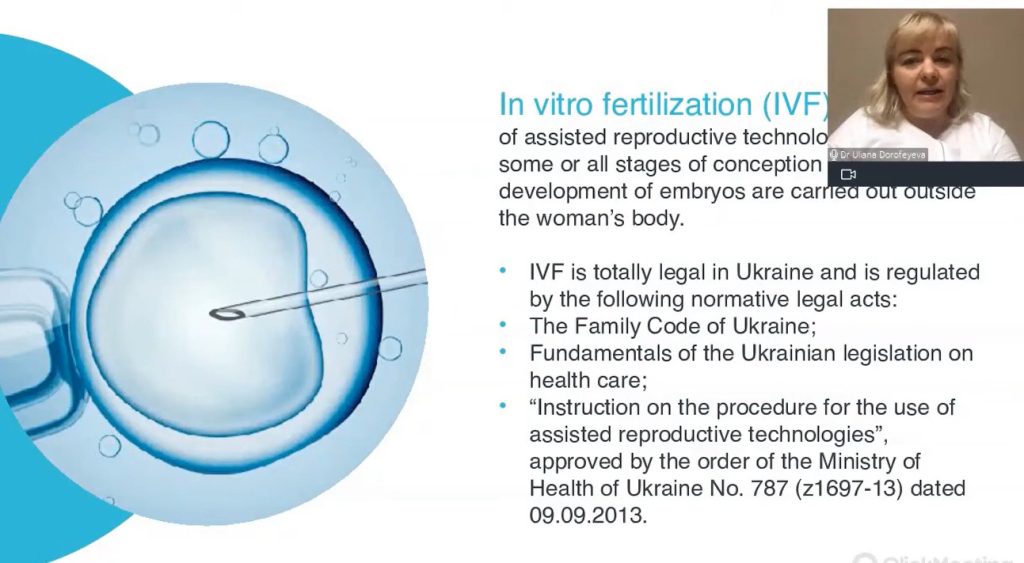 In Ukraine, they’re working to have a reproductive law; however, it should be based on the order of the Ministry of Health. This states that:
Moreover, article 123 of the family code of Ukraine determines the origin of a child born as a result of the use of assisted reproductive technologies. This says the following:
It’s important to mention that the age limit for IVF treatments in Ukraine isn’t determined, so adults who have medical indications, both male and female, for the use of ART technologies can be treated by IVF techniques.
Moreover, the decision and procedure are established by each clinic independently taking into account ethical and moral forms. Generally, you will hear from the clinics that the age limit is probably 51, 54 or 56 years old; however, they would definitely consider the somatic status and the health status of the patient.
Genetic testing of the embryos is performed to reduce the risk of hereditary diseases, and they can increase the frequency of the pregnancy.

This treatment can also indicate the possibilities or the risks of giving birth to the child with mutations of any isolated gene or with chromosomal abnormalities which have been detected as a result of medical and genetic examination.
Moreover, PGD may be performed at the patient’s discretion in the presence of the application for the pre-implantation genetic testing in the form of an Annex from the order of the Ministry of Health.
Experimental treatments aren’t specifically regulated by the law. In Ukraine, these include the ovarian rejuvenation, mitochondrial donation, pronuclear transfer, IVIG treatment, which are performed in accordance to the medical evidence and practical experience of the physicians and the experts in the clinics. Nevertheless, this is done after having signed consent and after considering all medical risks for the patient.
This, article 48 of The Law of Ukraine, states the following:

Furthermore, by the Order of the Ministry of Health, there are different types of donations allowed:
The oocyte donor candidates should be:

Nevertheless, egg sharing or so called egg sharing for oocyte donation, isn’t as common as in another countries. The privilege of oocyte donation are anonymous or non-anonymous considered by law female donors who are donating for the need of the infertile patients.
The requirements, by law, for oocyte donors are the following:
Dr Dorofeyeva mentions the indications for IVF treatment with oocyte donation, which are:

The requirements to be a sperm donor are the following:
In addition to the regulations by law, clinics may also decide regarding the specific signs or, for example, in Dr Dorofeyeva’s practice, they don’t allow donors to be over 30 years old because of the presence aneuploidy of the oocytes and they also control the quality of the biological materials donated by donors. Also, other criteria could be additionally dedicated by the clinics.

In embryo donation, the donor may also be a patient of IVF programs who, after birth, has their cryopreserved embryos stored in the clinics. To donate those embryos, they should sign a consent form.
Moreover, donated embryos could be created from donor oocytes and donor sperm.
In addition, under the voluntary, informed, written consent of donors or patients, these embryos may be used for the treatment of infertile couples who are recipients, as well as female recipients or single women.
Embryo storage isn’t limited by law as it is in some countries in the world where there’s limitation for 5 or 10 years of the storage of the biological materials for the patients.

In Ukraine, you may store your materialsfor as long as you wish. There should be just a signed statement due to which there’s an agreement for the storage of the embryos in the specific medical institution for the certain period of time. However, this period may be prolonged.
Furthermore, the clinic may destroy patients’ embryos only after receiving voluntary consent, originally signed by the patients. Nevertheless, Ukrainian law doesn’t have any procedure which regulates this issue; if there’s no signed document from both sides. Also, this can happen when many of the clinics are storing a lot of embryos and patients, especially patients from abroad, aren’t communicating with them.
Therefore, you must make sure that if you haven’t provided written consent with two original signatures, your clinic shouldn’t destroy your embryos.
According to Dr Dorofeyeva, the transportation of biological materials across the Ukrainian border is happening; however, there is no specific law which regulates this transportation. She also mentions being the co-founder of the Association for medical transportation because there are some discrepancies and some questions which need to be answered.
What they recommend to patients, because a lot of the transportation of biological materials is happening from Ukraine to different destinations as well as from different destinations to Ukraine, patients should provide a statement and an act of transferring cryopreserved embryos. There’s a draft of this act which you will receive by the clinic as well as a letter that the biological materials are ready to be sent and that another clinic is going to receive them.
Moreover, for the transportation through the customs, there should be a special code received for those biological materials. For this reason, it’s better to use special companies who have experience in this and, preferably, to be performed as the hand carry because there’s no specific procedure and to avoid keeping these materials for the long time in the customs.
It’s also known that the special containers, where the transportation is performed, have a certain time once they keep these special conditions and safe conditions for the embryos. Therefore, this should be well controlled and by the dedicated people; however, it’s happening quite often.
If this is happening to the company, they will avoid X-rays. If the clinic provides the statement that the material shouldn’t be x-rayed, and according to Dr Dorofeyeva, who has been involved in many of those transportations, the big airports which formally know the procedure, don’t perform the x-ray for the biological materials.
Additionally, different IVF techniques and the procedures are allowed and performed successfully in Ukraine, such as IVF, ICSI, IUI, Assisted Hatching, Frozen Embryo Transfer, Oocyte Donation (both fresh and vitrified embryo donation/adoption), Social Freezing and Preservation, PGS/PGD, Experimental treatments, and Ovarian Tissue of Cryopreservation.
Dr Dorofeyeva mentions some of the reasons why people should choose Ukraine to undergo treatment.
In many countries, the procedures are very limited or not allowed, such as oocyte donation and surrogacy.
Most of the procedures are much less expensive than in some comparable countries with the same quality of care and treatment. The quality of care and treatment in Ukraine is extremely high and you need to be specific in terms of selecting the clinic because, as mentioned before by the doctor, there are over 60 clinics practicing in Ukraine.
I’ve been working since I started my practical experience in the clinic, which was second on the territory of Ukraine, and we’re joking that even our IVF specialists are all quite young, your professional experience and expertise are not according to your age, however to the number of the treatment cycles you performed. – says the doctor
Even right now during the COVID situation, there’s no quarantine. This is also important to mention because patients may go even during all the time of the quarantine for the medical treatment.
You just need to ask your clinic and your physician to provide this data and all good clinics have this very specific information due to the infertility related to the age of the patient. Therefore, they are very open to share this.
These clinics, which are busy and take care about their patients, have enough oocyte donors or use egg banks. They usually have enough surrogates to start treatments immediately.
Moreover, their donors have extraordinary beauty and the proven fertility. The clinic also follows the screenings according to the regulations, not only in Ukraine but also for international regulations. This involves extended genetic testing, psychological deep evaluation for the donors, including all infectious disease with the PCR testing that gives more certainty about the detection of the infection.
For donors, Dr Dorofeyeva mentions that in her bank, they check the quality and the previous results, so they may share this data and predict the result from this donation. They only use very successful donors with great results.
To select a clinic in Ukraine from the huge list would be:
This is very easy to get right now. Some clinics, out of this big list, are ISO certified. This means you can ask for the internal procedures, instructions, SOPs for the specific procedure and how it’s going to happen.
Specifically for international patients, this is important. You need to have a person who will be 24/7 in touch with you answering all questions providing very detailed information with regards everything, starting from the accommodation, cost, success rates, how long should you stay in Ukraine, and what will be happening during each stage of your treatment.
The doctor can do a lot and the clinic can evaluate your previous history. Very often, patients who go to the clinic for a second opinion, are those who have repetitive negative outcomes before and they’re doing a lot in terms of the evaluation of the medical history of looking for the specific reason for their infertility. However, without a successful and well-experienced team of embryologists, this would be just a half of the success.
We may say that our embryologists in our team are the best. – affirms the doctor.
They need to be by the international requirements which is easy to follow.
The clinic also knows what needs to be done additionally, and this is a comfort for the patient to do this all in one location with the same team.
Clinics are communicating very openly now and every patient who has experienced the treatment in that clinic will be happy to share his or her experience.
This is important because there should be clear agreements and clear guarantees. In good clinics, not even one lawyer is working; however, a legal team is also involved in explaining all the details in terms of, specifically, surrogacy which always comes with many of the questions as it’s really time consuming and not an easy procedure due to the regulative aspects.
Due to the COVID situation and even before, part of the activities in clinics as well as their responsibilities was to provide export of biological materials out of Ukraine and to help different clinics and their patients all over the globe to stay at their home country with the best comfort and avoid travelling as well as get the biological materials in their home country, if possible, and regulated by their law.
Therefore, they’re sending a lot of oocytes and embryos created in Ukraine to different destinations. You just need to share with the clinic where you are located, and this will be possible, as well to avoid travelling to Ukraine. Nevertheless, you should get some of the treatment done in your country under the agreements between the clinics.