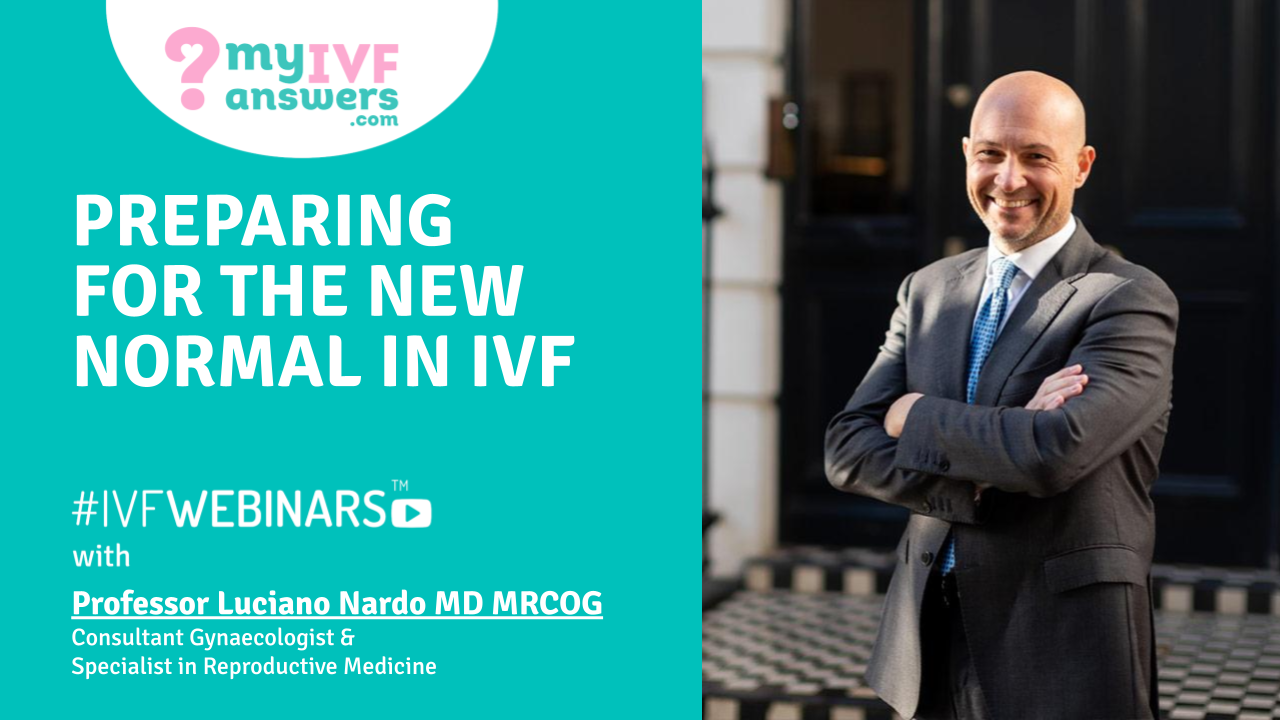
Prof. Luciano Nardo, MD MRCOG, Consultant Gynaecologist & Specialist in Reproductive Medicine is discussing going back to operation in IVF clinics after the lockdown and preparing for the new normal in IVF treatments.
I’m going to start talking about a new topic, the “new normal” in IVF. The ‘new normal’ of work, healthcare, business, travel, and multiple industries is being written now as the world is getting prepared to restart after the COVID-19 pandemic.
It was quite interesting while I was preparing myself for this presentation to see what other industries have come across with, and what are the challenges and all the suggestions that we plan to introduce in the field in order to move forward.
Moreover, this is a very interesting article that was published recently in The Guardian, ‘When Covid-19 has done with us, what will be the new normal?’ From online GPs, home working, smartphone tracking, the speed which we’re embracing technology is certainly unprecedented.
One of the most appreciated historians wrote in the Financial Times 3 weeks ago:
Pandemics press the fast-forward button on history. Suddenly, changes that would in the pre-corona times have generated years of debate, dissent, hesitation, opposition, and delay turn out to be possible overnight.
This is an unprecedented time. This is a one-in-a-lifetime for most of us, I hope, but what does the future look like in IVF clinics?
Professional organizations, professional societies such as the European Society of Human Reproduction and Embryology in Europe, the American Society for Reproductive Medicine in the United States, and two professional societies in the UK, the Association of Reproductive and Clinical Scientists and British Fertility Society, have now produced some guidance.
It’s very interesting how irrespective of being Europe, being America, or even being the UK, there is a common knowledge that we need to stay safe, we need to practice safely and effectively to protect patients and staff.
We also know from the Royal College of Obstetricians and Gynecologists that Coronavirus in pregnancy is not as dangerous as we would have expected. At the moment, there is no concern that pregnancies resulting from IVF could collapse and in an early miscarriage or pregnancy be affected by Coronavirus later on; however, we are all aware that more epidemiological studies, more information is required.
The two professional bodies in the UK, in the very well written guidance, I lighted five key points.
The Human Fertilisation and Embryology Authority, which is the UK government regulator, has also produced some useful information for healthcare professionals and for patients. There’s been a huge amount of work done by many professions in the UK, in Europe, and worldwide about trying to tackle the issues that fertility professionals and fertility patients undergoing treatment could face to these unprecedented times.
The HFEA produced guidance for healthcare professionals and patients. It has also kept records of all produced documents and made them available to patients and professionals.
The news was very welcomed on the 1st of May that fertility clinics will be able to reopen in the week commencing the 11th of May. This is based on the General Direction 001 in the UK that was lifted.
We, on the same day, welcomed the news on our website and, at the beginning of the current week, we’ve been working on making sure that everything we could do to make the clinic safe, to provide efficient and effective treatment to our patients, could be done.
One issue that we put some thinking beyond was whether patients starting fertility treatment should go into a sort of prioritization list. Our answer to this was no.
The many reasons why patients would embark on fertility treatment, but irrespective of the underlying reasons, infertility is a disease and despite practicing for 20 years in this field, I have never come across a patient or a couple that wanted to have an IVF treatment instead of trying to conceive naturally for fertility purposes. So, it is not a choice to embark on fertility treatment, so all patient populations should be treated the same when it comes to accessing fertility care.
This is also more important for the patient population that unfortunately embarked on a fertility treatment during the decline in the fertility stage of life.
As it can be seen in the graph, with advancing chronological age, the number of follicles decreases and the number of poor egg quality increases. It will not be certainly appropriate for women between the age of 30 and 40 to wait to start treatment because there might be other patients that are higher priority to begin fertility treatment.
The six main adding points or principles are:
I truly believe that there is no better time to meet the challenges posed by COVID-19 than to look at each of these principles and look at how each of them can make us better, change our lives, change our practice, and help us to adapt to a new life. Covid-19 will be with us for some time. I think we all need to accept it, we need to adapt to the changes as long as the safe and sustainable transformation will lead to efficacy.
Some questions asked are:
In line with the European Society of Human Reproduction guidance, the American Society for Reproductive Medicine guidance, and the UK professional bodies guidance, at the beginning of the week, we began with a long and working journey to risk assess everything we do.
Risk assessment means identifying the risks and the questions we asked ourselves about:
This is fundamental because identifying the risk now helps to mitigate the consequences.
Once we have assessed the risks, the next step is how to mitigate the risks. That means what measures we be put in place to reduce the risks. This leads to significant changes in the clinic within every department.
Risk mitigation entails:
In addition to general measures to mitigate the risks in the clinic, we have to go into a great deal to create some practical and logistical changes. For example:
Some clinical measures have also been introduced and some policies have been created and followed.
I think this is quite important to make it clear, all patients undergoing treatment would be triaged at some critical points during the treatment. At the time of a collection as well as at the time of embryo transfer or on the day before performing the procedure, patients will be presented with a triage questionnaire. If the patient develops symptoms since the last clinic appointment, we will advise to freeze the embryos. We are still uncertain about the effect of coronavirus in pregnancy, all the pregnancy and the fetus although initial reports are quite reassuring I think it’s fair that we will provide the freeze-all policy in order to mitigate any potential and unknown risks.
These very much depend on the clinic. In our clinic we have come up with a solution to ensure that patients and staff are protected from the risk of COVID- 19 infection before they attend the appointments and what we have done, we’ve created some patients PPE packs, so the patient’s will collect their own personal protective equipment pack and they will be invited to wear masks, gloves when they attend the clinic so we’re not taking the chance of patients coming to the appointment as we would be providing them with everything they need before they attend the clinic.
Absolutely, before patients enter our clinic and I suspect most clinics, they would be triaged, there be temperature will be screened. In our clinic, we are about to install a temperature screening pod which is similar to a screening that we are used to seeing at security sites within airports. The visitor will step from outside into the pod and his temperature will be screened by a member of our team before the person is allowed in. Once the person is within the clinic we are fortunate because of space within our clinic, but we will be limiting the number of patients within waiting areas, and we will maintain safety, the physical distance between patients and clinic staff. All the patients and the staff will adopt a mask policy, and depending on the circumstances, the clinic staff will also be wearing face protection devices.
There are no guidelines about being infected after the embryo transfer. That’s what infection has to be confirmed and what we use in our clinic and is the easier method which is 90 % sensitive and 100% specific to confirm ongoing all past infection. We recommend that patients have conceived after the embryo transfer, and they do get infected, then they will follow the national guidelines in terms of managing the pregnancy. The Royal College of Obstetricians and Gynaecologists in the UK, in their most recent guidance to patients, don’t say that pregnancies will be affected by the coronavirus. Clearly, we are just at the early stages of this pandemic, and we are waiting for more meaningful and robust information. What I would say is that 81% of healthy individuals may be asymptomatic or may have only mild symptoms. In time there will be a large proportion of pregnant women that would become infected, and as time goes by, we will acquire more information to provide robust advice but also add good guidelines.
The quick answer to that question is no. It is not because of the COVID-19 that we’ll be using a freeze-all policy. Within our clinic and many other clinics in the UK and worldwide, there’s been a move towards frozen transfer cycles anyway, and there is growing evidence, and there is published literature to indicate that the chances of a successful IVF cycle ending with a live birth are not significantly affected by the freezing, thawing and transfer of blastocyst. In our centre, the live birth rate of cycles, with the transfer of frozen versus fresh blastocysts is very much the same. This will certainly depend on the patient population, on the quality of the embryos, but more importantly on the freezing and thawing expertise policies and procedures available within each lab. Within our laboratory, we have 98% of our cryopreserved blastocysts that survive the thawing process, so 98% of blastocysts survive and are suitable for transfer.
Well, this is not possible. In the UK the government regulator advised all the clinics to complete the fertility cycles by the 15th of April. That means the advice was given when the lockdown started on the 23rd of March, so we had about three weeks to complete all the treatment cycles. There is no patient, that I’m aware of, at the moment in any IVF clinics in the UK that is in treatment unless it is a cancer patient as the government has allowed the provision of fertility services for fertility preservation in cases of cancer. Before the lockdown, treatment was in place, and treatment had to be completed after they lockdown by the 15th of April if not clinics had to cancel the treatment cycles. Now that we plan to reopen as soon as the HFEA permits IVF clinics to reopen. The measures put in place and also the strategies that each clinic will employ should limit the risk of cycle cancellation, but inevitably cycles may be cancelled if patients become symptomatic, test positive or decide themselves to cancel because they may be aware of becoming in contact with somebody that could potentially be infected.
It very much depends on what protocol and for controlled ovarian stimulation you will be needing for your treatment. There are some protocols where you can go straight from the pill straight into the stimulation. You don’t have to wait for any length of time, there are some protocols when you need to stop the contraceptive pill, but in that case, the period should return within 5 to 7 days, and that is when you can resume or start the fertility treatment.
Necessary cookies are absolutely essential for the website to function properly. This category only includes cookies that ensures basic functionalities and security features of the website. These cookies do not store any personal information.
Analytical cookies are used to understand how visitors interact with the website. These cookies help provide information on metrics the number of visitors, bounce rate, traffic source, etc.
| Cookie | Duration | Description |
|---|---|---|
| _ga | 2 years | This cookie is installed by Google Analytics. The cookie is used to calculate visitor, session, campaign data and keep track of site usage for the site's analytics report. The cookies store information anonymously and assign a randomly generated number to identify unique visitors. |
| _gat_UA-38575237-21 | 1 minute | No description |
| _gid | 1 day | This cookie is installed by Google Analytics. The cookie is used to store information of how visitors use a website and helps in creating an analytics report of how the website is doing. The data collected including the number visitors, the source where they have come from, and the pages visted in an anonymous form. |
Any cookies that may not be particularly necessary for the website to function and is used specifically to collect user personal data via analytics, ads, other embedded contents are termed as non-necessary cookies. It is mandatory to procure user consent prior to running these cookies on your website.
Other uncategorized cookies are those that are being analyzed and have not been classified into a category as yet.
| Cookie | Duration | Description |
|---|---|---|
| _gat_FSQM52 | 1 minute | No description |
| cf_ob_info | No description | |
| cf_use_ob | No description |