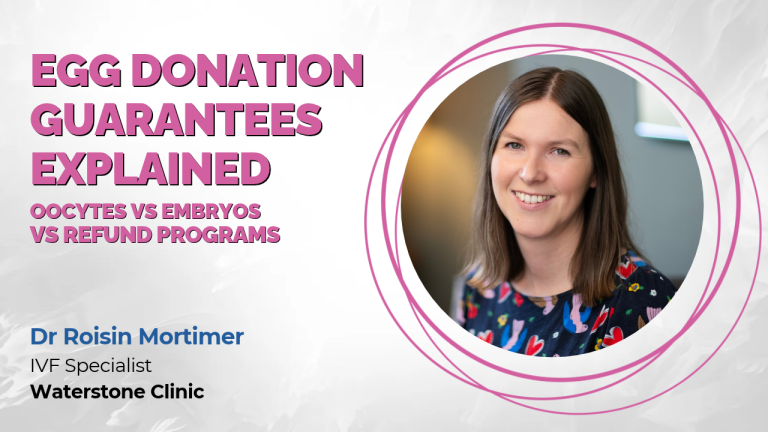


During our patient meeting with Dr Leticia Flores Roldán, a fertility specialist and gynaecologist specialising in laparoscopy, endometriosis, and reproductive medicine at NatuVitro in Barcelona, we explored the pros and cons of IVF with Donor Egg Guarantee Programs. We discussed key considerations, including egg donor matching, the step-by-step process of egg donation in Spain, refund policies, eligibility criteria, and the emotional and psychological impact of entering a guarantee program.
The session was hosted by Jessica Bourke, widely known as The Fertility Detective – a fertility expert with nearly 20 years of experience, TEDx speaker, and creator of Making Sense of Miscarriage™ and Fertility ReSet 2.0™.
I think it would be good to start by talking about two really basic concepts: the ovarian reserve and the quality of the egg. This is where everything starts. The ovarian reserve is the number of follicles that we have in our ovaries at a certain moment. When we are born, we are born with a certain number of follicles. Then, when we start our period as women, we start wasting those follicles. Although we just ovulate one egg with every period, it makes sense if I tell you that with age, this reserve diminishes with time.
About the quality of the egg — it’s the same. After a certain age, around 35–36 years old, the quality of the egg starts getting lower. Egg donation is indicated when a pregnancy is not possible with a patient’s own eggs because of age, for example, or because the quality of the egg is very low. We have very low ovarian reserve in some young women as well. It can happen. Other cases include ovarian failure or patients who have had 3, 4, or 6 IVF attempts that were unsuccessful.
The Spanish law tells us that we have to assign the donor as similar, typically speaking, to the patient. What we do — the advantage of our clinic is that we have our own bank of donors. All our donors are between 18 and 34 years old, more or less.
The Spanish law tells us that the donation has to be altruistic and voluntary. Of course, they can receive some compensation, but only for any inconvenience or any expenses they have to cover to come here.
Barcelona is a really cosmopolitan city, so we have donors from all around the world. They can be Caucasian, Asian, African, or Latin American. Basically, we have all phenotypes, all ethnicities. The thing is that we have to assign them as similar to the patient. For example, the patient can ask — if she’s from Asia, for example — if she can have an Asian 100%. We have donors like that, but the law tells us we must assign a donor as similar as her phenotype.
They must pass extensive medical and psychological screening, including genetic history testing. We do the karyotype test, full blood work, and tests to ensure that the donor is completely clear of any infections. This includes infectious diseases and sexually transmitted infections like HIV, Hepatitis B, and Hepatitis C.
We also do a gynaecologist assessment to see that they don’t have low ovarian reserve, and a psychological evaluation. We have to be sure they are developed in a healthy environment, that they don’t use any drugs, and that they are not using any anxiolytic or antidepressant treatments. Once all of that is clear and everything is fine, then we can proceed with the ovarian stimulation.
This is a question that we get a lot. Studies have shown that they are equally moved by altruism because they have some family, or someone close to them, who has fertility problems. Aside from that, Spain has one of the highest donation rates in Europe — not only for eggs but also for blood, bone marrow, and other organs — reflecting how strong the culture of solidarity and altruism is.
The most important point, and the reason why they do it, is a personal connection to fertility or donation.
Jessica Bourke: Especially with fertility treatment being 45 years old now, a lot of the donors who are going forward were either conceived through IVF or they were donor-conceived themselves. They feel that they want to pay it forward. So yes, it’s actually true that that’s the case.
No, they cannot choose. This is one of the Spanish laws. It is completely anonymous. They cannot know anything about the identity of the donor, and the donor cannot know anything about the patients. They cannot choose anything.
It’s not like in the USA. In the USA, it’s like a catalogue — you can know everything about the donors: where they went to college, what they did, their medical background, studies, everything.
Of course. If we happen to have two or three choices of donors for the patient, normally, this is discussed with the doctor and with the donor department. If there’s something we are unsure about, we can ask the patient, of course.
Yes. It’s so much better — the rates of successful fertilisation are higher.
I completely recommend doing the preimplantation genetic test. The preimplantation genetic test — the PGT-A — is used to study aneuploidies. PGT-A studies aneuploidies, which tells us if the embryo is chromosomally normal. When we do the PGT test, it happens once the embryo achieves day 5 or 6 — the blastocyst stage — which is the strongest stage of the embryo. It has expansion and differentiation of cells and is mature enough to be tested.
We take 3 to 5 cells and test that tissue. From that, we can know if the karyotype is normal, for example, trisomy 21 (Down syndrome), trisomy 18 (Edwards syndrome), trisomy 13 (Patau syndrome). It studies all 22 pairs of autosomes and the sex chromosomes, for example, Turner syndrome or Klinefelter syndrome. It also tells us if there is mosaicism. If we do the PGT test in the first attempt, we have more chances of getting pregnant — our chances are higher.
Without the PGT test, the success rate in the first attempt is 70%. With the PGT test, it goes up to 85%.
We offer the option to do it from the beginning. I think it’s ideal for patients who prioritize safety, success, and top medical standards.
The parameters that we study are concentration, motility, and normal forms. We have some criteria — the minimum criteria — so we can guarantee a blastocyst.
First of all, a spermogram, and depending on the result, we proceed to the FISH test. If we see that we need to do a FISH, then we do it. But first, the spermogram — it’s the basic one.
Jessica Bourke: The FISH test, which is more common in Spain, is fluorescence in situ hybridisation. That looks for chromosomes within the sperm and specific damage. It isn’t quite the same as a sperm DNA fragmentation test. But to anyone, in whatever country you’re in, you can do that test before you’re going.
Also, what’s interesting with egg donation is that those younger eggs can fertilise the sperm. They can make damaged sperm better in certain cases — not if it’s super damaged, but just for people to be aware of that as well.
There’s no difference if it’s a fresh or frozen transfer, just as there’s no difference if it’s a fresh oocyte or a frozen oocyte.
Statistically, it’s almost the same. For example, if an oocyte is frozen under –196°C, and then we thaw it and put it back to 37°C, if you compare them, they are almost the same. Nowadays, it doesn’t matter. If you think about egg donors, if we happen to have them frozen, we already know and can guarantee how many oocytes we are going to thaw. They have already studied — all of them. So we already have them, and the waiting time is lower.
We might have to wait one month, one month and a half, in case we don’t have it. There could be a six-week wait time if you need something very specific, but otherwise, there shouldn’t be.
In the clinic (NatuVitro), we have 5 programs, with or without the PGT test. The first one is the blastocyst guarantee, which includes one embryo transfer.
Another program is 1+1, which includes the first embryo transfer. It has to be said that we only transfer embryos of good quality — minimum 3BB in the Gardner classification. These are not genetically tested embryos, but they must meet minimum aesthetic requirements in terms of development. All the programs can be without the PGT test or with the PGT test.
1+1 blastocyst guarantee program means we transfer the first embryo. If a pregnancy is achieved and continues beyond 24 weeks, then the program is complete. If there is a miscarriage, no implantation, or the pregnancy ends before 24 weeks, then we provide another blastocyst to transfer.
The third program is 1+1+1, which means there are up to 3 blastocyst transfers. If we don’t achieve a pregnancy, don’t get a clinical pregnancy, or there’s no implantation, we can transfer a second or third blastocyst as needed. The program is fulfilled when the pregnancy reaches more than 24 weeks.
Jessica Bourke: Just for anyone who isn’t aware, at the 24-week mark, even though it’s extremely premature, a fetus is considered viable. That means the baby has a chance of surviving. From the clinic’s standpoint, viability is defined at 24 weeks, not the typical 38 or 40 weeks, because delivery could happen earlier.
We have to give you a blastocyst guarantee — either with the same donor or with a different donor. If it doesn’t work with that donor, we can work with another donor or with the same donor, depending. But what has to be said is that the patient will get a guarantee of a blastocyst one way or the other.
We know that with 3 transfers, without the PGT test, we get a 98% chance of achieving a pregnancy. It happens sometimes that, even though the patient has done IVF or other treatments with other clinics, depending on the patient — and also the sperm — we sometimes need more than 3 embryo transfers. We offer the guaranteed pregnancy program, where the patient has unlimited transfers for 2 years until a pregnancy is achieved.
There are some things that we have to talk about. Double donation means that we get to assign you the donor, as in sperm and egg donation. It’s not like that, it’s a mercenary donation. It’s an intervention, and we get to assign you according to ethnicity, but it’s not exactly phenotype. This is one thing. The other one is that sometimes you don’t get to do the PGT test on the embryo donation, and if you would like to do the PGT test, you can do it with double donation.
If we happen to have embryos already done, of course, we will say that. But what I suggest is to go for the double donation because you get to be assigned a donor similar to you, and you can do the genetic test on the embryo. It’s so much more specific for you. It gives you more choice, basically — more control and more choice.
We don’t like to transfer more than one because it depends on — obviously, it depends on the age of the patient. But because it’s a good quality embryo, and even though we have the PGT test, we guarantee a good quality embryo, so it’s better not to do more than one embryo transfer.
Also, because of the risk of pregnancy haemorrhage, diabetes, high blood pressure, and restricted growth, there are a lot of risks with a multiple pregnancy. We will have to discuss that with the patients, but normally, we don’t.
Jessica Bourke: I had clients who did that before, who actually were in Spain as well, and they put two embryos in, and one of them split, and they got triplets. So be careful what you wish for because it can happen.
In our clinic, in less than 2% of cases, it can happen — but it happens. We’ve had cases like that.
No. It’s not like, for example, in the USA, where for a surrogate, the woman has to have already had a pregnancy. Here, because of the age, the quality of the egg is good. So we know that it’s going to lead to a pregnancy. We have a really high probability of having a pregnancy with a clinician. So it’s not something that is a criterion.
Depending on the type of cyst. There are a lot of cysts — for example, endometriomas, physiological cysts, or haemorrhagic cysts. Depending on the stage of the cyst, we can work it out. For example, if we want to do an embryo transfer with an endometrioma, we can do it. We just need to evaluate each case depending on the sample of the cyst.
Normally, the body just absorbs the cyst. So it depends on the kind of disease — whether we can do the transfer or not, or if we have to wait. And the size as well, or how long it’s been around.
We do have immunology doctors. If we happen to go to the end of the road, and sometimes we need a hand from an immunologist, yes — we could work it out.
Okay, let’s clarify. Pregnancy after 24 weeks has 99% of chances to have a baby at home. We would love to guarantee that you will have a baby at home. But even in the last minute, something can happen, unfortunately. We haven’t had any problems. We haven’t had any kind of case where a guaranteed pregnancy program didn’t finish well.
But we cannot guarantee that. Sometimes at 38 weeks, 40 weeks, or even in labour, something happens. We cannot control that.
Jessica Bourke: It would be illogical to think that a clinic could control what happens at the end of the pregnancy to fully guarantee that there would be a live baby at home.
Normally, the pregnancy goes far. If it happens at 23 weeks, they are in neonatal care — they have everything for them. But it’s not because of us. We don’t have any control over that.
When it’s from egg donors, it’s less than 2%. When it’s natural, less.
The age and the blood type — that’s what they can know. Of course, we are strict, but we can also take into account what they would like. For example, if they are from Latin America and would like someone from a specific ethnicity, we can work it out.
Technically, we can’t really say. We try to match, as much as possible, similar to you. Of course, they’re not going to give someone the egg from a person who’s 6’2” if you’re 5 feet. If I have brown eyes, I can ask what kind of eye colour the donor has, because I know they’re not going to give me a donor with blue eyes.
Gardner classification. It goes from 1 to 6 depending on the expansion of the cells. And of the inside cells and the external cells — AB.
Jessica Bourke: So the first letter is more important because it refers to the inner cell mass, which becomes the baby, whereas the second letter refers to the trophectoderm, which becomes the placenta. When people ask if AB is the same as BA — it’s a little bit better if it’s AB, because that’s the baby.
The FertileChip depends on the characteristics of the sperm sample. It has to meet some criteria. For example, if we don’t have enough concentration, we cannot use the FertileChip. It depends on the characteristics of the sperm.
Jessica Bourke: If someone had very elevated sperm DNA fragmentation, you might be more likely to use it. But there still has to be enough sperm to work with for doing the selection — the count and everything.
The embryo cannot change the genetics of the endometrium. But the endometrium is constantly changing — the microenvironment as well — it’s always changing. So no, having a miscarriage at 10 weeks doesn’t mean the endometrium is bad or that something damaged the embryo.
Jessica Bourke: It was a termination, not a miscarriage. So I think the concern is that the pregnancy was ended, as opposed to it ending naturally.
The curettage sometimes can damage the endometrium, and that’s why we have to wait until the next 3 periods before starting another treatment. But normally, with one termination, the endometrium doesn’t get damaged.
This question can have many answers, and we should study your case specifically. If IVF was done in Portugal and the doctor wasn’t allowed to authorise testing until the third transfer, then we’d need to look more deeply. We could start with a study of why implantation is not occurring — for example, starting with a hysteroscopy, microbiome test, or testing the endometrium. But this is something I would like to explore more deeply because I don’t know the status of the embryo.
Jessica Bourke: I don’t see how the clinic could have predicted whether somebody would get two embryos or seven embryos. That’s not really how it works.
Dr Leticia Flores Roldán, NatuVitro: At least in our clinic, we don’t do that because of the money. Of course not — our priority is to achieve a pregnancy. A healthy pregnancy. One thing I don’t know about this question that’s really important to know — I assume it’s own eggs, right?
Jessica Bourke: In each situation, maybe the donor they chose — let’s say there were 10 eggs thawed and 9 fertilised — but they only got 2 embryos at day 5.
Whereas maybe in the second cycle, they had the same 10 eggs, but all of them fertilised — and that’s why they were left with 7 at day 5.
There are so many variables that go into the development of the blastocysts to day five. So it’s very difficult for a clinic to say, “Oh, you’ll get five embryos.” You can’t know that in advance.
Dr Leticia Flores Roldán, NatuVitro: No, we can’t know that in advance. Obviously, it depends on the quality of the sperm as well.
We don’t need a DNA fragmentation test in order to increase the chances of success if the sperm program is fine. We have already studied them, so there’s no need.
Jessica Bourke: I would agree with this up to a point. I see it from both sides. I understand that it would be very difficult — if you think about it, men produce a new batch of sperm every 74 days. So, the logistics would mean a clinic redoing a sperm DNA fragmentation test regularly. It’s not necessarily required if using donor eggs. But if you’re using a sperm donor with older eggs, that might be more of a concern. I’ve discussed this with clinics before, and they said it wouldn’t be feasible. It is a fair question — even a young man, if he binge-drinks, can impact a batch of sperm. Even if he’s in good health, it’s difficult for the clinic to know. Unfortunately, it isn’t done because it makes it a bit more down to luck, depending on the batch of sperm you’re getting on the day from the donor. It’s a tricky one.
The embryos we create here come from the donors we have. The advantage of our clinic is that we have our own bank of donors.
Jessica Bourke: So, in other words, they have walked into your clinic and gone through the retrieval in your clinic.
Exactly. We have our own surgery room and our own laboratory here. There’s no need to go somewhere else. The embryos of the other couples who come here and decide to use a donor are here.
As per Spanish and European fertility regulations, we recommend not performing embryo transfers in women over 50 years old. Following the recommendation of Spanish fertility law, embryo transfer cannot be performed in women over 50.
This is more of a personal question. It depends on what each patient feels. Spanish law requires complete anonymity. If the patient wants to know the ethnicity, Spain is not the place.
If you ask me personally, if I were the person to get pregnant with a donor, I wouldn’t like my child to have contact with the donor. I don’t know if I’d feel comfortable. But maybe if I were the child created from a donor, I would like to know about the donor. This is something very personal.
Jessica Bourke: It is. I would completely agree. I’ve seen all sides of this. It also depends on the country, as there are legal loopholes, like in Portugal, where donor information can be known. So it depends on the country and your personal preference. It’s very important to do your research.
From what I’ve seen, there are many donor-conceived children on TikTok speaking about how they feel. If you’re looking for how a future child might feel, listen to children who have been donor-conceived and then decide how you’d like to proceed.
Some patients feel they don’t have a connection to the embryo because their own genes are not there. But epigenetics refers to changes in gene expression or activity that do not change the DNA sequence. It depends on the environment in which the embryo develops.
Even though it’s not your own egg, you’re the one carrying it. You give something through the environment of your body. There is activity regulated between the placenta, the embryo, and the mother; that connection exists. It’s worth saying that even if it’s not your own egg, you are the carrier — and that is one of the most important and beautiful things.
Jessica Bourke: That reminds me of my law days. I remember studying in criminology a chapter on twin studies — identical twins, so genetically the same. One was raised in a different family, the other somewhere else. They were studying criminal behaviour, and it was not genetics. It was all nurture.
That’s encouraging for couples to know that how you raise your child is what matters. It’s not about genetics — it’s much more about nurture, which I think is very encouraging.


Necessary cookies are absolutely essential for the website to function properly. This category only includes cookies that ensures basic functionalities and security features of the website. These cookies do not store any personal information.
Analytical cookies are used to understand how visitors interact with the website. These cookies help provide information on metrics the number of visitors, bounce rate, traffic source, etc.
| Cookie | Duration | Description |
|---|---|---|
| _ga | 2 years | This cookie is installed by Google Analytics. The cookie is used to calculate visitor, session, campaign data and keep track of site usage for the site's analytics report. The cookies store information anonymously and assign a randomly generated number to identify unique visitors. |
| _gat_UA-38575237-21 | 1 minute | No description |
| _gid | 1 day | This cookie is installed by Google Analytics. The cookie is used to store information of how visitors use a website and helps in creating an analytics report of how the website is doing. The data collected including the number visitors, the source where they have come from, and the pages visted in an anonymous form. |
Any cookies that may not be particularly necessary for the website to function and is used specifically to collect user personal data via analytics, ads, other embedded contents are termed as non-necessary cookies. It is mandatory to procure user consent prior to running these cookies on your website.
Other uncategorized cookies are those that are being analyzed and have not been classified into a category as yet.
| Cookie | Duration | Description |
|---|---|---|
| _gat_FSQM52 | 1 minute | No description |
| cf_ob_info | No description | |
| cf_use_ob | No description |