In this OnlinePatient Meeting, Sarah Banks, Fertility Coach, and Mentor, helps you formulate questions you should ask yourself after a failed IVF cycle to get ready for another attempt.
Sarah Banks, Fertility Coach and Mentor, now works by supporting people who are going through fertility treatment after her own experience. She had tried to conceive for 6 years and had 2 cycles of IVF. She had 1 successful IVF cycle with her son of nearly 7 years old. Furthermore, she comments that she was fortunate to fall pregnant naturally afterwards and had a daughter who’s nearly 5.
After she’d been through the cycles and had her successful treatment, she wanted to do something to help other people who were still going through treatment and struggling to get pregnant because she was aware of the lack of support while people were going through treatment. Therefore, she trained to be a life coach and set up a support group in her local area as well as nationally.
Apart from helping in the support groups, she also works with clinics to help them increase the support offered to patients, and she explains it in the following way:
I feel like if they understand patients and how to support them, then they can support all the patients that come through them.
In October 2019, Sarah Banks launched a planner that she wrote and created called IVF Positivity Planner. It’s a 12-week journal, but it has a lot of coaching questions, a lot of coping strategies and a treatment section. She created it because she wanted to use everything she learnt from her personal as well as her coaching experience and from all the people she supports to help them through treatment and hold their hands through it.
The hardest part of Sarah’s fertility journey was after she had a failed cycle. For this reason, she thought about the things that would help people when they were going through it.
Coping after a failed transfer, at any point in your cycle, it’s like grieving for a loss, and for us, I saw IVF as a plan B and when it didn’t work, I suddenly realized that it wasn’t guaranteed (…) I felt like I had to grieve for that, so I grieved for the loss of hope that it would’ve worked for us. The loss of my embryo and the loss of the future that I had planned for myself. Suddenly, it felt like it wasn’t guaranteed, and I had to grieve for that. You pin all your hopes on it working, so when it doesn’t, it can leave you a bit flat and I felt like I just dropped into a black hole when we had our negative results (…) it’s very hard to know how to deal with that, and I know from speaking to people in my support groups that it’s a part they struggle with.
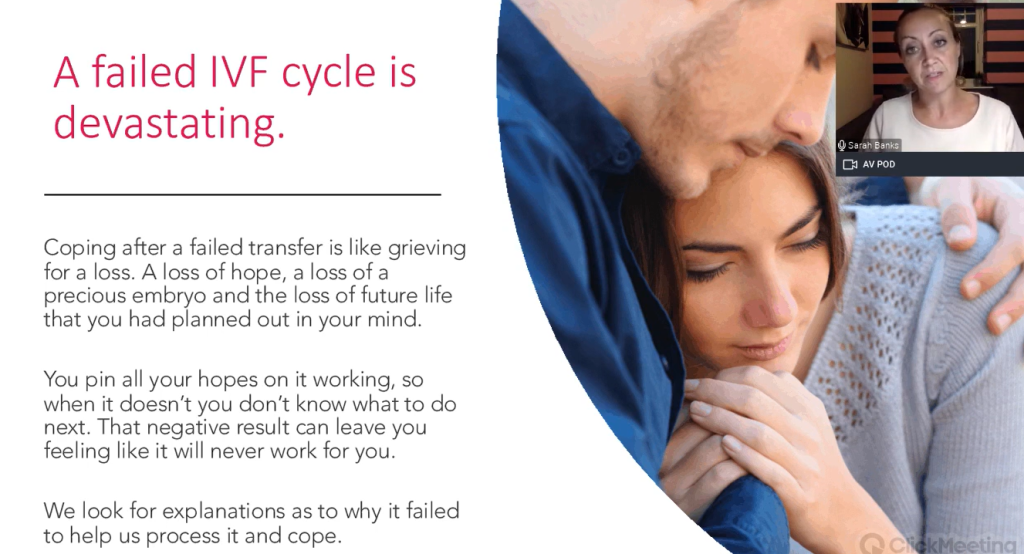
Sarah recognized there’s often very little support around. After people finish with their clinic, it’s just grieving for that loss and when something doesn’t work people look for answers to understand why it didn’t work to help with how to process it and cope with things.
Sarah shares some ways to cope after having a negative result, which can be at any point of the IVF cycle, and it’s not just the case of getting right to the end and having a negative result, but also includes if it was stopped.
After having a negative result and being with the clinic every day or every few days having appointments, it can feel very lonely. It can also feel very lonely after finishing treatment and the clinic contact stops as well as people who haven’t been through treatment, like friends and family, don’t always understand why some get so upset. According to Sarah:
They can’t understand why we’re grieving for something that never was… It was just the hope there and why you’re so upset.
It can be really difficult if the person doesn’t have enough support around to cope with the situation.
Moreover, after the negative result, people are often left with lots of questions about why it didn’t work and what they could’ve done differently.
There’s also an element of blame which is not necessary, but everyone feels that way. – expresses Sarah.
Typically, the NHS units are quite busy and may have long waiting times before the patient can get back for a follow-up appointment. Therefore, it’s very difficult, and it can feel like a long time, even if it’s only a week.
If people know what’s wrong, they feel like they can do something about it; therefore, when they get answers and know why the treatment failed (if there’s a certain reason), people feel like they can make changes next time and give them a better chance of it working for them.
Sometimes, says Sarah:
People want answers to those questions just to help them feel better and more positive going into the next cycle.
There may be some things that can be done on the medical side and a lot of IVF consultants Sarah spoke with said that exploratory treatment, so it’s the best way for people to learn more about their fertility. Once they start doing it, they can learn more than they can do beforehand.
Sarah emphasizes the unusual feeling from anything felt before, other than losing somebody. It’s fine to grieve for that and to be upset, people are within their right to feel that way and, as Sarah says, it’s important that people give themselves time, not fight it and feel like it’s nothing while putting a brave face and keep going.
It’s really important that people acknowledge what they’ve been through and if it continues for a while then seek professional help. Most fertility clinics are linked to a counsellor, so Sarah recommends speaking to a counsellor, especially for people struggling and if those feelings are going on for a while. Nevertheless, Sarah advises speaking to a counsellor at any point in the journey as it’s very important to get that support, especially if the person feels depressed anxious and sad for a long time.
Sarah states to take care of yourself. While going through treatment, people are often juggling with lots of different things, such as work, and there isn’t recognized time-off like there would be for a bereavement. Therefore, she recommends thinking about taking some time out of work, taking some time away at the weekend but always looking after yourself physically and emotionally; and doing things that help you relax, help you recharge batteries and make you feel better about yourself.
Sarah remarks:
It was a low point for me, and I struggled with that. So, it’s really important that some of those things we may stop doing, we start doing them again, start looking after ourselves and focusing and prioritizing self-care.
It’s also suggested by Sarah to take some time out with your partner as you’ve both gone through this journey together, and you’re grieving together. Maybe the treatment has been very focused on injections, timings injections, timings for treatment and when trying for a baby, especially through IVF, the focus can be only on that and you as a couple and other things can be put to the side.
You can also ask questions. After having all the information you’re fully informed, and you can make decisions based on that, so it’s fine to ask questions whether that’s making treatment decisions, looking at what you’d want to do differently and whether that’s taking some time out from the intensity of the treatment or exploring other routes to parenthood.
Plan some nice things to do with your friends and family in your close circle. This can be tricky depending on where you are, but having things to look forward to, at least gives you a little boost to see people that lift you. Therefore, don’t see people who maybe will not understand your feelings. Spend time with those you love and that will help you recover and feel better, and cheer you up as well as distract you from what you’re going through.
Attend support group meetings. According to Sarah, most of these have stopped because of COVID-19, so many are online; however, these are just as good. If you can have virtual meetings or if you can join online support groups, they’re great. The groups set up by Sarah are also great and the people in them are brilliant.
Sarah Banks presents some questions once you start feeling strong enough to ask them and think about the next steps. She remembers how difficult it was for the first weeks afterwards, to hold it together, but then she wanted a plan to move forward. Some people cope that way and others may need more time and it’s fine.
Think about what helped you feel better going through it, whether it’s emotionally or physically. Once you’ve worked out what you think went well and what you’re pleased you did, then you can replicate these to move forward such as deciding to have another cycle having already thought about the things that helped.
These can be the following:
Remember it’s okay to grieve and take that time to yourself and do what you need to do to get through this because everybody is different. – emphasizes Sarah
For instance, one of your friends suggests something that helped her and it’s okay if it’s not for you. If you feel that you cope better by having a Netflix binge, going through really long walks or having a weekend away you have to think about what works for you and recharge your batteries. Use your support network. This means surrounding yourself with friends who understand or support groups with people who provide comfort and support for you it’s really important.
Based on this information, what can we do differently to potentially increase our chances of success? – asks Sarah
This is something that you can speak to your clinic about. Sarah recommends making sure you think about all the questions you’ve got and write them down before your follow-up appointment. She also suggests people take a notebook with them with all the questions because she usually gets so emotional in her appointments that she would forget everything she wanted to ask as well as all the information she was told. Therefore, it’s advised to have a notebook to take the questions with you and write down any answers given so you can remember them.
For this reason, Sarah has put some space in her planner for that. She wanted all of it in one place.
Therefore, she recommends:
to ask any questions that you’ve got as there’s no stupid question because if it puts your mind at ease then that’s a positive thing.
Sarah goes on by explaining that the questions could be whether it’s worth trying a different medication or a higher dosage, if you’re on a different protocol or different add-ons, or whether it’s looking at using donor conception instead. She emphasizes writing them down and taking them to speak with your consultant; “what can we learn? What could we do differently?”, says Sarah. Your consultant will be able to advise you based on your specific circumstances.
From a medical point of view, if there’s anything different or something that can be learned, such as IVF, shows many different answers once it starts and they can learn so much from it. Therefore, maybe they will have learned that something happened in the first cycle and now they can tailor it differently next time. It’s about looking for positive changes and not placing blame because that will create a lot more negativity around any follow-up cycle.
Not everybody wants to consider this question and it’s up to each individual how to feel about it. It’s all-consuming going through fertility treatment and even Sarah Banks didn’t want to think about this question because very often the focus, month after month, is on waiting for the next chance to hopefully get pregnant. Due to this fact, many people won’t take a break and others feel that they need to because it has been very draining or they haven’t been well.
Although it is tempting to jump straight back into the next cycle, it’s really important to recover physically and emotionally, to feel emotionally and physically recharged, for the next cycle. This is also to chat through with your partner, “what do you think you need to do as a couple? Are you both ready to go straight back into it?,” asks Sarah. Sometimes it’s very difficult when the woman’s going through treatment for her partner to watch her go through that. Therefore, “Does your partner feel like they need a break but also thinks you need a break?”, Sarah goes on. This is because it’s been very emotionally draining.
You also have to consider if you want to have another cycle, taking into account costs. For instance, according to Sarah, the funding in the UK unfortunately isn’t always there and in other countries, it may be very different and there may not be any funding. Thus, it’s a big implication, a big cost if you’re paying for a full cycle.
Moreover, Sarah advises more things to consider:
Also, depending on the whereabouts you are in your journey, if you’d want to look at other routes to parenthood, such as:
Sarah remarks that while some things get ruled out completely, it’s important to take time to consider them depending on where you are in your journey and whether you feel comfortable doing so so that you feel ready for the next cycle.
Sarah runs an international support group called TTC Support UK and anybody in the world can join.
If you want to join, you have to answer some questions to ensure the group’s safety and to prevent people who don’t need support or might spam the group from joining. Sarah wants to make sure that all members and you stay safe in it.
If you need any support, I’m here and I’m happy to have emails. If you follow me on Instagram, please message me if you need anything. I’m very passionate about supporting people trying to conceive and going through IVF after knowing what it’s like myself. So, please feel free to reach out. – affirms Sarah
I’m so sorry, I hope you’re feeling all right after that, and I’m not medically trained, so I’m not able to advise on a medical point of view, but if you’re concerned, don’t feel bad about asking your doctor again. I’d say if you’ve got questions whether you’re well and whether there are any actual medical issues still then I definitely go to see another doctor. If you’re not happy with the answer, you could always get a second opinion on that. I think it’s really important, you know your body, so get that checked, don’t be afraid to ask and say that it’s really bothering you, I’d make sure that you’re medically safe first before starting any other treatment because you don’t know if it could impact the treatment, but that’s definitely a question I’d ask your consultant. Try to explain your worries about what you’ve gone through and check that there’s no health implications or implications on treatment. Ask if they’ve checked if it was damaged or if they know it’s not damaged, if they say that it’s definitely not, you can check if they have scanned it, what have they done to check that. I think in terms of how long to wait before trying again, I think it’s completely personal.
I would say sort out the medical side first that you’re comfortable there and ask your consultant, but you’ve got to feel emotionally ready because it’s going to have a bit of an impact. The fact that you’re concerned about that I’d definitely make sure that you feel comfortable, that all the medical side is safe and ready before you start trying again, and you know maybe speak to if there’s a counsellor at the clinic, maybe speak to them about what you’ve been through while you’re waiting in the meantime. Don’t feel afraid about asking the questions again to make sure that you’re okay even if they’ve acted like it’s no big deal. I would say tell them why you’re concerned and ask if they can talk through it with you again. I hope that helps and I hope you’re okay as well.
In terms of support groups, there are quite a lot around on Facebook, all of them tend to have the same group rules about confidentiality and keeping things safe within there and not talking outside of the group. I certainly have that, and there’s no judgment, so I’d say closed support groups are great because they are full of people who’ve been through it themselves, places like forums are probably a little bit more public than closed groups.
There’s a lot of support on Instagram, so it does not support groups as such, but if you open an account under an anonymous name then you can post things and get some support on there, and as I said you’re more than welcome to join my group. I check it every day, to make sure it’s staying safe and the people are okay in there, it’s really hard, if your partner doesn’t like talking about it, but it’s because you must get support as well. If you’ve found that the counsellors don’t really help some people find it a bit like it’s a ticking a box that they’ve been and they’re not always best, and it’s not for everybody. I think in terms of how we find the right people to help us prepare for the next move, it depends on what helps you recover. For me, I went to see a life coach because after my failed cycle I felt that it wouldn’t work next time, I was convinced, it wouldn’t work again, and I needed to get myself out of that, and I didn’t feel that seeing a counsellor and talking about it would help, and that might be just my perception of counsellors at that time, but that’s why I went to a life coach because I felt I needed somebody to help me to make an action plan to move forward and which is what really helped me because they gave me techniques to stop the spiral of worrying and that really helped me. I’m a very action-oriented person, and I wanted to have that kind of support, but some people like to process what’s already happened, so counselling is more for them and some people like acupuncture because they get the health benefits, but it’s also a bit of talking therapy.
For me, the needles always put me off, and so it depends on what kind of person you are, but if you want, you can email me, and I can try and signpost you, and in the right direction of anybody that can help based on how you are, then please feel free to message me, you can get a lot of support anonymously, so you know it takes away that worry of your husband finding out about it as well, and so if you can join something anonymously then that’s a good way around, it’s less personal for you but as I said if you want to email me and say what kind of thing helps you, I can try and signpost you in the right direction.
I don’t have a list, but that might be a good blog to try. I would go and ask if you get chance to speak to the embryologist, I find them really helpful actually, they don’t get much contact with patients, so I find that when they get a chance to be asked questions, they’re really helpful with it. I think just generally asking how it works if they can explain why this might have happened to you, is there anything you could do differently to stop this happening, is there anything that could have caused it, so I think it’d be a lot around lessons learned from what happened. If you’ve tried IVF the first time, and there was a failed fertilization, that next time they’d look at ICSI instead. Actually, they found that the sperm quality had gone down since the sample or actually, because of the failed fertilization, they’d probably look at doing ICSI next time anyway.
I’m not sure how much you know, but ICSI instead of just allowing it to happen on its own, they’ll find the best sperm and inject it straight into the egg, so in terms of that it’s around the lessons learned, what can you learn from what’s already happened and why might it have happened, what can we do differently next time to stop that happening, so if it’s embryos that disintegrate and is there any vitamins or anything like that you could take, is there anything you could do differently, is there any medication so it just is around what can we learn from what happened but if you can get in front of an embryologist then that would obviously be helpful because they’ll know more than the consultant. I hope that helps, but I’ll have a think and see if I can think of anything else.
I’m not sure, I’m afraid because as I said I’m not medically trained, and I don’t understand hormones that much, but I’m trying to think who it might be worth following, people who are nutritionists or hormone therapists they may have a better, so there’s quite a lot of that on Instagram, there is fertility nutritionist, there’s Rosy Life, and they’re two ladies I know that are really lovely and really good and are a lot more upon this kind of thing that may be able to advise certain dietary changes that might make that happen. I’m not sure if you’re against acupuncture as I was, although people have told me that it’s not bad at all, especially if you’ve been doing your own injections through IVF but if you’re concerned about acupuncture it might be worth speaking to somebody about it. If you have a look on my website I’ve got an interview with an acupuncturist, and she explains the process so on the blog sections on my website if you go through, there’s an interview with an acupuncturist, so she may be able to give you a bit more advice from in the interview that might help with the understanding of acupuncture. Other than that I’d say maybe look at people like nutritionists to follow on Instagram so that you could ask them that because I’m not able to answer I’m afraid as I’m not sure.
I’m really sorry about that, I hope you’re feeling okay, and that you’ve got support around you as well. I’m guessing that the question could be should you have been taking more progesterone but definitely and they’re some of the things that I would say to ask your consultant for next time so lessons Lenart. Would having a higher progesterone dose have helped, things like that, so I just say what have we learned and was your protocol right. I would just doublecheck what could be done differently, whether they could leave you a bit longer for your lining to increase, is there anything you could have done differently, is there anything in terms of aftercare after the transfer that they’d recommend doing next time and following this, and so I would go in kind of with an open mind with questions like what would you recommend, we do differently that could improve the chances next time.
I can completely understand that with time ticking. I’m not sure if you mean that the consultant has said to wait 3 months, whether your acupuncturist has said to wait 3 months. If it’s your acupuncturist, I’m guessing it’s because they feel starting from a 3-month point might be beneficial but what I would say is I’d speak to your consultant before waiting because they’ve said so because your consultant may say actually every month counts and that they think that the best thing to do would be to get started again sooner. I think it’s probably better based on when they can look at what happened in your IVF cycle and analyze what happened in your cycle, what lessons they can learn. I would definitely say to speak to your consultant around the waiting because they may say with your age and your previous cycle that it’s better to start sooner. Talk to your acupuncturists as well and say the same, that you’re worried about time and what difference does it make waiting 3 months. Ask if there is anything you could do while you’re waiting to get started sooner, and your consultant says that’s the best option, is there anything that can be done on a shorter time frame for you. That might be ideal, and that’s great if you’re younger and that might be an ideal time scale they want to start before someone starts treatment, but I think it’s probably getting all the information so you can weigh up what your best chances are. I’d say speak to your consultant if it’s your consultant that said about waiting 3 months that might just be from a medical point of view and why they think it’s worth waiting for.
It’s really hard, I remember myself and looking for them at times when we were trying. I have a full blog on this on my website with loads of tips, so please have a look at that because there are loads more information on there. One of the main things I’d say is to maybe take time off from social media. It’s difficult because at the minute it’s almost been a bit of a lifeline with us all being locked in our houses and not being able to really see many people, but I’d maybe take some time off social media if you find that it’s really triggering. You can’t escape from it there, we all sit with our phones, and it’s very hard you’ve got no safe space because it’s always accessible and so I’d say maybe just take a little break from social media if you’re finding it hard. Try and spend time with friends who maybe aren’t trying to get pregnant, so that you don’t have that immediate announcement there from them when you’re out and about. Just focus on looking after yourself, so I’d say switch off from social media would be my biggest thing, it’s also hard if your support groups are on there as well.
Spend time with people that are supportive and that are unlikely to be making announcements anytime soon, spend time as a couple and just do things that really recharge your battery so maybe have a digital detox, focus on reading, or watching box sets, going for walks and things that help recharge your batteries and relax, but remember it’s all right to feel sad when you see those things, and it’s all right to feel jealous, it’s all right to feel frustrated that things seem to be happening easier for everybody else. I felt all of those things and then felt the guilt for feeling those things about friends, but it’s completely normal, so it’s really important not to beat yourself up about that, it’s really normal, and we all feel the same. Just take care of yourself, do anything you can to help you relax and feel good about yourself.
+ 2 more answers
+ 13 more answers
Necessary cookies are absolutely essential for the website to function properly. This category only includes cookies that ensures basic functionalities and security features of the website. These cookies do not store any personal information.
Analytical cookies are used to understand how visitors interact with the website. These cookies help provide information on metrics the number of visitors, bounce rate, traffic source, etc.
| Cookie | Duration | Description |
|---|---|---|
| _ga | 2 years | This cookie is installed by Google Analytics. The cookie is used to calculate visitor, session, campaign data and keep track of site usage for the site's analytics report. The cookies store information anonymously and assign a randomly generated number to identify unique visitors. |
| _gat_UA-38575237-21 | 1 minute | No description |
| _gid | 1 day | This cookie is installed by Google Analytics. The cookie is used to store information of how visitors use a website and helps in creating an analytics report of how the website is doing. The data collected including the number visitors, the source where they have come from, and the pages visted in an anonymous form. |
Any cookies that may not be particularly necessary for the website to function and is used specifically to collect user personal data via analytics, ads, other embedded contents are termed as non-necessary cookies. It is mandatory to procure user consent prior to running these cookies on your website.
Other uncategorized cookies are those that are being analyzed and have not been classified into a category as yet.
| Cookie | Duration | Description |
|---|---|---|
| _gat_FSQM52 | 1 minute | No description |
| cf_ob_info | No description | |
| cf_use_ob | No description |