


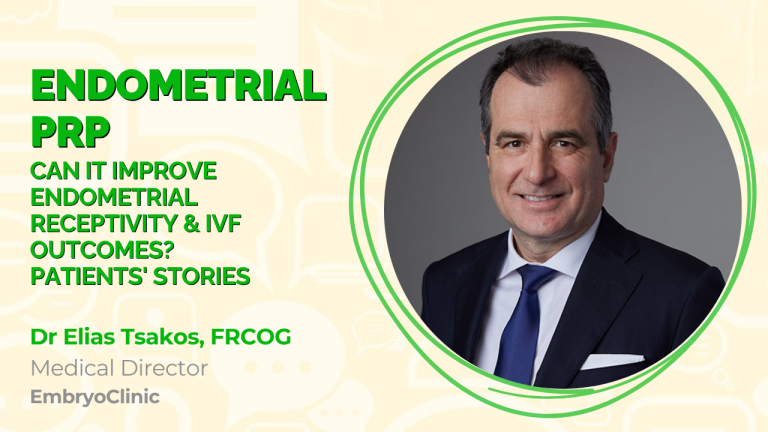
Dr Elias Tsakos MD FRCOG, Medical Director of Embryoclinic, discussed innovative Endo-PRP treatment and explained how this cutting-edge therapy can enhance endometrial thickness and potentially boost your IVF success rates.
Endometrial PRP (Autologous Platelet-Rich Plasma) is an innovative and new technique, although it has been used in medicine for about 10 years. However, in the context of fertility applications, it is still fairly new. Dr Tsakos mentioned during his presentation that until recently, he had been studying this technique, researching it, and speaking with various colleagues around the world, particularly in Europe and the US, including some of the pioneers of this technique. Plasma comes from blood, and the whole technique involves extracting a very high-density and high-concentration specimen of platelets from the patient’s own blood and plasma. This is what PRP looks like: it is the part of the patient’s blood that contains a high density of platelets.
PRP is an autologous product, which means it comes from the patient’s own body fluids—specifically, their blood. It is derived from peripheral blood, which is simply drawn from the patient. The preparation involves centrifugation, a demanding technique that took the team of Embryoclinic many months to perfect.
PRP has been used for various types of injuries, such as knee and hip injuries, in orthopaedics. It has also been applied in the treatment of degenerative diseases in orthopaedics, as well as by plastic surgeons for the rejuvenation of various parts of the skin and healing processes. Cardiothoracic and abdominal surgeons have used it for similar purposes. Additionally, the new speciality of aesthetic gynaecology, which aims to improve both the aesthetic and functional aspects of the external genitalia in women, has adopted this technique.
PRP has been used by fertility specialists for many years to improve endometrial function—not just its appearance on scans but also its receptivity to embryos. It has also been used for what is often termed “rejuvenation”.
It’s a simple and quick process—except that it’s not that simple, nor that quick. Quality control is crucial in this treatment. Quality control involves measuring the concentration and density of platelets in the sample. It also includes culturing the sample to confirm it’s microbe-free, ensuring the microbiology culture is negative.
For fertility treatment, a very high concentration of platelets in the sample is needed—more than 800,000 platelets per microlitre. The only way to ensure this is by measuring it. Dr Tsakos mentioned that it took the team many trials, errors, and attempts to reach that level. To accurately assess the outcome of your infusion into the uterus, you need to know the concentration you’ve injected. This helps in assessing the outcome prospectively and deciding whether one infusion is enough or if more are needed to achieve the optimal result.
It’s performed 5 days before transfer—this is one protocol, but there are others. This technique may be used outside the context of IVF. You might have a fertile couple with recurrent miscarriages or thin endometrium who don’t need IVF. So, it’s not just associated with IVF.
The procedure itself is fairly painless, and no anaesthesia is required. It’s performed with a thin catheter similar to an IUI catheter.
In my opinion, this procedure must be performed in an aseptic environment, such as a theatre, an IVF clinic, or a hospital. This ensures a few critical factors like aseptic technique, proper culture within the laminar flow of the lab, and having personnel on hand to support any very rare adverse reactions such as vasovagal fainting attacks or stress disorders. I wouldn’t perform this in my outpatient clinic with just a secretary sitting outside and no personnel available to support the patient in case of an adverse reaction, even though it’s rare, it can happen.
The total duration of the injection is 8 to 15 minutes, depending on how smoothly the procedure goes and how cooperative the patient is.
The patient’s blood is taken—the whole blood—and centrifuged. Most people wouldn’t share their exact combination of centrifugation—what type of machinery they use, how many revolutions per minute, how many cycles of centrifugation, and for how long. The centrifuge is used to separate the platelets, and this is what we have after the centrifugation process. Some people take the whole of this plasma, which includes the platelet-poor plasma. Even some expensive machines available in the market would use all of it. But if you use all of it, you don’t achieve the concentration that you need. The concentration used at Embryoclinic has a metric: a minimum of 800,000 platelets per microlitre, and 2 to 3 microlitres are needed for infusion.
At Embryoclinic, 30 to 40 mLs is taken. This isn’t a huge amount—it’s fairly reasonable. For example, when someone undergoes a full hormonal, biochemical, vitamin, and genetic test, around that amount of blood is needed. The blood undergoes an initial long centrifugation, and specialized tubes are used to achieve the desired separation. Then the plasma is separated and the concentrated red blood cells, and the platelet-rich plasma is taken.
On average, we 2 mLs of PRP fluid is used. A small proportion of this is always sacrificed for quality control every single time because it’s necessary to know what is injected. On average, 4 to 5 times the platelet concentration in the final fluid is found. Platelets have cytoplasmic granules which contain many useful proteins, such as antimicrobial peptides, multiple growth factor proteins (PDGF, EGF, VEGF, HGF, etc.) and anti-inflammatory cytokines. The ability of these platelets concentrates lies in cell proliferation, tissue healing, neoangiogenesis (the body’s ability to produce new veins and vessels), and immune modulation. There’s a lot of activity—cell proliferation through growth factors, and immune modulation via cytokines and interleukins.
The reduction of scarring is a clear indication of the use of PRP. It is indicated in cases of Asherman’s syndrome, previous surgeries on the uterus, and cases of obvious scarring on the uterus that may be associated with adverse fertility issues. There are even proposals to use this technique for the prevention of adhesion formation. For example, if someone has repeated uterine surgeries for scars, Asherman’s syndrome, polyps, miscarriages, and so forth, PRP may be used for prevention.
What’s the evidence? There are a lot of available papers, as there is a plethora of published research. However, one notable paper, published last year in 2023 in BMC (Pregnancy and Childbirth)—a very reputable journal—conducted a meta-analysis on the effects of PRP from other studies. It included some high-quality studies that provided the evidence of its usefulness.
The meta-analysis found the following:
The study showed an average of 75% higher live birth rate. Interestingly, the improvement in endometrial thickness was only about 1 millimetre on average. Although this may seem negligible to some, it could be significant for many patients. For example, an endometrial thickness of 6.5 mm is quite low, and increasing it to 7.5 mm is closer to normal. Additionally, there was a higher positive pregnancy B-HCG rate, with no difference in multiple pregnancies or ectopic pregnancies.
In the subgroup of patients with implantation failures, the positive effects of PRP were even more pronounced. These patients may need closer examination before applying this technique. PRP seems to have much better value in patients with thin endometria, which often indicates adhesions or scarring.
The future prospects of PRP in IVF are promising, although there are only a few pilot studies at the moment. Most studies focus on patients with recurrent implantation failure and thin endometrium. PRP can also be injected via direct vision with a hysteroscope, which may theoretically improve its effect. Recent scientific reports suggest this approach may be beneficial.
Beyond endometrial PRP, there is also ovarian PRP. Currently, the evidence for ovarian PRP is not as robust as for endometrial PRP. However, surely more evidence will emerge. Ovarian PRP is reserved for patients who are one step or half a step away from giving up on their own eggs, either due to poor response, previous surgery on the ovaries, early menopause. It has also been proposed not only for fertility factors but also for prolonging ovarian function and delaying menopause.
I don’t know the clear answer. It depends on what we’re treating. Regarding adenomyosis, I can’t see any mechanisms by which it could be beneficial unless adenomyosis has caused scarring of the endometrium or miscarriages that were treated surgically, which may have caused scarring in the endometrium. A direct effect on the adenomyosis in the wall of the uterus? I can’t see any mechanism that may be helpful because the treatment is mainly directed at the endometrium.
As for endometriosis, it depends on the location. I presume you’re referring to ovarian endometriosis, like endometriomas. As we all know, endometriomas harm ovarian reserve and may lead to someone having had surgery on the ovaries. In theory, that would refer to ovarian PRP, which is the subject of my next webinar so I will stay on the fence a little bit here.
This is always a concern. This is always something that I think most people cannot answer. It depends on the cross-talk between the different pathways and the expression of those growth factors. Of course, we don’t want them to be overexpressed. It’s tough to answer as it has to do with genetics, epigenetics, and other effects. I don’t know the clear answer, but even if it does affect the endometrium, I think it’s very, very unlikely that it may cause abnormal growth or malignancy. We need to be on the lookout, but at the moment, there’s no particular evidence of adverse effects of growth factors contained in the PRP fluid, and we haven’t had any serious reports from orthopaedic surgeons who have been using this for more than a decade.
On the other hand, chronic inflammation may be associated with pathological changes, so maybe there’s more scope in growth factors fighting chronic inflammation and improving healing, which may prevent pathological changes. But of course, with any innovation, we need to be on the lookout. We need to monitor, record, inform, counsel, and consent our patients. This is a very valid concern that we should be having.
Maybe that is the answer. I usually discuss that option, especially with international patients and those flying in from far away. So yes, we can do it during hysteroscopy and adhesiolysis. This approach has a couple of advantages. First, it’s 2 procedures in 1—on the go, 1 anaesthetic if we give anaesthesia or local, so we kill 2 birds with 1 stone. Secondly, we may be able to direct PRP infusion to areas of excessive scarring, if there is any, in the hope that it would work a little better. So yes, it can be done.
Absolutely. Well, it depends on why we’re doing it and on the assessment and indication. For example, if we have Asherman’s syndrome, no, I wouldn’t do it before the embryo transfer because, invariably, with Asherman’s syndrome, I would need a second-look hysteroscopy after the treatment. So for Asherman’s syndrome, no. For someone with extremely thin endometrium, perhaps 3 or 4 millimetres, again, I wouldn’t do it in the embryo transfer cycle because I would have no time to assess the effect.
In the embryo transfer cycle, I would probably do it for someone with recurrent miscarriages or with one miscarriage and thin endometrium, someone with thin endometrium secondary to perhaps endometritis or multiple endometrial surgeries, who has a borderline endometrium, perhaps 7 or 8 millimetres. In that case, I would probably discuss it. I mean, I’m very cautious—I don’t think it’s one size fits all, and I don’t think it’s for everyone. I’m very careful about who I advise intrauterine PRP for, given that the evidence is still coming through.
So, for someone with 7 or 8 millimetres, thin endometrium, and perhaps one or two failures or episodes of endometrial surgery, yes, then I would do it 4 to 5 days before the embryo transfer.
Depends is the answer, and we don’t know. We don’t have enough evidence. It depends on the patient. I don’t know the answer. But what I have seen in my few months of experience now is that if you do it for patients with extremely thin endometrium, it may take a couple of months to see that millimetre or 2 millimetres increase.
May I mention here that it’s not just about the size and thickness of the endometrium? There are perhaps another dozen, at least 12, parameters that we look at, such as the shape, the vascularity, the trilaminar appearance, and so forth. The studies that we do on that, like 3D, seem to be not superior at the moment, but they’re helpful. So it’s not just about the size. I mean, 1 millimetre can vary within 10 minutes on the same patient, so there are a lot of parameters we look at. We don’t know how long it lasts. At the moment, we have some extreme cases where we have used it—some desperate cases of nearly absolute endometrial factor. If someone has a hopeless endometrium, 3 to 4 millimetres associated with Asherman’s type IV and half a dozen hysteroscopies, you don’t have many options other than trying this technique. Otherwise, you would have to resort to surrogacy or uterine transplantation, and there are many such cases.
We’ve used it on some desperate cases, and one of them involved someone who had such a thin endometrium and myometrium that when we did a hysterosalpingogram (HyCoSy), the fluid went through the uterus into the endometrial cavity and then into the abdominal cavity. We thought it was almost transparent, just a little sliver, a thin layer of endometrium, and then nothing. In that patient, we saw a thickening of the myometrium to 5 or 6 mm when it was 2 mm before. So, you know, we’ve tried it on desperate cases, and there seems to be some movement, some effect.
But how long does it last, and whether that could be associated with a good outcome in the end? We don’t know. We’re here to find out, to monitor the data, to discuss with patients and our colleagues. We’re here to protect our patients and keep an eye on the endometrium. As I said before, I don’t think it’s one size fits all, and I don’t think it’s a miracle technique that will cure Asherman’s syndrome forever. No, that’s not going to happen. All we’re doing here is trying to improve the chances for the individual patient, especially the ones with damaged endometrium or with multiple failures, to have a better chance.
I mean, there’s no agreement on what we should be doing. I believe that perhaps in the next couple of years, we may be having conferences on PRP, like we have conferences on robotic surgery or hysteroscopic surgery, and so forth. At ESHRE this year—and I’m very happy about this—there’s a pre-congress workshop that I’m happily participating in on the Sunday before the official opening of the conference. I’m hoping that I will be able to interact with some wonderful people in that workshop to perhaps agree on some guidelines and best practices.
So, depends is the answer. I mean, it’s empirical. This is a technique that’s under a lot of criticism. I was watching a panel of very respectful scientists and clinicians only a couple of days ago, and most of them are sceptical. On the other hand, we can’t turn a blind eye to a technique that has been used for 10 years or more, a technique that has publications, a technique that has theoretical advantages, a technique that has scientific evidence, published data, and meta-analyses. No matter how some people view those original studies as perhaps not of perfect quality, there is evidence out there—at least for endometrial PRP—that, with caution, stricter criteria of safety, and quality control, we need more data, but the data seems to be promising.
Yes, I have had patients trying ovarian PRP, but I don’t think it’s viable to share specifics since it’s outside the scope of today’s webinar. All I can say is that I can give three messages from my limited personal clinical experience, although my theoretical experience is about 10 years.
First, if you have PRP, make sure it’s performed under very strict conditions—in a theatre condition, in an OR, or in an IVF clinic—a licensed IVF clinic condition, not in the doctor’s office.
Second, insist on quality control. We were unpleasantly surprised when we did quality control on the samples—thankfully, of our own blood—before deciding which technique to use. We did quality control on very branded, very expensive machines and equipment that were even CE marked and FDA approved, yet the concentration of the platelets was very low, around 100,000 to 200,000, which is not good enough. So make sure it’s done in a licensed, proper facility. Make sure you have a report of the sample that was injected, so you know what they’ve given you.
Third, you need very careful counselling and consent. It’s not a marketing thing; it’s not something we should be making available very liberally. In my opinion, we should be very cautious and selective, reserving it for patients with a clear indication that they need something extra beyond what we’ve been doing so far, which might involve giving estrogens, perhaps through different modes of administration—oral, transdermal, vaginal—that hasn’t worked. We have used some add-ons to deliver those estrogens into the endometrium, but if all of those have produced either a very poor endometrium or multiple failures and miscarriages, I would reserve endometrial PRP despite the evidence that it may be beneficial. At the moment, I would personally reserve it for patients with a clear indication of endometrial factor infertility.
Yes and no. I mean, it’s not because we’re talking about different substances. It’s similar in terms of being autologous—it’s from the patient’s own cells and is directed into the organ that needs to be treated. I’m not going to use the term “rejuvenated.” I think we have to agree on PRP first, which is the simplest of these treatments. We need to agree on protocols, indications, and outcomes. Once this is scientifically secure, with more evidence, then we may consider moving on to stem cell treatment and so forth. I feel that it’s probably going to be a couple more years, if not more, before we proceed to that.


+ 3 more answers
Necessary cookies are absolutely essential for the website to function properly. This category only includes cookies that ensures basic functionalities and security features of the website. These cookies do not store any personal information.
Analytical cookies are used to understand how visitors interact with the website. These cookies help provide information on metrics the number of visitors, bounce rate, traffic source, etc.
| Cookie | Duration | Description |
|---|---|---|
| _ga | 2 years | This cookie is installed by Google Analytics. The cookie is used to calculate visitor, session, campaign data and keep track of site usage for the site's analytics report. The cookies store information anonymously and assign a randomly generated number to identify unique visitors. |
| _gat_UA-38575237-21 | 1 minute | No description |
| _gid | 1 day | This cookie is installed by Google Analytics. The cookie is used to store information of how visitors use a website and helps in creating an analytics report of how the website is doing. The data collected including the number visitors, the source where they have come from, and the pages visted in an anonymous form. |
Any cookies that may not be particularly necessary for the website to function and is used specifically to collect user personal data via analytics, ads, other embedded contents are termed as non-necessary cookies. It is mandatory to procure user consent prior to running these cookies on your website.
Other uncategorized cookies are those that are being analyzed and have not been classified into a category as yet.
| Cookie | Duration | Description |
|---|---|---|
| _gat_FSQM52 | 1 minute | No description |
| cf_ob_info | No description | |
| cf_use_ob | No description |
